Insights from a Curator: Secrets Behind Action Figure Exhibitions
Why Action Figure Exhibitions Matter More Than Ever
If you have ever walked into a museum or convention display and felt oddly underwhelmed despite being surrounded by pieces you love, you already know why exhibit design matters. I have had that moment in front of a row of incredible anime figures arranged like a grocery shelf: everything technically “on display,” yet nothing really speaking to you.
Museum and exhibition designers worry about that feeling a lot. A museum design brief from Wonderful Museums describes exhibit design as the art and science of shaping space, content, and technology into narratives that educate, inspire, engage, and preserve. When that alchemy works, you do not just look at objects; you feel like the story is unfolding around you. When it fails, even priceless artifacts fade into the background.
The pressure is real. A report summarized by Stqry notes that about half of museums are still below pre‑pandemic attendance, with typical visits hovering around eighty percent of previous levels. Exhibits are not just decoration; they are survival. The same is true for action figure exhibitions in stores, galleries, and fan events. A well‑designed figure show can turn casual browsers into buyers, fans into community, and a roomful of PVC into a living, breathing story.
From years of curating anime figure showcases and helping retailers and fan clubs stage their collections, I have learned that the “secrets” behind great action figure exhibitions are surprisingly close to what top museum and trade show designers use. The difference is that we get to apply those tools to Gundams, shonen heroes, magical girls, and kaiju.
Let’s pull back the curtain.
What Counts as an Action Figure Exhibition?
Before we get tactical, it helps to define what we are talking about. In the exhibit world, physical 3D displays are sometimes called “sculptures with a job.” An architectural display guide describes exhibition models that simplify complex concepts and make them instantly graspable, whether that is a jet engine or a skyscraper. Your figures can do the same for stories and fandoms.
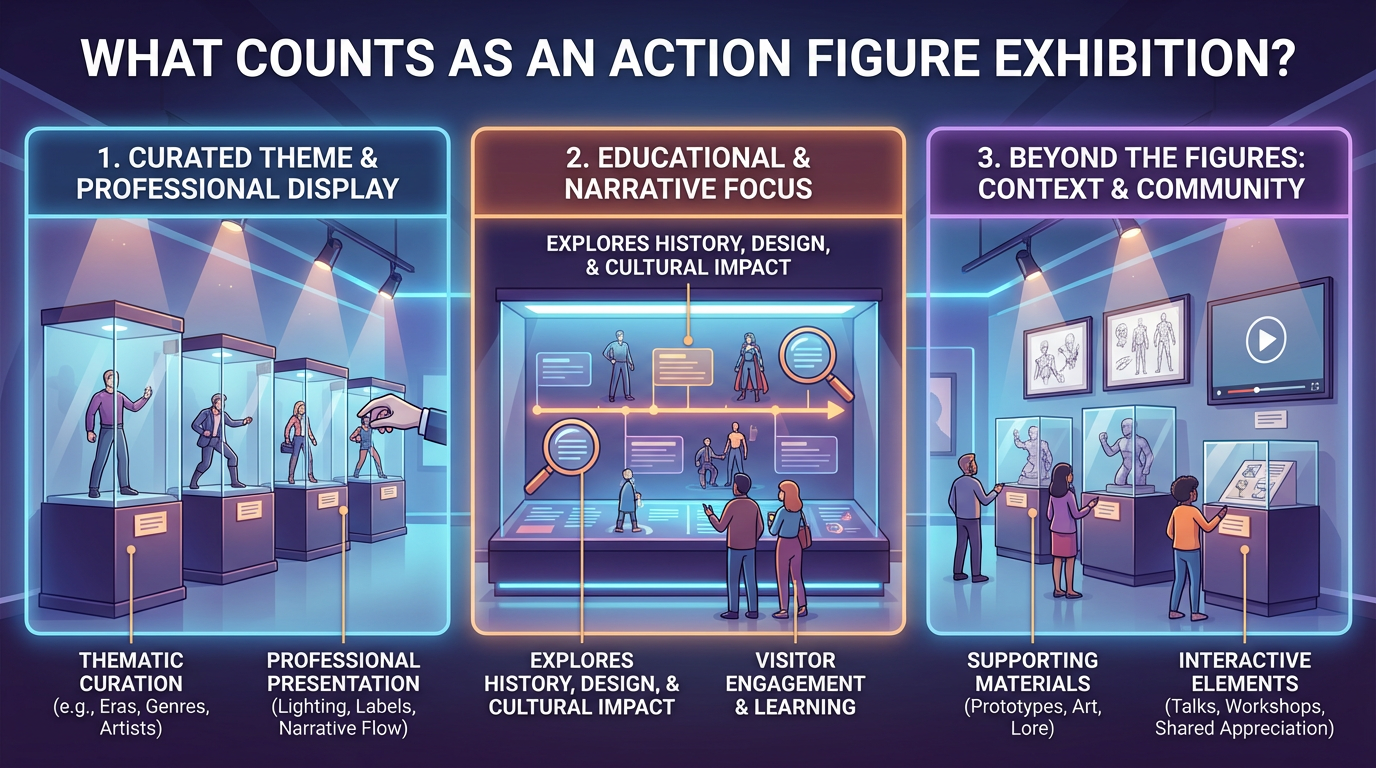
An action figure exhibition is any space where figures are arranged to do more than sit in storage. It could be a glass cabinet in your bedroom styled like a mini museum, a store wall that guides collectors through new releases, a convention booth built to stop people in their tracks, or a pop‑up gallery celebrating a single franchise. The scale does not matter; the intention does.
In other words, the moment your figures move from “line them up where they fit” to “I am using these to tell a story or create a mood,” you have stepped into exhibition territory. That also means you can borrow the same professional tricks museums, trade shows, and retail designers use every day.
Secret 1: Start With Your Why
One of the most powerful ideas in exhibition design comes from the “know your why” framework, which Exhibit Central applies directly to exhibits. The concept, inspired by Simon Sinek’s work, is simple but ruthless: define your purpose before you touch a single shelf or figure.
Ask yourself what this exhibition is really for. Is it meant to educate newcomers about a franchise’s history? Is it a store display focusing on sales and preorders? Is it a personal gallery meant to celebrate a decade of collecting and invite conversation? Each of those “whys” leads to very different choices.
Research on engaging exhibitions stresses that once the purpose is clear, every element should reinforce it. The selection of figures, the layout, the lighting, even the interactive pieces all need to point back to that core idea. When visitors step into the space, they should feel the purpose immediately, even before they read a label.
In practice, that might mean curating a “Villains Through Time” wall that sacrifices some fan favorites so the story stays tight. MuseumNext argues that strong exhibitions embrace focus and constraints instead of trying to please everyone. In figure terms, that is the courage to admit that your “all my figures in one cabinet” setup is really just a storage solution, not an exhibit.
Once your why is nailed down, you have a powerful filter. Any new idea—another riser, a big LED sign, a screen with trailers—has to answer a simple question: does this serve the purpose, or just add noise?

Secret 2: Build a Story, Not a Grid of Figures
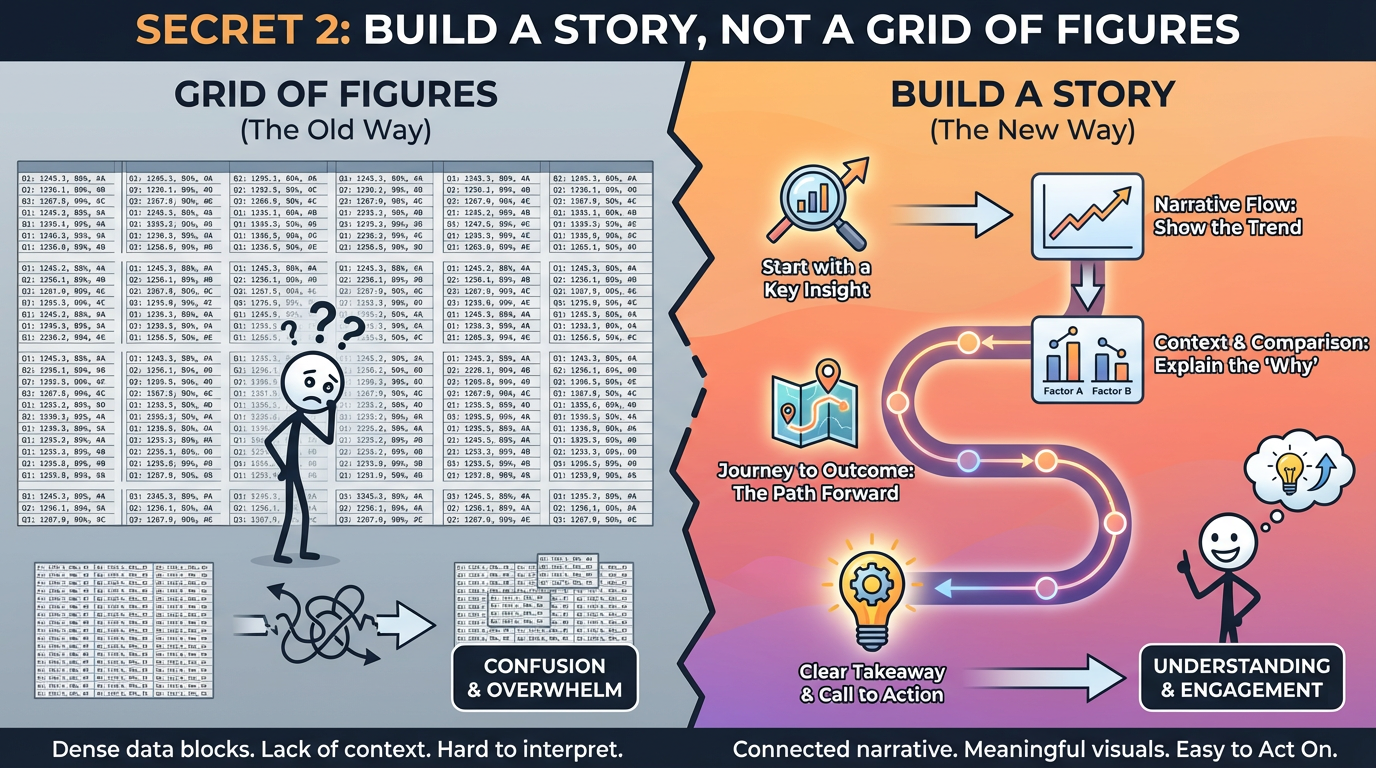
Most disappointing figure exhibitions fail not because the figures are bad, but because the display is basically a content grid: rows of characters sorted by brand or release date, with no real sense of story. Several museum and exhibit design guides warn against this trap. MuseumNext and Stqry both emphasize starting from a “big idea,” then shaping everything—objects, graphics, space—around that narrative.
In anime terms, your big idea is your season arc. Maybe it is “The Evolution of Shonen Heroes,” “Every Version of Saber,” or “Mecha and the Cities They Destroy.” Once that phrase feels right, you can define a couple of key messages you want people to grasp and a handful of questions you want them to leave thinking about. Stqry describes this as moving from a headline idea to supporting messages and critical questions.
Story shows up in the way you sequence figures. Solaris Japan suggests curating by theme or visual harmony rather than just chronology. That could mean starting a shelf with a small diorama showing a pivotal scene—say, a rooftop showdown—then letting other figures expand that world outward. A guide from Wonderful Museums points out that narrative exhibits usually have a clear beginning, middle, and end; visitors should feel progression as they move.
Collectors are already doing this instinctively. One case study from an anime‑display article describes a fan named Alex who turned a gaming room into a My Hero Academia space using shelves painted in hero colors, character‑coded LEDs, and DIY logos. Another collector, Mia, built a minimalist Studio Ghibli display with bamboo shelves, soft warm lighting, and tiny bonsai plants to echo the films’ calm naturalism. Those are not random setups; they are story worlds.
The difference between a story and a grid becomes obvious when you watch visitors. In a grid, they skim the top row, maybe recognize a character or two, and drift away. In a story, they lean in, trace connections, and start talking: “Wait, this is from that arc where…” That engagement is your signal you are no longer just storing figures; you are directing a narrative.
Secret 3: Design the Journey: Flow, Sightlines, and “Wienies”
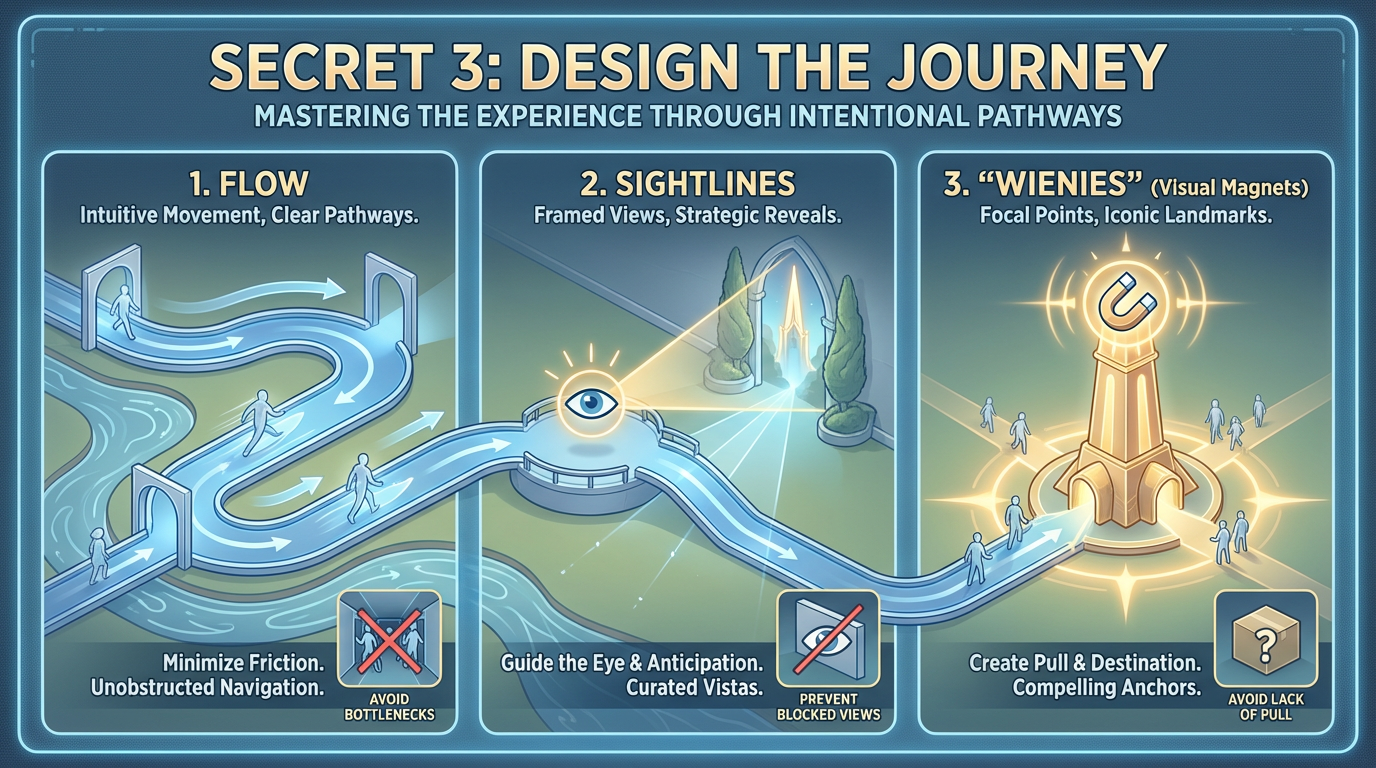
Once your big idea is in place, you need to choreograph how people move through it. A trade show design article in Exhibitor Online notes that both museum exhibits and booths succeed or fail on three things: attracting people in, helping them know what to do next, and communicating a clear message before their patience runs out.
Visitor flow is not just a concern for giant institutions. A small room crammed with detolf cabinets can feel like a maze if you do not think about entry points, pathways, and pauses. Aram’s guide on immersive exhibitions recommends planning zones and transitions early so visitors experience a series of deliberate reveals rather than random corners.
Exhibition designers sometimes borrow language from Disney: “wienies,” “rivers,” and “ponds.” A “wieny” is a visual lure—a glowing centerpiece, a towering mecha, an oversized backdrop—that pulls people deeper into the space. “Rivers” are circulation paths where visitors stroll, and “ponds” are areas where they are meant to stop and spend time. In a figure gallery, you might use a dramatic, well‑lit grail figure as a lure, then place more detailed, text‑heavy sections in the “ponds” nearby.
Time and cognitive load also matter. Exhibitor Online points out that visitors have an unconscious time limit; they will not invest ten or fifteen minutes in a space that looks confusing or demanding. For a figure show, that means keeping labels short and strategically placed, giving clear cues about where to start, and alternating visually intense zones with calmer ones where eyes and minds can rest.
In a store or convention booth, flow directly affects sales. The Global Display Solution notes that well‑placed vertical shelving and freestanding fixtures can guide collectors from hot new releases to high‑value locked cases without creating bottlenecks. You want people to be able to browse, photograph, and chat without feeling like they are blocking traffic.
When I am laying out an anime figure exhibition, I literally sketch it like a dungeon map: entrance, first reveal, side rooms, boss room, treasure. That mental model forces you to think about pacing and reward, which is exactly what a good exhibit journey should deliver.
Secret 4: Choose Interactive Elements With Intent
It is tempting to throw every gadget at a modern display: AR filters, QR codes, touchscreens, trivia tablets. Interactive engagement pieces from Neos Creative and Formtex both celebrate these tools, but they emphasize one caveat: technology is only powerful when it serves the story and the audience.
Interactive engagement is defined there as two‑way interaction, not just pushing information out. In an action figure context, that could mean a touchscreen that lets visitors swipe through concept art and prototypes for the figures in front of them, a simple AR overlay that shows a transformation sequence when you point a cell phone at a statue, or a small game where guests “build a team” from different series and see how their choices change a virtual battle.
Gamification is particularly effective when it stays simple and brand‑aligned. Neos Creative highlights challenge games, leaderboards, and spin‑to‑win mechanics as ways to anchor product knowledge in fun. For a figure event, that might become a “pose the hero” station with a basic figma on a turntable where visitors copy iconic scenes and vote on the best poses, with a small prize or photo wall.
Technology also opens up pre‑ and post‑show engagement. Formtex suggests teasing interactive elements on social media before an event to build anticipation, and following up afterward with personalized messages, surveys, or virtual stand tours. For a store, that might mean inviting customers to share photos of their favorite shelf, then featuring those images in a digital display inside the shop.
The key is to choose a few interactive elements that clearly align with your goals—education, sales, community building—rather than sprinkling tech everywhere. A museum‑tech overview from Stqry stresses that digital tools should enhance storytelling and accessibility, not become a distraction. If a screen does not help visitors connect more deeply with the figures or the fandom, it is probably just background noise.

Secret 5: Display Hardware: Cabinets, Shelves, Acrylic Boxes, and PC Cases
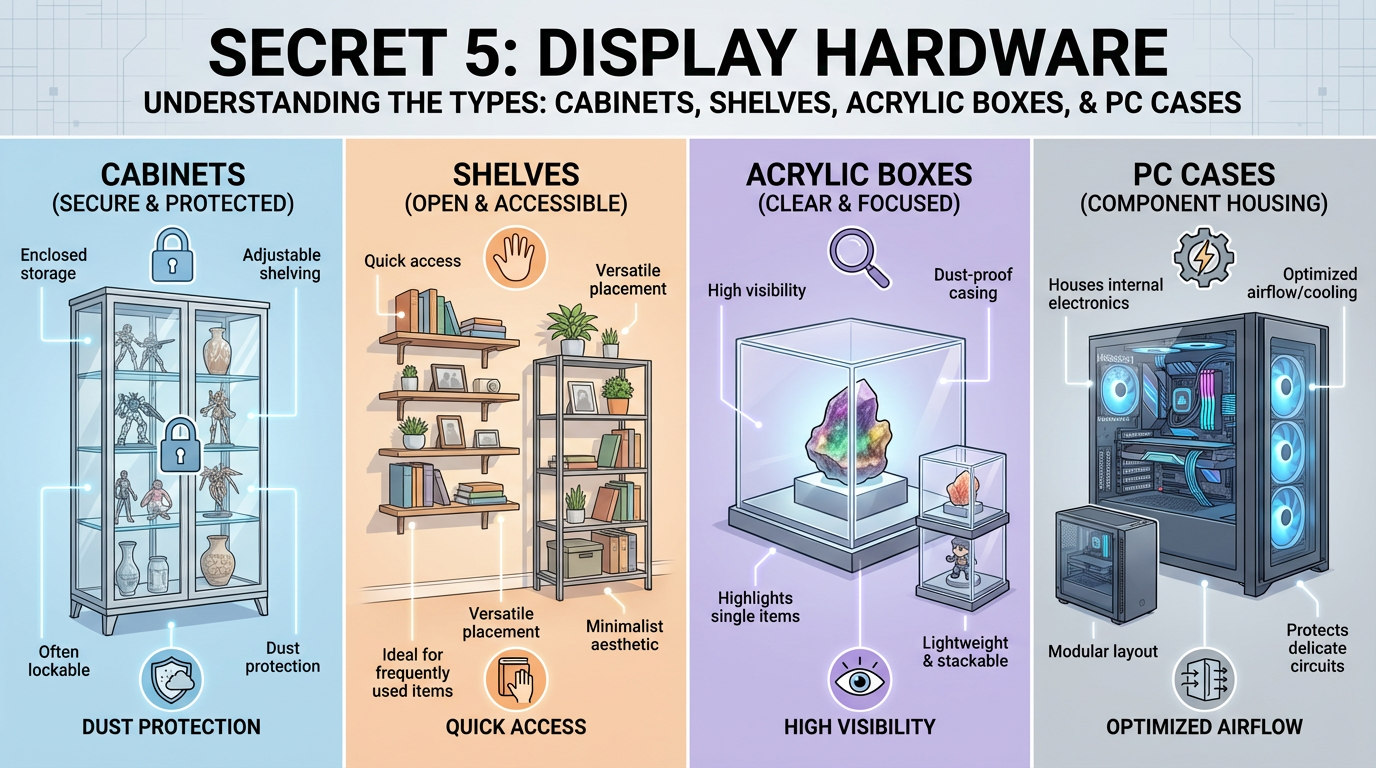
Once the conceptual work is done, you still need somewhere to actually put the figures. Collectors and display specialists have tested an enormous range of options, from repurposed bookshelves to custom glass walls. Across sources like FigureDisplay, Solaris Japan, HomeBaa, Koontz, and Lemon8, a few patterns emerge.
Here is a quick comparison of the most common approaches for action figure exhibitions.
Display option | Best for | Key strengths | Key trade‑offs |
|---|
Glass or acrylic cabinets with doors | High‑value or rare figures; “centerpiece” exhibits | Excellent dust and physical protection; museum‑like look; easy to integrate LED lighting; can use adjustable shelves | Higher cost; can feel closed off without careful lighting; large units must be anchored for safety |
Open bookshelves and freestanding units | Large or growing collections; budget‑conscious setups | Easy to repurpose; simple to rearrange; good access for posing, cleaning, and photography | Minimal dust protection; requires more frequent maintenance; can look cluttered without strong theming |
Floating shelves and wall‑mounted display cases | Small rooms; turning figures into wall art | Uses vertical space; keeps floor clear; wall‑mounted cases add dust protection and an “art gallery” vibe | Weight limits; installation effort; shallow depths restrict very large figures or dioramas |
Stackable clear acrylic boxes | Modular “pod” displays; mixed‑size collections | Protects from dust; highly flexible; can be rearranged or expanded as the collection grows; individual boxes frame standout pieces | Visible seams; cost adds up over many units; stability limits stacking height, especially for lighter boxes |
PC case displays | Gamers blending rigs and figures | Dramatic, RGB‑driven look; great for a small number of showpiece figures next to a computer setup | Heat and dust risks; cramped space; requires careful airflow management to avoid warping or paint damage |
Retail fixtures, pegboard, and slatwall | Stores and convention booths | Extremely flexible; easy to reconfigure; ideal for carded figures and frequent resets; works well with signage and pricing | Less “premium” look without added theming; exposed to dust and handling; can feel like pure merchandising if not curated |
Glass cases and wall‑mounted display cases come up repeatedly in guides like Solaris Japan and HomeBaa as the gold standard for protection. They block dust, reduce accidental bumps, and can be upgraded with UV‑filtering glass or film. FigureDisplay notes that collectors often invest in a few high‑quality cases for grail pieces and supplement with more affordable shelving elsewhere.
Bookshelves and open units shine when paired with strong organization. Japan Figure and HomeBaa both recommend grouping by franchise, scale, or color to create visual coherence, then using risers to build a “stadium” effect so figures at the back are still visible. HomeBaa also highlights size‑based placement: larger figures lower and smaller ones higher up for a balanced look.
Stackable acrylic boxes, popular in communities like Lemon8, are a clever middle ground. One collector who redecorated a room around anime figures chose clear acrylic cases because they are easy to assemble—about five minutes per box—and modular enough to expand as the collection grows. The only caution they raised: stacking more than roughly four units can become unstable, especially for lighter models.
PC case displays are the wildcard. Both Solaris Japan and Shumi’s practical guides acknowledge the appeal but warn about heat buildup and dust. If you go this route, watch temperatures, maintain strong airflow, and keep priceless pieces elsewhere.
For stores and shows, retail‑grade fixtures make life easier. The Global Display Solution emphasizes clear acrylic shelving, locked glass cabinets, and slatwall systems for flexible merchandising that still respects condition concerns. The same principles that make a trade show booth effective—good sightlines, protected focal points, and clear navigation—apply directly to action figure retail.
Secret 6: Lighting That Flatters, Not Fries
If you want to feel like a curator overnight, fix your lighting. A guide for collectors from Koontz calls lighting a core design element, not an afterthought. Done well, it reveals sculpted details, creates mood, and guides the eye. Done poorly, it fades paint, warps plastic, and throws harsh glare across every glossy box.
Multiple sources converge on one simple rule: use LED lighting. FigureDisplay explains that LED strips are low‑heat and emit essentially no UV, which dramatically lowers the risk of discoloration compared with incandescent bulbs. Koontz recommends installing LED strips both above and below shelves so light wraps figures evenly and shadows stay soft.
Color tone matters too. Display guides from Solaris Japan and anime‑collector articles suggest thinking in terms of warm, neutral, and cool white rather than obsessing over exact color temperature numbers. Warm white feels cozy and cinematic, great for slice‑of‑life or nostalgic scenes. Neutral white keeps colors honest and works well for most mixed collections. Cool white can feel high‑tech and sharp, perfect for mecha or cyberpunk displays, but can look clinical if overused.
Positioning is as important as color. FigureDisplay and Koontz both advocate using multiple light sources from different angles, sometimes adding reflective surfaces like white foam board behind or beneath figures to bounce light into dark areas. That technique is especially useful in deep cabinets where the back row tends to vanish.
One more non‑negotiable: avoid direct sunlight. Both Solaris Japan and Koontz warn that natural light can make figures look gorgeous short‑term but fades paint and degrades packaging over time. If your exhibition space has big windows, use blinds, curtains, or UV‑filter film, and keep an eye on shelf temperatures during hot months.
Think of lighting as painting with invisible brushes. You are not just “making it bright”; you are sculpting what visitors notice and how they feel in the space.

Secret 7: Preservation, Climate, and Safety
The most heartbreaking messages I get from collectors are some version of “I opened my cabinet and everything was sticky, bowed, or yellow.” The good news is that a few museum‑inspired habits dramatically reduce that risk.
FigureDisplay recommends treating climate control as your first line of defense. They suggest keeping rooms around 65–70°F and relative humidity in roughly the 45–55 percent range. That sweet spot helps prevent both plastic warping from heat and mold or corrosion from dampness. Basements and rooms near heating vents or direct sun are flagged as danger zones. A simple hygrometer and, if needed, a small dehumidifier or some silica gel packs go a very long way.
Materials matter just as much. Acid‑free materials and UV‑resistant containers—clear acrylic boxes, polyethylene sleeves, and similar—protect both loose and boxed figures from slow chemical damage. This is straight out of the conservation playbook museums use for archival objects.
Handling and maintenance show up repeatedly across sources. FigureDisplay advises supporting figures by the torso or base rather than limbs or weapons, washing hands before touching, dusting weekly with soft brushes or compressed air, and doing a more thorough wipe with slightly damp microfiber about once a month. Solaris Japan adds an earthquake‑minded trick: museum or “earthquake” putty to secure bases to shelves without leaving residue.
For serious collectors, value preservation extends beyond the shelf. FigureDisplay notes that professional‑grade storage and display setups often fall in the 3,000 range, with individual cases around 400 and modular shelving units around 800. At that point, insuring your collection like other collectibles becomes reasonable. They also point out that keeping high‑value items mint in package generally protects resale value better than opening them, even if it means a little less posing fun.
Safety is not just about the figures. Koontz is blunt about case stability: large shelving units should be anchored to walls. They describe options like nylon straps or metal brackets with cables, and using proper anchors in drywall when studs are not available. For wall‑mounted displays, that kind of hardware can be the difference between a heroic gallery and a shattered tragedy.
When you treat climate, handling, and safety as part of your exhibition design instead of afterthoughts, you are not being fussy. You are acting like a curator protecting a collection for its next chapter.

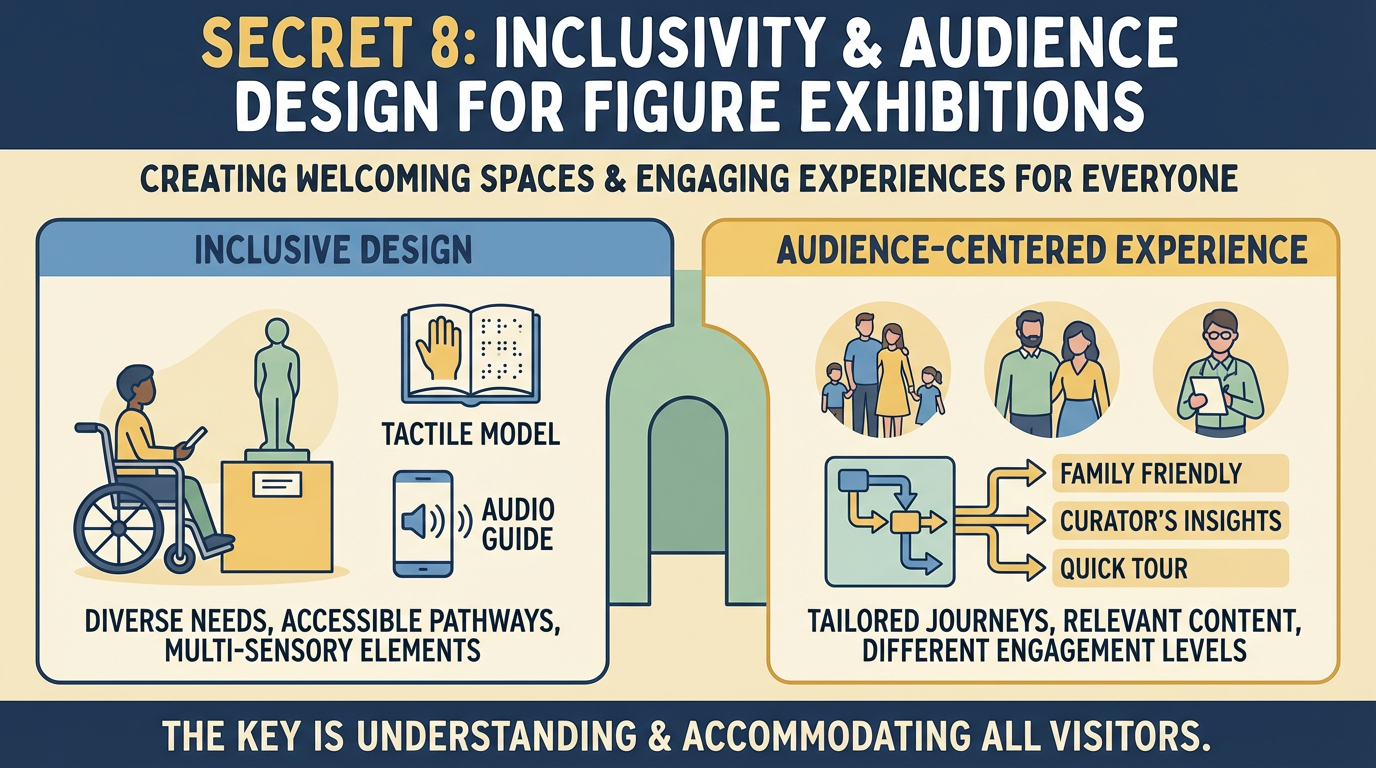
Secret 8: Inclusivity and Audience Design for Figure Exhibitions
Exhibit Central and Wonderful Museums both insist on the same mantra: design for people, not just objects. In museum work, that means thinking about visitors of different ages, abilities, cultures, and knowledge levels. In an action figure exhibition, the audience may range from hardcore collectors comparing paint apps to kids seeing a favorite character in person for the first time.
Inclusive design starts with simple physical choices. Keep aisles wide enough for strollers and wheelchairs. Place at least some hero pieces at child eye level instead of putting everything up high. Make sure labels are legible, with good contrast and font sizes, so people are not squinting at your grail like it is a test.
Content inclusivity matters too. Exhibit Central highlights multilingual materials and tactile experiences as ways to open exhibitions to more people. For figures, that might translate into bilingual labels for Japanese and English titles, or a small “touch‑safe” figure station where visitors can handle a sturdier piece while more delicate statues stay behind glass.
Digital tools can boost accessibility without much extra space. Stqry notes that self‑guided tour apps increasingly support audio descriptions, text‑to‑speech, and alerts to manage crowding. For a major figure show or store, a simple audio guide or QR‑based micro‑site can carry deeper lore, making the exhibit enjoyable for both quick browsers and deep divers without cluttering every shelf with text.
Finally, there is thematic inclusivity: making sure the stories you highlight reflect a broad slice of fandom instead of one narrow slice. That might mean dedicating space to classic shonen, shojo, mecha, and slice‑of‑life, or curating a section that spotlights women creators and characters. When visitors see themselves in the stories on display, they feel invited in rather than merely tolerated.
Research summarized by Stqry even shows how much audiences care about values: around ninety percent of museum visitors report concern about climate change, and more than eighty percent believe museums should actively promote sustainability. Translating that into figure terms could involve choosing energy‑efficient lighting, reusing fixtures between shows, or highlighting eco‑themed characters and stories. It is a subtle signal that your exhibition cares about more than just sales.
Secret 9: Measure, Iterate, and Refresh
One of the biggest differences between a casual shelf and a true exhibition is what happens after opening day. Professional guides from Aram, Exhibit Central, Neos Creative, and Stqry are unanimous on this: no exhibit is ever “finished.” It is prototyped, launched, observed, and tuned.
Aram’s immersive exhibition guide recommends deliberate pre‑launch testing, watching how people actually move through the space, where they linger, and where technology fails. Exhibit Central encourages collecting visitor feedback, whether through formal surveys or simple comment prompts, and then using that to refine story focus, accessibility, and interactivity.
Interactive engagement articles from Neos and Formtex go one step further by treating data as design fuel. If your touchscreen logs which character bios people open most, or which trivia questions get skipped, that is a clue. If a certain shelf shows up constantly in social media posts while another never does, you can respond by adjusting lighting, labels, or figure choices.
Stqry notes that museums are increasingly using dwell time, movement patterns, and interaction rates to inform future layouts and programming. Even at a modest figure event, you can approximate that by sketching a floor plan and marking where people logjam, which cabinets empty out first, and which dioramas get the most camera phones pointed at them.
Refreshing content is not just about chasing trends; it is about giving fans a reason to come back. Aram argues that immersive exhibitions should be treated as dynamic platforms, with content updated regularly to reward repeat visits. For action figures, that might mean rotating seasonal themes, adding new releases into existing stories, or giving under‑appreciated lines their own spotlight for a while.
When you get into that rhythm of test, watch, tweak, every exhibition becomes a living conversation with your audience rather than a one‑time monologue.

Short FAQ
How many figures should I put on a shelf if I want it to feel like an exhibition, not a warehouse?
Guides from HomeBaa, Solaris Japan, and Quirkshelv all stress the same principle: less is more, and negative space is your friend. Instead of packing shelves edge to edge, group figures by theme or color, vary heights with risers, and leave breathing room around key pieces. A shelf that looks a little “under‑full” in photos will usually feel just right in person and makes each figure read as part of a curated story instead of a row of inventory.
Is it really safe to display figures inside a PC case?
Display articles from Solaris Japan and Shumi acknowledge that PC case displays can look spectacular, especially with good RGB lighting, but they warn about real risks. The inside of a case is a warm, dusty environment, and sustained heat can warp plastic or soften joints. If you do it, limit yourself to a few less fragile figures, monitor internal temperatures, keep your cooling system strong, and avoid placing irreplaceable or very expensive pieces inside the case.
Do I need museum‑level climate control at home to protect my collection?
You do not need a full conservation lab, but the climate guidance from FigureDisplay is a smart benchmark. Keeping your display room roughly in the mid‑sixties to around seventy degrees Fahrenheit with humidity in the mid‑forties to mid‑fifties helps a lot. Combine that with LED lighting, UV‑resistant cases, gentle handling, and secure shelving, and you are already applying the same preservation logic museums use, scaled to an apartment or home.
At the end of the day, the “secret” behind unforgettable action figure exhibitions is this: treat your collection the way a great museum treats its artifacts and the way a passionate fan treats their favorite story. Start with a clear why, build a narrative, design the journey, protect what you love, and keep evolving. Do that, and your figures stop being objects on a shelf and become a world people cannot wait to step into.
References
- https://architecturalmodels.net/ultimate-guide-to-exhibition-models/
- https://www.koontz.com/a-collector-s-guide-to-creating-action-figure-display-cases59fcabfb
- https://aram.eu/designing-engaging-immersive-exhibitions-a-comprehensive-guide/
- https://exhibitcentral.com.au/know-your-why-unlocking-the-key-to-engaging-exhibitions/?srsltid=AfmBOorRl4ZjX2iliQr-aibezAzlTDQ108bqn85t6tCB73cMUFHbvGsp
- https://smart.dhgate.com/creative-and-practical-ways-to-showcase-your-anime-action-figure-collection-with-style/
- https://www.exhibitoronline.com/topics/article.asp?ID=2742
- https://figuredisplay.com/how-to-store-and-display-action-figure-collection/
- https://www.lemon8-app.com/@j1ngyiiii/7298359573881209346?region=sg
- https://neoscreative.com/blog_list/interactive-engagement-exhibitions
- https://www.sparefoot.com/blog/how-to-store-and-display-action-figures