Understanding How Light Exposure Affects Your Collectible Figurines
Controlling sunlight, UV, and indoor lighting is one of the biggest factors in whether your figures stay vibrant for years or fade and warp far sooner.
You know that mini-heartbreak when you realize your once-neon hair gradients now look pastel, or that crisp card art behind your favorite grail has quietly gone dull while you were just enjoying your shelf setup. Collectors who stay on top of light, temperature, and UV protection consistently report sharper colors, clear blisters, and unwarped bases far longer than those who leave pieces in “just a little” window glow. This guide walks through what different kinds of light actually do to plastic, paint, and packaging, and how to set up a display that looks great now without sacrificing your collection’s future.
Why Light Is Tough on Figurines in the First Place
UV light is one of the main slow killers of collectible plastics, inks, and cardboard, gradually causing fading, yellowing, and structural damage that permanently lowers both appearance and value. In plain language, every time light hits your figure, a tiny amount of energy is absorbed by the plastics and paints; over thousands of hours, that energy breaks chemical bonds in pigments and in the plastic itself.
Many figures and statues are made from vinyl or related plastics that behave very similarly to the PVC discussed in material science articles. When ultraviolet radiation hits these plastics, it breaks some of the polymer chains that give vinyl its flexibility and strength, a process called photodegradation that eventually makes the material brittle, faded, and more likely to crack. That breakdown speeds up the more intense the sun is and the longer pieces sit under it, while protective additives and coatings only slow the process instead of stopping it completely, which is why even “UV-stable” vinyl still needs careful placement and casing. Explanations of how UV breaks polymer chains in mirror what collectors see in figure plastics.
Light is also ruthless with the pigments in your paintwork. UV rays break apart the molecules that give colors their saturation, which is why collectors of bright vintage lines like TMNT, MOTU, or bold anime hair gradients notice those areas lose intensity first. Detailed guidance on action-figure preservation notes that UV light slowly destroys pigments in figures, card art, and blister plastic, turning glossy, saturated finishes chalky, yellow, and dull over time, especially on older, more vibrant lines. Specialist action-figure case makers explicitly warn that UV is a primary cause of fading and yellowing in plastics and packaging.
Archivists who work with plastics go a step further and point out that many plastics have an “inherent vice,” meaning they are unstable by nature and deteriorate quickly when pushed by light, temperature swings, humidity, and pollutants. For storage, best-practice advice is to treat light damage as cumulative and irreversible, keeping sensitive items in dark conditions whenever possible and using UV-filtering film on windows or lights when things must be displayed. Artifact-care guidance stresses that plastic objects deteriorate quickly and need more protection than metal, glass, or ceramic pieces.
When you put that together, the big picture is simple but slightly brutal: any light that lets you see your figure is also, in microscopic slow motion, aging it.
The goal is not to avoid all light—you want to enjoy your collection—but to control how much, what kind, and for how long, then layer in protection to stretch the clock.
Direct Sun, Indirect Glow, and Room Lights: What’s Actually Dangerous?
A lot of collectors ask whether “a bit of sun” or “just room light” is really that bad. The answer depends on the type of light, how long it hits, and how well you shield your display.
Direct sunlight is the final boss. Self-storage and collectibles guides consistently call out action figures, statues, and bobbleheads as items that should be kept in dark, windowless environments because light and heat together can warp bubbles, discolor plastics, and fade prints. One storage guide specifically singles out action figures as a category that benefits from dark storage, describing how carded bubbles and accessories can warp or discolor when exposed to light and recommending wrapping boxed figures and storing them in covered totes or bins to block light. That same guidance lists action figures among collectibles that are especially vulnerable to light exposure.
Outdoor resin ornaments tell the extreme version of this story: there are documented cases of resin decor going from vivid to almost colorless in a single sunny summer because UV and low-quality dyes do not mix, which is a harsh but useful warning about how aggressive strong light can be on painted figures. Reports on garden resin ornaments show that a single high-UV season can noticeably strip color from exposed pieces.
Indirect daylight is slower but still matters. Collectors have reported fading on figures kept in rooms where sunlight only arrived after passing through shades, curtains, or reflections off nearby surfaces. If you can see the object by that light, photons are bouncing off the surface and some fraction of that energy is being absorbed. UV can reflect and refract, not just travel in straight beams, so a figure sitting across the room can still be getting a steady drizzle of UV even if the sun never directly hits it.
Indoor lighting is where you have the most control. UV comes mainly from the sun, but some artificial lights, especially older fluorescent bulbs, also emit UV and heat. Modern collectors’ guides strongly favor LED lighting because LEDs produce minimal UV and much less heat, so they are gentler on plastics and paints while still giving you that crisp, gallery-like look. Advice on preserving cards, comics, and figures consistently recommends LED lighting with controlled brightness and color temperature, paired with UV-resistant sleeves, cases, and glass or acrylic to create a safe display environment that still pops.
Here is a quick comparison you can mentally apply to any shelf or cabinet in your space:
Light source | Typical risk to figures | Simple example | Safer use case |
|---|
Direct sun through glass | Fastest fading, yellowing, and warping; heats plastics | Figure on a windowsill getting several hours of sun on one side every day | Avoid entirely for serious collectibles; use curtains plus UV cases if needed |
Bright indirect daylight | Slower fade and yellowing; still cumulative | Shelf across from a bright window, room feels naturally lit most of the day | Limit how long blinds stay open, rotate figures, use UV cases |
Non-LED room lighting | UV and heat vary, can dry plastics over time | Ceiling fluorescent tubes in a hobby room left on for hours | Swap to LEDs, use dimmers, turn off when not in the room |
LED strips and spots | Very low UV, some heat if very close | LED strip inside a glass cabinet about 2 in above a figure’s head | Keep a little distance, use lower brightness, avoid 24/7 illumination |
If you imagine a figure sitting where it gets four hours of bright window light every day, that is more than 1,400 hours of exposure over a year.
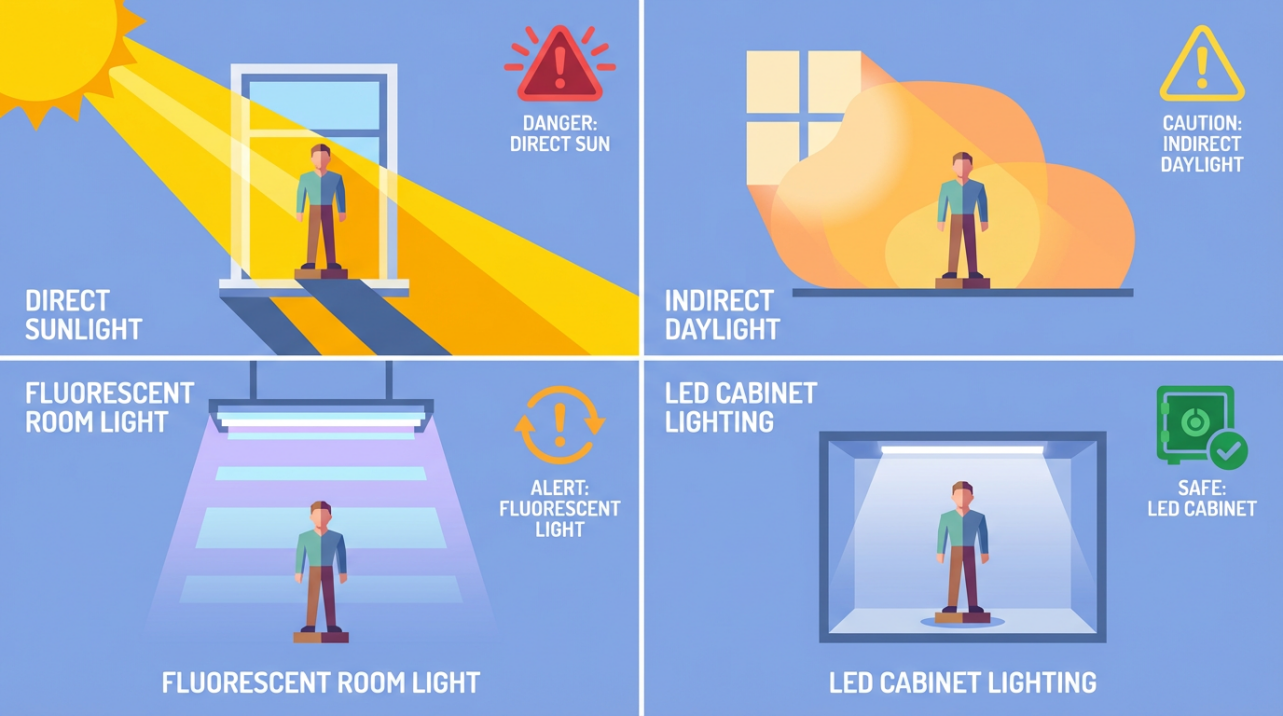
A figure in a cabinet lit by LEDs for a couple of hours each evening racks up much less cumulative stress, even if it looks just as dramatic to your eyes.
How Light Damage Actually Shows Up on Your Figures
Faded paint, washed-out gradients, and dull details
Anime figures are tiny paintings in 3D: shaded hair, airbrushed clothes, metallic weapon edges, and tiny eye prints. Direct sunlight and heavy UV are notorious for breaking down these paint layers, causing colors to fade and gloss finishes to go flat. Collectors who specialize in figures and statues repeatedly emphasize that keeping pieces away from direct sunlight and harsh indoor lighting is one of the most important steps in avoiding dull colors and faded paint, recommending shaded cabinets, walls away from windows, and UV-filtering films where needed. Guides focused on anime figures stress that direct sunlight is one of the quickest ways to ruin paint and decals.
On the packaging side, the same thing happens to card art and printed boxes. Pigments in cardboard inks are just as vulnerable as the paint on your figures. Detail-focused action-figure resources warn that UV exposure fades card art, yellows blisters, and can even cause glossy finishes to turn chalky or hazy over time, which is a direct hit to both display appeal and resale value for mint-on-card or boxed collectors. Specialist action-figure preservation advice notes that UV rays are especially harsh on bright, saturated printing and clear plastic.
Yellowed plastic, brittle joints, and warping
Color changes are only half the story. Plastic itself ages under UV and heat. Materials experts describe how UV radiation breaks bonds in vinyl and similar plastics, gradually making them less flexible and more brittle; you start with a soft, slightly flexible surface and end with a dry, crack-prone one. Technical explanations of vinyl breakdown describe UV-driven bond breakage as the root of this loss of strength.
Powersports care guides describe the same pattern in seats and trim: first the color fades, then continued UV and heat cycling make plastics brittle and rubber crumbly, eventually cracking under stress. Real-world examples from outdoor plastics show colors dulling first, then plastics becoming brittle and cracked under ongoing UV and heat.
You can see the same effect on older plastic toys and figures that have lived near windows or under strong lights. Over years, plastic can yellow—especially clear parts or lighter colors—while joints and thin pieces lose resilience. Preservation professionals caution that plastics are among the fastest-deteriorating materials in their collections and recommend separating them from other materials, keeping them away from direct light, and avoiding spaces with big swings in temperature and humidity. Collectible storage recommendations explicitly flag plastics as chemically unstable and in need of careful, low-light, climate-controlled storage.
Card backs, blisters, and bases
Light exposure does not stop at the figure. Card backs, blisters, and bases tell the story just as clearly. Collectors of mint-on-card action figures have long observed that even indirect light can yellow clear blisters and fade printing while making card stock curl. Preservation-minded action-figure guides warn that UV exposure warps card backs, makes bubbles brittle or cracked, and flattens bold card art into washed-out pastels, particularly for older bright lines and rare variants. Action-figure case makers repeatedly highlight warped card backs, brittle bubbles, and faded printing as the most common complaints from collectors who store figures in bright rooms.
Bases and dioramas, especially when they use resin or low-cost plastics, can also fade and chalk out. The extreme outdoor example of resin garden ornaments turning from bright and saturated to almost ghostly pale after a single sunny season is a good mental image of what paint and resin are up against when left in strong light for long periods. Experiences with garden resin pieces show how quickly cumulative UV and weathering can strip color and surface detail. Indoors, you have less intensity, but the same mechanism over enough hours.
Designing a Light-Safe Display You Still Love Looking At
Placement and room layout
The easiest and cheapest protection is simply where you put your shelves. Serious statue and figure-care guides repeatedly suggest avoiding windows, heaters, bathrooms, and basements, and instead favoring interior walls and climate-controlled rooms with moderate humidity. They recommend keeping indoor conditions around typical room temperature, with relative humidity roughly in the 40–50% range, to prevent mold, warping, and paint discoloration while also minimizing joint looseness and plastic stress. Collectible-care advice for statues and figures highlights humidity as a key factor alongside light and temperature.
For a light-safe anime shelf, that means picking a wall that does not get direct sun, staying a few feet away from any window, and keeping figures clear of vents or radiators that blast hot or dry air. If your room is naturally bright, lean on curtains, blinds, or blackout shades during peak sun hours and keep them more open in the morning or evening when the light is softer. Think of your display like a small gallery: the room should be comfortable for you to sit in for hours, and if the light feels harsh on your eyes or hot on your skin, it is also harsh on your figures.
UV-protective cases, glass, and films
Once you have smart placement, the next big upgrade is adding UV protection between your figures and the light. Collectibles guides consistently recommend UV-resistant acrylic or glass cases for figures, statues, and carded items, both to block a large portion of harmful UV and to keep out dust, accidental knocks, and some humidity swings. Action-figure storage and display advice points collectors toward UV-protective cases when condition and long-term value matter.
Some specialist action-figure cases use thicker UV acrylic, around 1/6 in, which creates a stronger, clearer barrier than typical thinner cubes closer to 1/12–1/8 in and forms a controlled micro-environment that reduces dust, softens humidity changes, buffers temperature swings, and protects from bumps. Custom action-figure cases that use this thicker UV acrylic are designed to keep colors, card art, and blister plastic looking closer to their original state for longer.
Window film is another powerful tool if your display room simply cannot avoid sunlight. Preservation experts who deal with artifacts recommend UV-filtering film on windows and fluorescent light tubes, drawing shades when possible, and turning lights off when rooms are not in use to cut down on cumulative light exposure. Artifact-storage tips explicitly call for UV-filtering window films in spaces where light levels are hard to control. Paired with UV cases and LED lighting, that gives you multiple layers of defense: the film softens the sun, the case blocks most remaining UV and dust, and the LEDs let you control exactly how your figures are lit.
The trade-off is cost and a bit of visual separation. UV cases, especially custom-fitted ones, add up quickly if you have a big collection, and some collectors do not love the extra reflections. A common compromise is to prioritize UV cases for high-value or grail pieces and keep more common figures in unenclosed but well-placed displays away from windows and under LED lighting.
Dark storage and rotation
If you really want to slow light damage without turning your home into a cave, rotation is your friend. Storage providers and collectibles writers often recommend keeping part of your collection in dark storage and only rotating a portion onto display at any given time. Guides on collectibles that need dark storage urge collectors to think in terms of each object’s lifetime light budget, not just what it experiences in a single week or month.
Dark storage does not have to be fancy. Collectors frequently use well-sealed drawers, opaque bins, under-bed containers, or closets for off-rotation figures, often with silica gel packs and labels so pieces are easy to find and swap in. Broader collectibles best practices suggest rotating displays every month or two, especially for pieces near brighter areas, so that UV-exposed items get breaks and the overall damage is spread out instead of concentrated on the same favorites. Holistic collecting advice highlights rotating which items are showcased, giving UV-exposed pieces more frequent breaks, and inspecting storage boxes regularly.
The obvious downside is that you cannot see everything all the time. For many collectors, the sweet spot ends up being a hybrid: a hero shelf or cabinet in a prime, light-controlled spot for current favorites, and a dark “vault” for the rest that you raid when you want to refresh the lineup.
Light, temperature, and humidity: the trio you cannot separate
Light rarely travels alone. Areas with strong sun also tend to get hot, and temperature swings combined with humidity changes are another major threat to figures. Storage and display guides repeatedly recommend keeping figure rooms around typical indoor comfort levels, often about 65–70°F with moderate humidity somewhere in the 40–50% range, and avoiding attics, basements, and garages where temperature and moisture can swing wildly. Expert action-figure display advice suggests climate control around those ranges as a baseline and warns against storing figures in spaces that feel stuffy, damp, or drafty.
Anime statue and collectible-care articles echo that high humidity can lead to mold, warped plastic, and paint discoloration, especially in poorly ventilated spaces, while drastic temperature swings and proximity to heat sources accelerate material breakdown. They recommend climate-controlled spaces like closets or interior rooms, plus dehumidifiers and silica gel packs in bins and cases to keep things steady. Guidance for statues and collectibles emphasizes keeping humidity in a moderate, stable range so plastics, paints, and adhesives are not constantly expanding, contracting, or absorbing moisture. When you get light, temperature, and humidity into a safe range, everything else you do—UV cases, window film, rotation—works better.
FAQ: Everyday Light Decisions for Anime Figure Collectors
Is it okay if my figures only get sun when I open the curtains for a bit?
Short, occasional bursts of sun are less risky than hours of daily exposure, but the damage is still cumulative. Experts who work with artifacts frame light damage as irreversible and cumulative over an object’s lifetime, which means every hour you add is an hour you never get back. Collectible artifact guidance specifically calls light damage cumulative rather than temporary. If you love throwing open the curtains, try to do it when the sun is not directly streaming onto your shelves, and pair that habit with UV cases or by moving your main display to a wall that stays shaded even when the room is bright.
Are UV-protective acrylic cases really worth it, or is that just for ultra-expensive grails?
The strongest case for UV-protective cases is for rare, vintage, or high-value figures and statues, where condition directly drives value and replacements are hard to find. Specialist action-figure preservation advice explicitly recommends UV-protected acrylic cases for high-value or rare pieces because they preserve color, card art, blister clarity, and plastic tones while lowering the risk of warped card backs and brittle bubbles. Custom case makers stress that UV acrylic cases are a long-term investment that helps keep prized pieces closer to their original appearance. For everyday prize figures or budget statues, you might not want to spend as much on cases as on the item itself, but even then, a basic UV-resistant acrylic cabinet and good room placement can make a meaningful difference.
Can I still use LED strip lights and spotlights in my Detolf or bookcase?
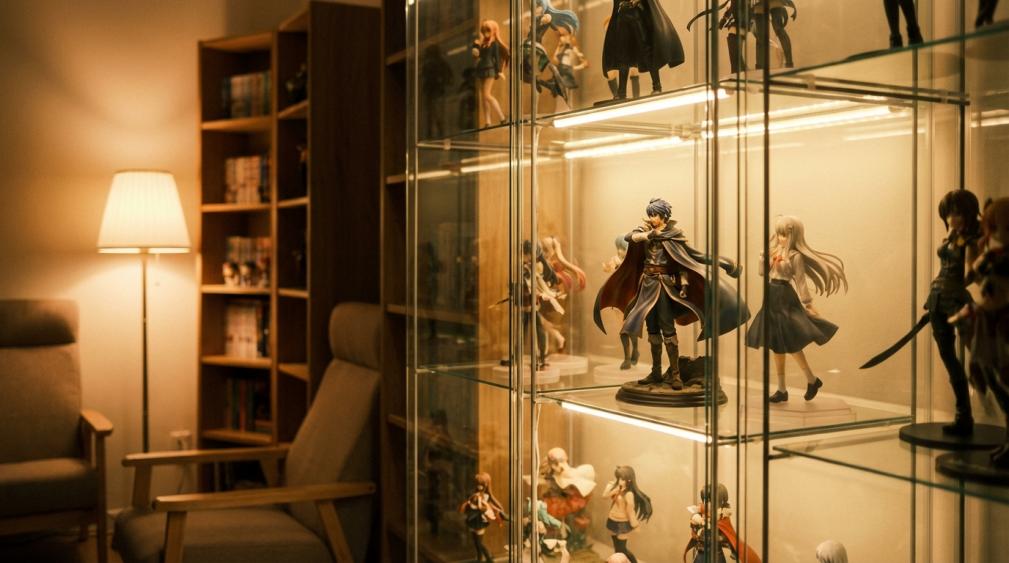
Yes, LEDs are generally the safest option for display lighting as long as you manage distance and runtime. Collectible preservation resources consistently recommend LED lighting because it produces minimal UV and less heat than fluorescent or incandescent bulbs, which reduces both light and heat damage risk while giving good color rendition. Collectible-lighting guides describe LEDs as the preferred choice due to their low UV output and cooler operation compared to older lighting. Aim to keep LED strips a couple of inches away from surfaces, avoid leaving them on all day when you are not home, and combine them with UV-resistant glass or acrylic doors for an extra layer of protection.
Closing
Light can be either the best part of your display photos or the quiet villain that steals your colors, clarity, and value while you are busy enjoying the view. With smart placement, UV-conscious cases and films, climate control, and a little rotation, you can let your favorite characters bask in the spotlight while keeping their colors and sculpts ready for the long haul of your collecting story.