Understanding Why Some Figurines Keep Falling Over (And How To Fix It)
Figurines topple mostly because their weight, joints, and display surfaces are working against gravity, not with it, but once you understand those forces you can use a handful of collector-tested tricks to keep even dramatic poses stable for the long haul.
That sick new anime statue finally arrives, you nail the pose, step back to admire it… and a day later your shelf looks like the aftermath of a kaiju attack. Another time, a whole squad of figures falls like dominoes because someone closed a drawer too hard. Collectors, toy engineers, and even classroom designers have wrestled with this same stability problem in displays, storage, and adaptive toys, and they have found practical ways to make things stay put. Here is how to diagnose why your own figurines keep falling over and what to do about it, from quick posing fixes to deeper mods.
Figurine Physics: Why That Perfect Pose Turns Into A Faceplant
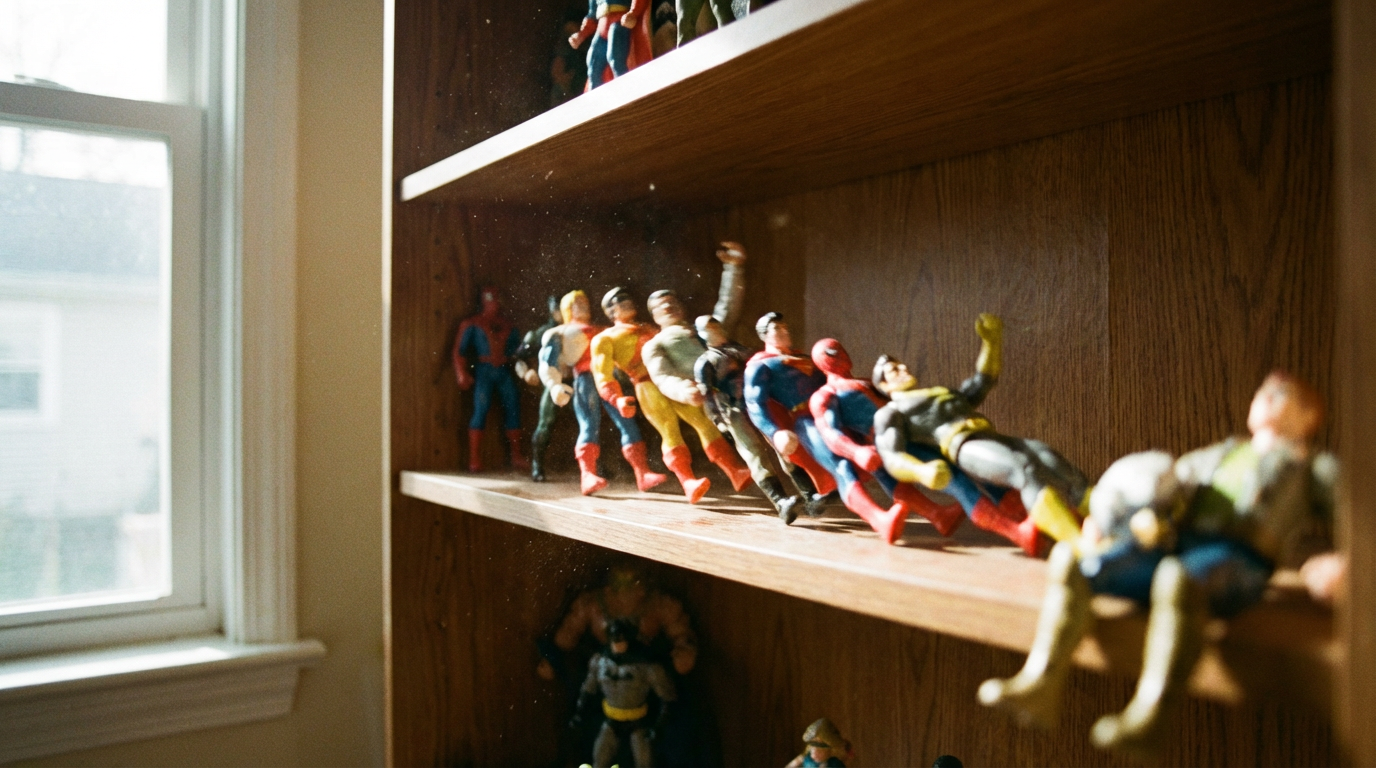
Some figurines are fighting a losing battle with gravity from the moment they come out of the box. Collectors often notice “crooked spine” sculpts, tiny feet under huge capes or hairstyles, or a battle droid–style design where nearly all the mass is above the waist and the legs are spindly. In one Star Wars collecting discussion, a Jedi-like figure insisted on leaning forward just enough to mimic a hunched old emperor, while a battle droid was so top-heavy that the owner gave up and displayed it folded down instead. When that heavy upper body tilts even slightly past the footprint of the feet, the center of gravity moves beyond the base and the figure tips with the slightest vibration.
Small factory errors in the ankles and feet make this worse. Out of the package, a lot of figures have ankles that do not sit flat on the shelf or foot-peg holes that are drilled at a subtle angle. That barely visible misalignment forces the figure into a lean, even in a “neutral” pose. Some collectors have had success gently warming the plastic in the feet and ankles and then resetting them in a straighter, more weight-bearing position so the soles sit flush; simply getting both feet truly flat drastically improves balance.
Articulation can be both friend and enemy. Posing guides for action figures emphasize starting from the ground up: plant the feet, tune the legs and hips, then adjust the torso, arms, and head while never losing that solid base. They also point out that ankle rockers—which let the foot tilt sideways—are crucial, because they let you increase the amount of foot surface actually touching the shelf and move the center of gravity back between the legs. Loose joints, especially in hips, knees, and ankles, undo all that careful work by letting the figure sag into a new position over time, while overly stiff joints tempt you to force them and risk breakage.
Your shelf itself often finishes the job of knocking figures over. Collectors on general toy forums report that even stiff, well-posed figures will eventually fall if the shelf lives above a frequently used desk, TV stand, or door that sends tiny vibrations through the wall or furniture. Glass and thin laminate shelves transmit these micro-shakes more readily than thick wood, and shallow shelves give you less room to widen stances. If the front row goes, the rest of your display is at the mercy of the domino effect.
Easy, Reversible Fixes You Can Try Today
Before you reach for a drill or boiling water, there are gentler fixes that can transform how stable your display feels.
The first is smarter posing. Start with both feet as flat as possible, then slide one foot slightly forward or back so the stance is wider than shoulder width without looking awkward. Rotate the hips and torso so that if you imagine a straight line dropping from the heaviest part of the figure—usually the chest or backpack—it lands somewhere between the heels and toes. In walking or running poses, move arms and legs in opposite directions, which not only looks more natural but helps keep weight balanced instead of loading everything onto one side.
The next easiest upgrade is stands. Peg stands fit into foot holes and effectively widen the base; waist or “crotch” stands clamp around the torso and hold up heavier characters or figures without pegs; flight stands support midair poses. Many one-sixth collectors rely on stands even when they dislike the look, because they simply get tired of resetting figures that crash every time a door slams. Multi-packs of generic bases and brand-specific options exist for most scales, and once you pose a few figures with discreet stands, they start to disappear visually behind the character’s silhouette.
Adhesive putties are another go-to. Poster tack, so-called museum putty, and glue-tack products are soft, reusable materials you knead into small blobs and press under the feet to add grip without permanently gluing anything. A niche sticky tack marketed specifically for custom action figures is sold in bricks weighing about 1 oz for about $25.00, which hints at how seriously some collectors take this solution. These specialized putties can be convenient, but ordinary high-quality poster tack often does the job at a fraction of the price. Toy safety guidance on accessible parts and heavy metals in coatings, including lead and cadmium limits for pieces kids might mouth, stresses paying attention to what ends up in small hands and mouths, especially for younger children. That is a good reminder when you are adding new materials to figures that kids might still play with or chew on in the same space Toy safety guidance on accessible parts and heavy metals. For adult-only display shelves, putties are generally low risk but should still be spot-tested on an inconspicuous area to check for residue.
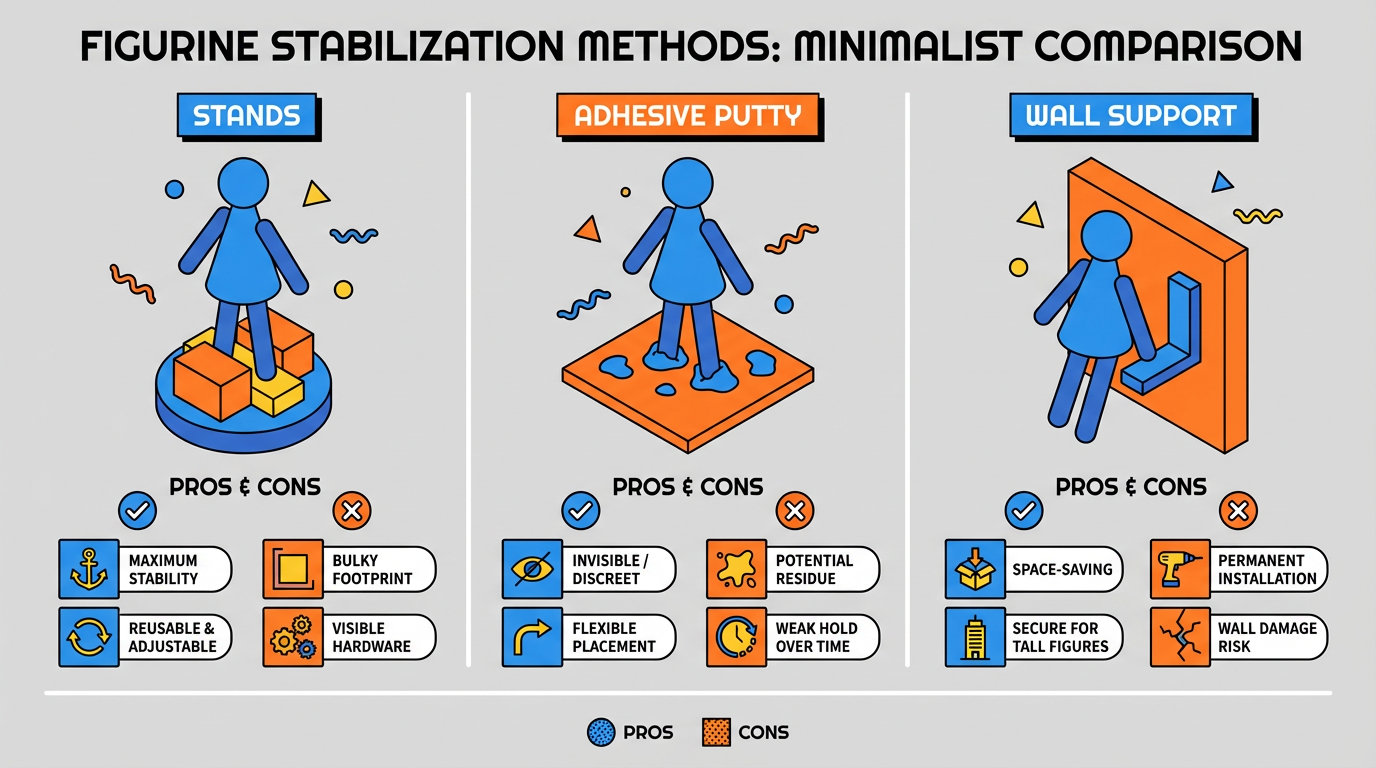
If you absolutely hate visible stands, you can cheat the physics using your environment. Some collectors pose figures so they lean ever so slightly back against a wall, giving them a hidden support while still looking upright from the front. Others arrange tightly packed ranks where the figures subtly brace each other. This can work well for armies of cheaper figures, though a single fall can still trigger a small avalanche.
To compare the main reversible options at a glance, it helps to think of them in terms of what they trade off.
Method | Best for | Pros | Trade-offs |
|---|
Careful posing | Most figures with decent joints | Free, no extra gear, preserves sculpt | Takes patience, limited help for very top-heavy designs |
Stands (peg/waist/flight) | Heavy or dynamic poses, figures without flat feet | Strong stability, easy to move or re-pose | Visually noticeable, cost scales with collection size |
Adhesive putty | Light to medium figures on smooth shelves | Invisible from front, reversible, cheap | Possible residue, weak in high heat or on dusty surfaces |
Wall/figure support | Crowded shelves, armies | No extra tools, uses space you already have | Can create domino effects, limited flexibility |
Advanced Fixes For Stubborn, Top-Heavy Figurines
Some problem characters will still insist on faceplanting even after better posing, stands, and putty. For those, collectors turn to gentle reshaping and structural mods.
One surprisingly effective technique is heat reshaping for warped or misaligned feet and ankles. Hobbyists working with plastic miniatures and larger figures use two closely related methods: controlled heat from a blow dryer or a brief dip in very hot or boiling water. The idea is to warm only the warped area until the plastic becomes just pliable, straighten the part into a more neutral, weight-bearing position, and then hold or cool it in place so it “remembers” the new alignment. Experienced modelers usually recommend the blow dryer first because it is easier to control than boiling water and avoids dunking painted parts; boiling should be done quickly and carefully, with attention paid to not overheating thin details. Even a small adjustment that lets both feet sit flat and parallel can turn a perpetually bowing swordsman into a stable, confident stance.
When joints themselves are loose, adding friction can help. A posing guide for collectors suggests brushing a thin layer of clear acrylic—like a matte topcoat or clear acrylic floor polish—onto the joint peg while repeatedly moving the joint so the coating spreads evenly inside. As it dries, that clear layer slightly thickens the peg and roughens the surface, giving the joint more resistance without gluing it shut. Done carefully, this can restore enough stiffness for the figure to hold a pose instead of slowly sagging over an hour. The trade-off is that you are altering the joint, so you want to go in light, test as you go, and avoid flooding anything.
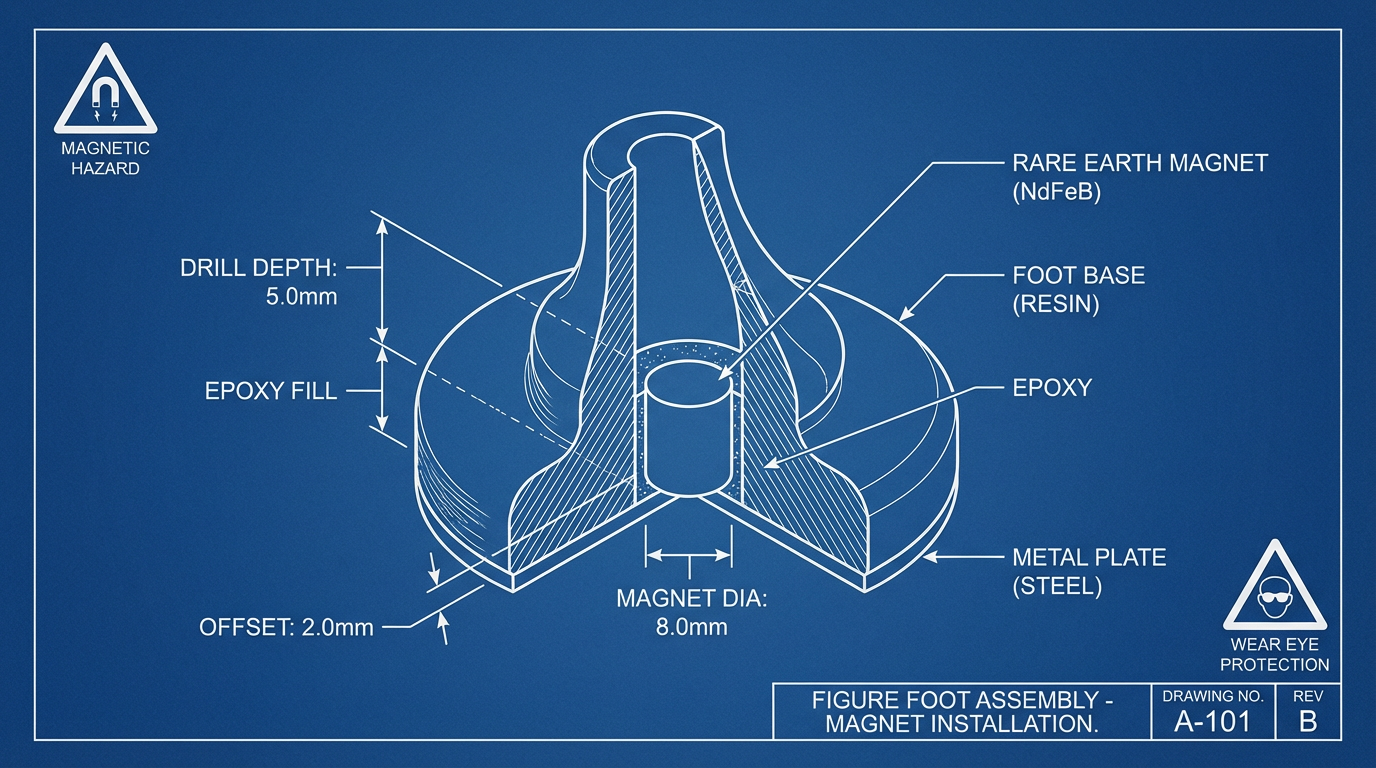
For the most dramatic, dynamic displays or stop-motion animation, magnet mods can be game-changing. One popular DIY method involves drilling a shallow hole in the bottom of each foot, gluing in a small rare earth magnet with a five-minute epoxy, and then posing the figure on a steel sheet or hidden metal plate under a diorama base. Once the epoxy cures, the figure can stand, walk, hop, or jump across that surface in ways that would be impossible without the magnetic grip, and the magnets are invisible in normal viewing. This is a permanent modification, and it comes with safety and health caveats. Epoxy, paints, and similar materials call for good ventilation and basic protective gear; workplace safety guides for toy and recreational-goods manufacturing emphasize controlling exposure to solvents, resins, and paints, along with proper ventilation and fire protection Workplace safety guides for toy manufacturing. The same logic applies at hobby scale on a desk: treat strong adhesives and fine drilling debris with respect.
If there is any chance small children will handle your shelves, magnet mods demand extra caution. Toy standards address both chemical safety and the danger from small parts that can be mouthed or swallowed, and they set strict limits on accessible components in products aimed at young kids, as that same toy safety guidance on accessible parts and heavy metals explains. A magnet that comes loose from a foot becomes a tiny, very appealing piece of hardware to a toddler. For that reason, magnetized figures are best treated as adult collectibles and kept well out of reach of children under typical toy-regulation ages.
Planning Displays For Long-Term Stability
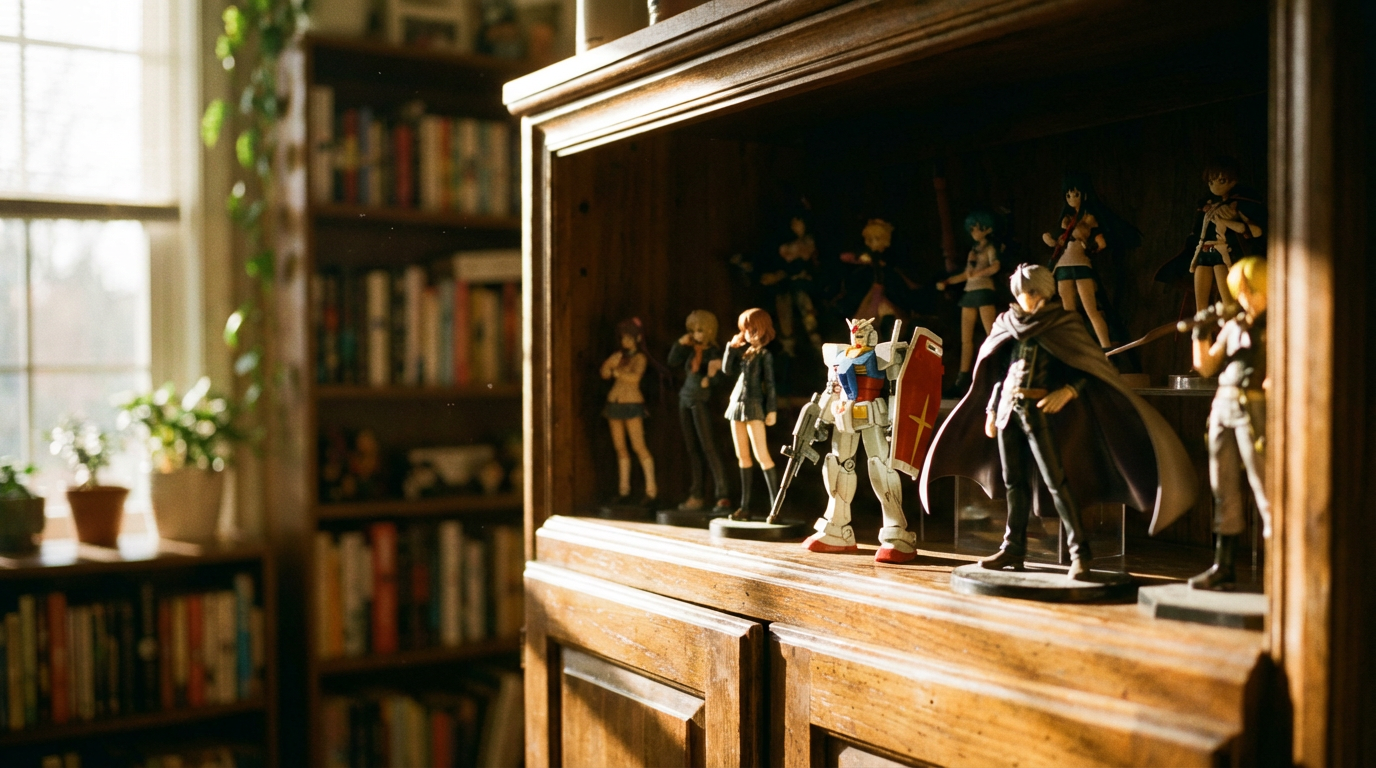
Beyond fixing single problem figures, the way you design your whole display can make the difference between a stable anime shrine and a shelf that never quite stops shedding characters.
Research on children’s toy storage shows how much layout affects real-world behavior. A study on toy lockers for 3–6 year-olds used interviews and observations to map what kids actually do when they grab and return toys, then ran an eye-tracking experiment with 30 children to compare different locker layouts, colors, and divisions. The team combined qualitative data with a quantitative weighting method to identify which design features mattered most and found that clarity, stability, and age-appropriate ergonomics were key Toy storage furniture layouts tested with eye tracking. A display shelf is not a kindergarten classroom, but the lesson carries over: group figures so you instinctively know where each type goes, use risers and deeper shelves so bases are not perched on the edge, and think about how your own daily movements will shake or brush the furniture.
Adaptive toy programs offer another perspective on stability. At one engineering school, students and faculty modify ride-on toy cars and build adaptive toys so children with disabilities can move and play more independently; since 2016 they have produced more than 90 adapted toy cars for local families. One of their projects is a body weight support frame that can be assembled over stand-up toys like kitchen sets or work tables so kids with stability issues can interact safely Adaptive toy programs that modify ride-on cars and build support frames. That is essentially a human-scale figure stand. When you add a clear support arm to hold up a massive, winged anime heroine on a high shelf, you are doing the same thing: building a structure around the figure so the pose is safe and sustainable, not a temporary stunt.
Even outside the toy world, stability research makes a similar point about testing. Work on a toy model for AI-based dynamical systems in atmospheric science found that the numerical stability of those systems depended less on flashy neural network architectures and more on how broadly the training data sampled the system’s possible states. When the network was trained on a narrow, single trajectory, it behaved for a while and then blew up; when the data covered more of the space, the system stayed stable long-term. For figures, that translates into this habit: do not just balance a new pose once and walk away. Tap the shelf, close the cabinet, check again after a few hours or a day, and see which characters subtly shift or sag. The ones that fail that “real life” test need a wider stance, a stand, or a bit of putty.
A simple maintenance ritual keeps everything under control. Every so often, run your eyes along each shelf, watching for new leans, sagging weapons, or crowded spots where a single nudge could start a chain reaction. Move the most fragile or top-heavy characters to safer positions, refresh putty that has dried out, and retire any joint that has gone so loose it can no longer hold even a neutral pose. A bit of preventive attention is much easier than rescuing a fallen resin grail whose ear or sword tip snapped on impact.
FAQ: Quick Answers To Collector Headaches
Do stands or putty hurt the value of a figurine?
Stands themselves do not affect value; if anything, they protect it by preventing falls and breakage. Reversible putties are usually safe as long as they do not stain paint or leave residue, which is why many collectors test a small spot on the underside of a foot first and avoid cheaper, oily formulations. Permanent glues or mods, on the other hand, can reduce resale value unless the buyer specifically wants that customization.
Why do some figures lean over time even if they were fine at first?
Leaning often comes from a mix of top-heavy design, slightly misaligned ankles, and joints relaxing under constant load. Even if a figure technically stays standing, small imperfections can make it bow or hunch in ways that look wrong on the shelf. Gently correcting the feet with heat, tuning the stance, and tightening key joints can slow or stop that gradual drift.
A stable shelf lets your favorite heroes, idols, and mecha look like they are mid-scene rather than mid-fall, and it frees you to focus on world-building and storytelling instead of emergency cleanup. Once you tame gravity with a mix of smart posing, subtle supports, and thoughtful display design, your collection starts feeling less like a pile of plastic and more like a living, reliable slice of your fandom.