Comprehensive Guide to Understanding 108 Types of Plastics (From Anime Shelves to Industry Labs)
If you collect anime figures, Gunpla, or any kind of merch that lives on a shelf, you already live in the plastic multiverse. PVC prize figures, ABS mecha joints, clear acrylic risers, soft vinyl keychains, the PET clamshell your grail shipped in, even the polyester shirt with your favorite character splash art—every one of those is a different “type” of plastic.
Manufacturers and engineers don’t actually talk about 108 types the way a shonen series might talk about 108 secret techniques, but in practice there are dozens upon dozens of resin families, blends, and grades. According to data summarized by Wikipedia and multiple industrial guides, plastics span everything from cheap shopping bags to aerospace parts and high‑temperature circuit substrates. Once you get your head around the main families and how they behave, the rest of the “108” are essentially variants and spin‑offs.
What follows is a fandom‑flavored, data‑grounded tour through that plastic multiverse: what plastic is, how it is classified, what the big families are, and how to choose wisely—whether you are speccing a product or just trying not to ruin your favorite figure in the sun.
Plastic 101: What This Stuff Actually Is
In chemistry terms, plastics are materials built from long chains of repeating units called polymers. Wikipedia describes them as synthetic or semi‑synthetic materials whose plasticity—the ability to be shaped—lets them be molded, extruded, or pressed into almost any solid form. Xometry notes that those polymers are typically made from petrochemical feedstocks like natural gas and crude oil, with a smaller but growing share coming from bio‑based sources such as starch or cellulose.
At the molecular level, imagine a backbone made of carbon atoms with different side groups attached along the chain. That chemistry determines whether a plastic ends up soft or rigid, clear or opaque, brittle or tough, solvent‑resistant or easily dissolved. Additives—plasticizers, flame retardants, fillers, colorants, UV stabilizers—tune those base polymers further. A PVC pipe and a flexible vinyl cable jacket can both be PVC, but with very different additive packages.
Scale is where this gets a little scary. Research summarized by Wikipedia estimates that between 1950 and 2017 humanity produced plastics on the order of 20 trillion lb, with more than half of that made since 2004. Annual production today is already close to 900 billion lb and is projected to roughly triple by 2060. That works out to about 110 lb of new plastic made every year for every person on Earth.
Most of that plastic does not break down quickly. The Precious Plastic Toolbox notes estimates on the order of 500 years for decomposition, and global data show that less than about ten percent of discarded plastic has been recycled. A significant share ends up as pollution, with Wikipedia citing estimates of tens of billions of pounds of plastic leaking into oceans every year, mostly packaging.
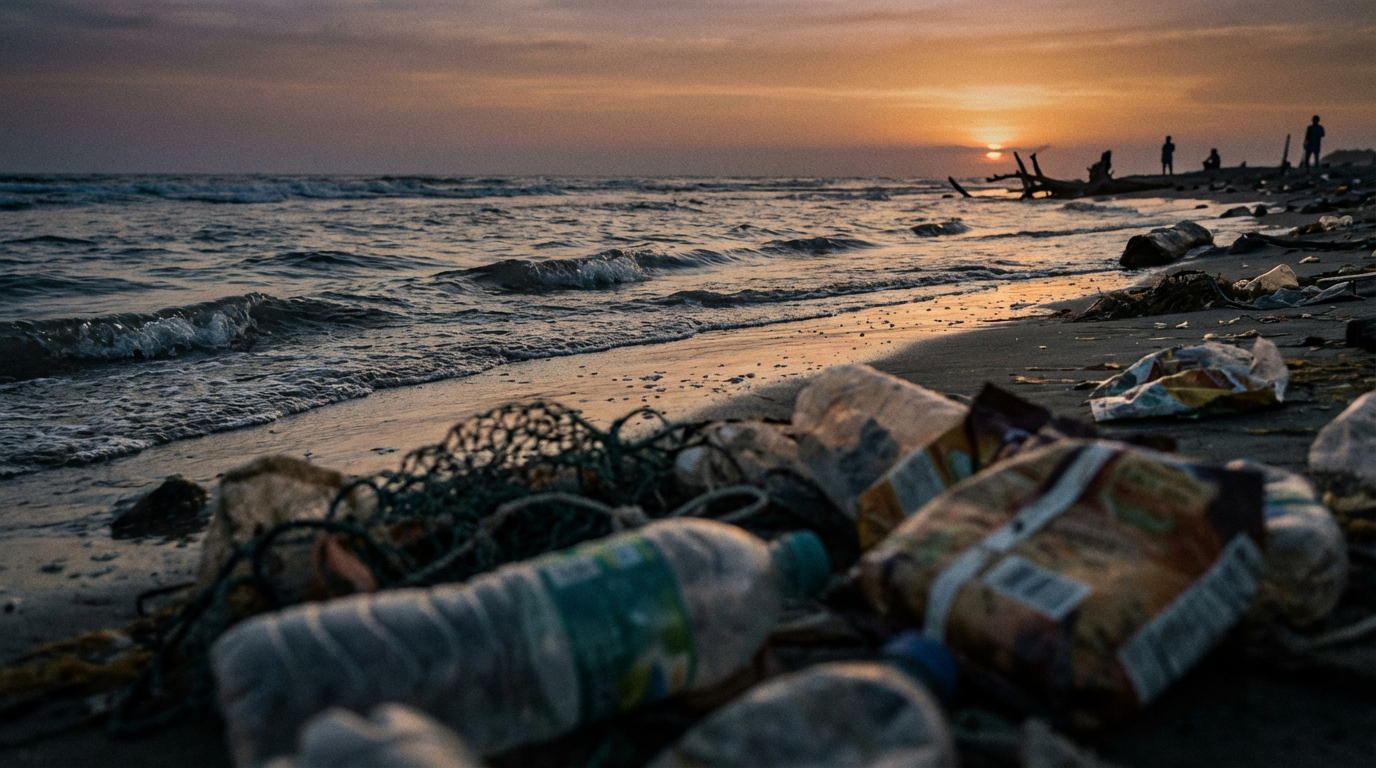
So yes, plastic is everywhere. Which brings us to the first big fork in the material tree.
Thermoplastics vs Thermosets: The First Power Split
When engineers talk plastic, the first question is not “PVC or ABS?” but “thermoplastic or thermoset?” This is the core classification that everything else branches from.
Thermoplastics are polymers that soften and eventually melt when heated, then harden again when cooled. Wikipedia and multiple industrial sources agree that you can repeat this melt–cool cycle many times without fundamentally changing the chemical structure. Think of it like butter in a pan: solid in the fridge, liquid on heat, solid again when it cools.
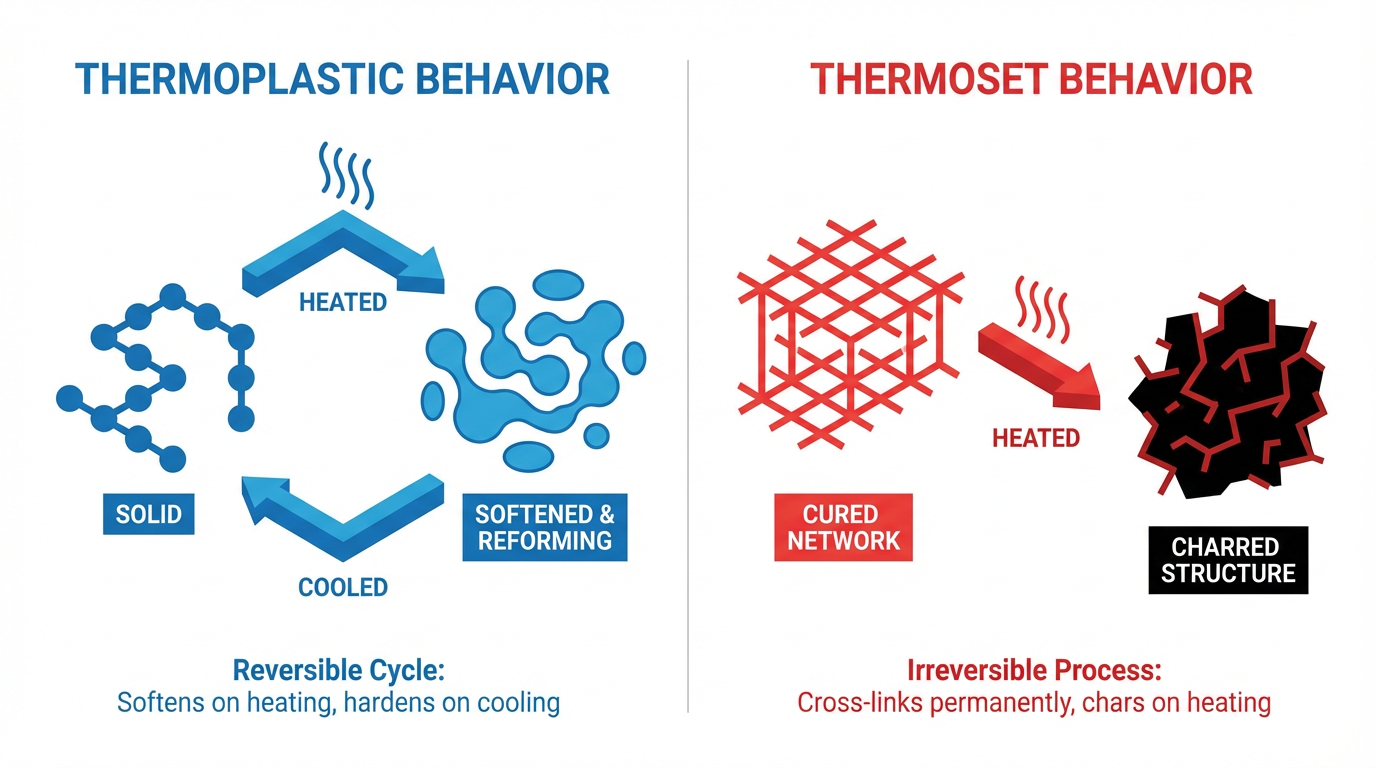
Precious Plastic notes that roughly eighty percent of plastics in circulation fall into this thermoplastic category.
Thermosets are different. As guides from Get‑It‑Made, Cadence, Polymershapes, Xometry, and others explain, thermoset resins start as low‑viscosity liquids. When heated or cured with chemicals, they form three‑dimensional cross‑linked networks. Once that network forms, it is permanent. Heat it again and it will not melt; it will char and eventually burn. The bread metaphor from the Precious Plastic Toolbox fits nicely: once you bake bread, you cannot melt it back into dough.
For an anime collector, almost everything you touch—PVC, ABS, polystyrene model kits, PET packaging—is thermoplastic. Thermosets are more likely hiding in places like epoxy potting on a PCB inside your light‑up base, silicone insulation around wires, or high‑temperature structural components in cars and aircraft.
Here is how the two classes compare at a glance, based on data assembled from Wikipedia, Fictiv, Get‑It‑Made, Osborne Industries, and other technical guides:
Aspect | Thermoplastics | Thermosets |
|---|
Heat behavior | Soften and melt when heated; can be reshaped repeatedly | Do not melt once cured; will char or burn when overheated |
Molecular structure | Mainly linear or branched chains | Densely cross‑linked network |
Recyclability | Often recyclable; scrap can sometimes be remelted | Not recyclable by remelting; usually landfilled or ground as filler |
Typical uses | Packaging, toys, bottles, consumer goods, figure bodies, most model kits | High‑temperature housings, electronic encapsulation, structural composites, some adhesives and foams |
Strength vs temperature | Good impact resistance; can creep or soften at higher temperatures | Excellent dimensional stability and creep resistance at high temperatures |
Industrial sources point out that some thermosets such as polyimide can keep working above about 500°F, and certain imidized plastics like polybenzimidazole and polyamide‑imide can tolerate similar extremes. Thermoplastics usually tap out at lower service temperatures, but they win on recyclability and processing flexibility.
As a rule of thumb, if your part needs extreme heat or long‑term structural stability, thermoset might be your hero. If it needs to be mass‑produced, reprocessed, or recycled, thermoplastic usually gets the role.
The Big Commodity Families: The Seven “Main Characters” Of Everyday Plastic
In practice, a huge share of everyday plastic use collapses into a handful of commodity families. Wikipedia notes that about eighty percent of global plastic production is low‑cost commodity plastics, especially polyethylene, polypropylene, PVC, polystyrene, PET, and related materials. Many consumer items even carry a little recycling triangle with a number that maps to these families.
Understand these and you have a working map for a big slice of the “108 types.”
PET: The Bottle And Fiber Workhorse
Polyethylene terephthalate, usually called PET, is the clear, tough plastic behind most disposable beverage bottles. DirectIndustry describes it as strong, thermally stable, transparent, and widely used in bottles, food containers, and synthetic fibers. The Precious Plastic guide notes that it is lightweight, impact‑resistant, and used in films, electrical fittings, ropes, and carpets as well.
PET has genuinely good performance for packaging: it forms a decent barrier to water and oxygen, has good electrical properties, and, according to industrial sources, is one of the more recyclable plastics. Recycled PET is commonly turned into textile fibers and industrial strapping. That is why you see claims about bottles becoming fleece or T‑shirts.
On the downside, Precious Plastic flags PET as somewhat tricky for small‑scale processing, with issues like high mold shrinkage, heat degradation, and harmful fumes if handled incorrectly. Some research also suggests that components may leach into contents during long‑term use, which is why many collectors prefer not to store drinking water in old PET soda bottles for months on end.
For figure fans, PET shows up more in the ecosystem around your collection: bottle labels, blister windows, strap packaging, and sometimes in flexible display materials, not usually in the figures themselves.

The Polyethylenes: HDPE And LDPE
Polyethylene, abbreviated PE, is the world’s most produced plastic. It comes in several densities, with high‑density polyethylene (HDPE) and low‑density polyethylene (LDPE) being the main commodity versions.
DirectIndustry calls polyethylene the most widely produced plastic, noting HDPE as rigid, impact‑resistant, and broadly recyclable, with typical uses such as milk jugs, detergent bottles, and piping. LDPE is flexible, transparent, and moisture‑resistant, used for bags, films, and some containers. Precious Plastic adds that HDPE is tough, chemically inert, and a great “starter” material for small recycling machines; LDPE is more flexible and often used in wraps and grocery bags.
Plastics For Change describes HDPE as a strong, thick, impact‑resistant plastic used in grocery bags, milk jugs, recycling bins, pipes, playground equipment, and shampoo bottles, and notes that it can withstand temperatures up to about 248°F. They emphasize that HDPE is among the easier plastics to recycle and is accepted at many recycling centers. LDPE, by contrast, is cheap and flexible but often not accepted in curbside recycling, so a lot of it ends up as waste despite its ubiquity in bags and wraps.
From a collector’s perspective, HDPE and LDPE are in bottle caps, detergent bottles you might repurpose as paint water containers, and bags that protect boxes during shipping. They rarely show up in high‑detail figures because they are hard to paint crisply and do not hold sharp sculpted detail as well as PVC or ABS.
PP: The Hinge Hero And Food‑Contact Staple
Polypropylene (PP) is another titan. DirectIndustry describes it as versatile, fatigue‑resistant, and chemically resistant, with good tolerance for relatively high temperatures and a balance of toughness and flexibility. Plastics For Change notes that it is the second‑most widely produced commodity plastic and highlights its ability to survive repeated bending, which is why PP is famous for “living hinges” in things like flip‑top caps.
PlasticsToday and Polymershapes both point to PP as a go‑to for containers and vessels because it resists oils and many solvents and is often safe for food contact. Everyday examples include food tubs, syrup bottles, and household storage boxes.
The Precious Plastic Toolbox describes PP as stronger and stiffer than polyethylene, with higher temperature resistance but some weaknesses such as brittleness below freezing, poor UV resistance, and a tendency to keep burning once ignited.
For fandom gear, PP pops up in food containers with character art, some types of caps and lids, and occasionally as structural parts for organizers or display accessories. Its fatigue resistance makes it attractive whenever a lid or joint needs to flex thousands of times without breaking.
PVC: Extremely Useful, Surprisingly Problematic
Polyvinyl chloride (PVC) is the plot‑twist character. On paper, it looks amazing. DirectIndustry describes it as a durable, low‑cost plastic available in rigid form for pipes and window frames and flexible form for plumbing, cable insulation, clothing, and some medical uses. The Precious Plastic Toolbox lists pros like low cost, chemical resistance, flame retardancy, stiffness, and strength.
Plastics For Change notes that PVC is one of the world’s most widely produced synthetic plastics and that its lightness, durability, and processability let it replace wood, metal, concrete, rubber, and ceramics in many building applications. Rigid PVC is common in water and wastewater pipes; flexible PVC shows up in flooring, wiring, and hoses.
The dark side is that PVC can be nasty when it comes to additives and end‑of‑life. Precious Plastic flatly calls it “toxic” for small‑scale recycling and refuses to work with it because overheating can release hydrogen chloride and dioxins. Gaylord’s archival storage guide warns strongly against PVC pages for photos: plasticizers used to make PVC flexible can migrate out, releasing gases, making pages feel oily, and causing yellowing and breakdown over a relatively short time, while also endangering the stored documents.
Recycling is also a problem. Plastics For Change describes PVC as hard to recycle despite industry efforts and recommends avoiding it when possible.
Anime figures complicate this picture. Many PVC scale figures and prize figures are technically made from forms of flexible PVC, often with other plastics like ABS used for structural parts. Those parts are safe in normal use, but the underlying material reminds us not to burn or casually home‑recycle damaged figures and to be cautious about prolonged contact between PVC and archival prints or documents.
PS: Styrofoam, Shiny Casings, And Coffee Cups
Polystyrene (PS) is another chameleon. DirectIndustry calls general‑purpose PS hard but brittle and highlights uses such as disposable cutlery and CD cases. High‑impact PS adds rubber for tougher items like appliance housings and toys. Expanded PS, better known as Styrofoam, appears in foam cups, protective packaging, and building insulation.
The Precious Plastic Toolbox treats PS as clear, glossy, hard, and stiff, with pros such as low mold shrinkage and good insulation, but cons like brittleness and poor wear and chemical resistance. They rate its safety as “medium” and warn that burning PS can release toxic styrene. Plastics For Change describes PS as highly flammable, leaching harmful chemicals when heated—for example in microwaved take‑out containers—and notes that its foam form is light and easily wind‑blown, making it prone to polluting the environment. They also point out that PS foam is typically not accepted in curbside recycling and is rarely recycled even where technically accepted.
In the anime ecosystem, PS is a staple for model kits and some structural shells. That glossy, glass‑like finish you sometimes see on clear parts can be PS or PMMA. It machines and polishes beautifully, but you do not want to be burning PS sprue over a candle to bend parts; ventilation and safer heat tools are a must.
Type 7 “Other”: ABS, Polycarbonate, Acrylic, Nylon, Tritan, And Friends
The “7” in the recycling triangle is a catch‑all for plastics that do not fit types 1 through 6. Plastics For Change points out that this bucket includes polycarbonates and other specialty resins that are often hard to recycle and sometimes release chemicals like bisphenol A (BPA) when exposed to high temperatures. The Precious Plastic Toolbox adds that ABS, PLA, nylon, polycarbonate, and acrylic often land here and that properties vary widely.
Even though these are grouped as “other” on recycling labels, many are absolutely main characters in engineering and collectibles.
DirectIndustry highlights ABS (acrylonitrile butadiene styrene) as an impact‑resistant engineering plastic used in automotive components, toys such as LEGO bricks, and electronic housings. BBC Bitesize describes ABS as lightweight, rigid, tough, and resistant to impact, chemicals, heat, and abrasion, with good low‑temperature performance and polished finishes. That pretty much describes why so many higher‑end figure bases and joints use ABS: it resists snapping and holds shape under stress.
Polycarbonate (PC) gets described by DirectIndustry as transparent, high‑impact, and temperature‑resistant, used in eyewear lenses, bullet‑resistant glazing, CDs, electronic components, medical devices, and automotive parts. PlasticsToday adds that PC is a stronger, more durable clear plastic than acrylic and can be bent and formed at room temperature without shattering, though it is more expensive and raises food‑safety concerns at high water temperatures because of chemical leaching. That combination of toughness and clarity is exactly what you want in things like clear mecha parts, protective shields, and display windows.
Polymethyl methacrylate (PMMA), also called acrylic or Plexiglas, is another big one. DirectIndustry portrays it as a transparent, lightweight, shatter‑resistant glass alternative used in skylights, signs, displays, lenses, and taillights, especially where clarity and weatherability matter. For collectors, acrylic shows up in risers, display cases, and some custom bases. Compared with polycarbonate, it is more scratch‑resistant and polishes easily but is less impact‑resistant.
Nylon, or polyamide, is valued for high tensile strength, elasticity, abrasion resistance, and chemical resistance, as described by DirectIndustry and PlasticsToday. It appears in textiles, fishing lines, gears, and machine parts. In hobby life that means everything from nylon gear trains inside servo motors to strong, wear‑resistant bearings and bushings in articulated stands.
Tritan copolyester, developed by Eastman and mentioned in DirectIndustry’s guide, offers glass‑like clarity, high impact resistance, high‑temperature tolerance, and dishwasher safety. It is marketed as free from BPA and other bisphenols and appears in reusable bottles, food containers, and baby products. For fandom purposes, it is the kind of resin you might encounter in “premium” clear drinkware or containers in merch lines that call out “BPA‑free” and “dishwasher‑safe.”
All of these Type 7 materials highlight why the “108 types” framing is not just a joke. Once you include all the proprietary blends, copolymers, fiber‑reinforced variations, and flame‑retardant formulations, the family tree gets dense very quickly.
Engineering And High‑Performance Plastics: When Stat Blocks Really Matter
Commodity plastics cover most bottles and bags, but when engineers need to replace metal or glass in demanding environments, they reach for engineering and high‑performance plastics.
Wikipedia notes that in modern cars plastics make up about half the vehicle’s volume but only around 12 to 17 percent of its weight. That kind of lightweighting can improve fuel efficiency by roughly 6 to 8 percent. Achieving that means swapping metal for plastics like ABS, high‑impact polystyrene, polycarbonate, nylon, PBT, and more. Polymershapes highlights how materials like PEEK, ULTEM (polyetherimide), UHMW polyethylene, and glass‑filled plastics enable structural parts, while acetal (POM) and nylon take on weight‑bearing and wear roles.
High‑performance polymers push further. Wikipedia lists families such as aramids, ultra‑high‑molecular‑weight polyethylene (UHMWPE), PEEK, polyimides, PTFE, PPS, PES, PVDF, liquid‑crystal polymers, and PBI. These materials hold up at temperatures above roughly 300°F, often significantly higher, and offer exceptional chemical and dimensional stability. They end up in body armor, jet engines, aerospace components, medical implants, semiconductor tools, fiber‑optic components, and high‑reliability electrical systems.
Guides from Cadence and Fictiv emphasize that thermoset epoxies remain a standard in integrated‑circuit packaging and over‑molding for electronics because they combine strong adhesion, excellent thermal management, and chemical resistance. At the same time, thermoplastic polyamides serve in low‑pressure encapsulation of PCB assemblies for industries like automotive and medical, trading away some extreme robustness for easier processing and reworkability.
In collector land you rarely see labels like PEEK or PBI on packaging, but you do live with their downstream effects. Lighter, stronger, heat‑resistant plastics in vehicles, devices, and infrastructure mean products that are safer and more efficient to manufacture and ship. And if you are building custom display rigs with CNC‑machined plastics or ordering specialty sheets, you are already stepping into this engineering‑grade tier.
How To Choose The Right Plastic For A Project (Or Your Collection)
Industrial guides from Polymershapes, Silicone Plastics, PlasticsToday, Plastics Engineering, and others all hammer the same basic point: material selection is a structured process, not a vibe check. The right plastic is the one whose mechanical, thermal, chemical, optical, and regulatory profile fits the actual job.
Engineers start by defining what the part must do. Is it a structural component bearing weight, a clear window, a flexible gasket, or a container for hot liquids? Polymershapes breaks this down into roles such as structural parts, weight‑bearing and wear parts, clear optical pieces, and containers. Each of those suggests different candidate families: PEEK or glass‑filled plastics for structural parts, acetal or nylon for wear, acrylic or polycarbonate for clear windows, PP or HDPE for containers.
Then come the environments. What temperatures will the part see, both normal and extreme? Polymershapes stresses that plastics have maximum and minimum service temperatures; push too close to those and you risk warping, creep, or outright failure. Are there chemicals involved, such as cleaners, oils, fuels, or solvents? Materials like PVC, PEEK, and PTFE shine in aggressive chemical environments but might be overkill for simple packaging.
Time matters too. Plastic behaves differently under quick impacts than under long‑term loads. Fictiv and Plastics Engineering highlight concepts like creep—the slow, permanent deformation under steady stress—and fatigue. A nylon gear might be great for intermittent movement but need careful design if it is under constant torque for years at elevated temperature.
For anything electrical, dielectric behavior, heat resistance, and moisture absorption come into play. ABS, PVC, and some thermoset resins are common in electrical housings and components, as noted by industry sources.
Aesthetics and tactile feel have their own lane. PlasticsToday points out that materials like ABS, polystyrene, and acrylic can be polished to glossy finishes or textured for grip. Thermoplastic rubber (TPR) and thermoplastic polyurethane (TPU) add soft‑touch surfaces for handles and grips, with TPU offering excellent abrasion resistance and low‑temperature performance.
Finally, there are constraints: cost, manufacturability, and regulations. Food and beverage containers must meet FDA, USDA, or related standards. Medical devices look at FDA, USP, and ISO biocompatibility. Some applications demand BPA‑free or specific flame‑retardant ratings. Engineering sources recommend starting with a broad but well‑documented set of candidate materials, then narrowing based on real service conditions and multipoint data such as stress–strain curves over temperature, creep behavior, and fatigue.
For a collector or hobbyist, you can borrow this mindset in smaller ways.
If you are choosing a display case, an acrylic box is a good default: light, clear, shatter‑resistant, and, according to BBC Bitesize, weather‑ and UV‑resistant enough for signage and aquariums. Polycarbonate is better if you expect impacts, but it is more expensive and can raise more complicated health questions for food contact at high temperatures.
If you are sleeving prints, photos, or signed shikishi boards that come with your Blu‑rays or collector’s editions, Gaylord’s archival guidance is gold: look for archival polyester (PET), polypropylene, or polyethylene that is marketed as inert and stable. They explicitly warn against PVC pages because plasticizers can migrate out, damage artwork, and cause oily, yellowed pages. For thick or fragile items, higher‑thickness films measured in mils (thousandths of an inch) offer more support. A four‑mil sleeve is about 0.004 in thick and sturdier than a two‑mil one.
If you are scratch‑building props or diorama parts, plastics like ABS and polystyrene from hobby suppliers are popular because they glue, sand, and paint well. PlasticsToday notes that ABS has high impact resistance and good surface finish, while high‑impact polystyrene is versatile and economical for tough cases, albeit with environmental downsides.
The more you align material choice with what the part actually has to survive—weight, heat, sunlight, chemicals, handling—the less likely you are to end up with warped bases, yellowed sleeves, or cracked joints.
Recycling, Microplastics, And Responsible Fandom
Any honest “comprehensive” guide to plastics has to talk about waste. Wikipedia’s synthesis of the research is blunt: most plastic ever made is still around, and only a small fraction has been recycled. A significant share has gone to landfills or leaked into the environment. Estimates suggest that on the order of 18 to 26 billion lb of plastic, mostly mismanaged packaging waste, flows into oceans every year, contributing to garbage patches and widespread microplastics.
The Precious Plastic Toolbox emphasizes how unsmart it is to keep producing hundreds of billions of pounds of virgin plastic annually while reusing less than a tenth of what exists. Plastic Collective adds nuance around terms that often get used loosely. Bioplastics are plastics made from renewable sources like corn starch or algae; that says nothing about whether they are biodegradable. Biodegradable plastics are designed to break down more quickly than conventional plastics but can still be made from fossil fuels and may still generate microplastics, just faster. Compostable plastics need specific conditions to turn into actual compost. Microplastics are fragments smaller than about 5 mm that typically come from the breakdown of larger items and are now found throughout marine and terrestrial ecosystems.
BPA, called out by Plastic Collective as a component of many polycarbonates and epoxy resins, has been identified as a risk factor for certain cancers, leading to bans in some applications and a whole wave of “BPA‑free” marketing. That label usually means the product uses alternative polymers like Tritan or different additive packages, but it does not mean the item is plastic‑free or impact‑free.
From a fandom standpoint, you cannot personally fix global plastic policy, but you can make choices.
Focusing your buying on higher‑quality items that you will keep for years rather than disposable trinkets reduces the turnover. Choosing goods made from easier‑to‑recycle plastics like PET and HDPE, and actually getting them into the recycling stream where facilities exist, helps. Avoiding unnecessary PVC—especially cheap PVC packaging and sleeves that will degrade quickly—lines up both with archival best practice and with recommendations from sources like Precious Plastic and Gaylord.
If you tinker with recycling at home, the Precious Plastic materials are clear: stick to well‑understood thermoplastics like HDPE and PP, avoid PVC and mixed‑resin items, and respect fumes and temperatures. When in doubt, do not melt unknown plastics.
None of this means you have to give up figures, artbooks, or model kits. It just nudges you toward treating plastic less like infinite magic and more like a powerful but finite resource.
FAQ: Plastics Through A Collector’s Lens
Is PVC always bad, especially for figures?
The industrial and archival guides agree on this: PVC becomes a problem when you heat it or when plasticizers leach out. Gaylord’s research on photo storage shows that flexible PVC pages can release plasticizers, give off gases, feel oily, and yellow, damaging what they hold. The Precious Plastic Toolbox and multiple engineering sources warn that heating or burning PVC can release corrosive hydrogen chloride and toxic byproducts.
For PVC figures and merch, normal display use is not the same as burning or home‑recycling. The practical takeaway is to keep PVC items away from high heat, open flames, and archival paper materials, and not to treat damaged PVC as safe DIY fuel or melt stock. When you can, choose non‑PVC options for sleeves and storage.
Are bioplastics and “compostable” plastics automatically eco‑friendly?
Plastic Collective makes a key distinction. Bioplastics are about what the plastic is made from—renewable versus fossil feedstock. Biodegradable and compostable describe what happens at end‑of‑life, under specific conditions. A bioplastic can still behave like conventional plastic in the environment, and a compostable plastic might require industrial composting conditions rather than a backyard bin.
From a user point of view, labels like “biodegradable” and “compostable” are only meaningful if your local waste system can actually process them. When they end up in landfills or the ocean, they can still generate microplastics.
What does “BPA‑free” really tell me?
According to Plastic Collective, BPA is commonly used in epoxy resins and polycarbonate plastics and has been linked to health risks, spurring regulations and “BPA‑free” marketing. A BPA‑free bottle or container usually means it uses a different plastic, such as Tritan copolyester, or different additives. It does not guarantee that all potential migration issues vanish; it just removes one well‑known chemical from the roster.
For everyday use, especially with hot liquids, treating plastic drinkware as consumable over time and rotating it out, rather than relying on the same piece forever, aligns with the cautious stance many material scientists and regulators take.
When you first get into this, plastics science can feel more complex than the lore chart for a long‑running shonen series. But once you internalize the big splits—thermoplastic versus thermoset, commodity versus engineering, the main resin families—the “108 types” fall into place as variations on themes rather than an impossible monster manual.
The next time you unbox a new PVC scale, pick up an acrylic riser, or choose sleeves for signed prints, you will know what those materials are actually doing for you, where their weaknesses are, and how to treat them kindly. That is how you keep your collection looking crisp, your conscience a little lighter, and your inner materials nerd just as satisfied as your inner fan.
References
- https://en.wikipedia.org/wiki/Plastic
- https://plasticseurope.org/plastics-explained/
- https://www.plasticsforchange.org/blog/different-types-of-plastic
- https://www.plasticsengineering.org/2024/01/steps-into-plastic-material-selection-003106/
- https://resources.pcb.cadence.com/blog/2023-thermoplastic-vs-thermoset-plastics
- https://get-it-made.co.uk/resources/thermoset-vs-thermoplastic-whats-the-difference
- https://www.fictiv.com/articles/thermoplastic-vs-thermoset-plastic-mechanical-properties-overview
- https://info.gaylord.com/resources/choose-the-right-plastic
- https://npfasteners.com/inserts/technical.htm
- https://www.plasticcollective.co/types-of-plastic-guide-to-different-plastic-types/