Intelligent Control Systems for Anime Collecting Cabinets
Intelligently controlled cabinets can turn a cluttered figure shelf into a secure, glowing gallery you can command with a tap, a voice cue, or fully automated scenes.
You know that moment when you tiptoe into the room at night, fumble for the light, and send a scale figure’s weapon clattering to the floor? Or when your “temporary” overflow shelf has quietly become a leaning tower of Nendos and prize figures? Many homeowners are already using tech-enhanced cabinets to gain more usable storage, cleaner lines, and easier daily routines, and the same ideas translate beautifully to display setups. This guide walks through how to borrow proven smart cabinet tech and build intelligent control systems that make your collection safer, easier to manage, and a lot more magical to look at.
Why Smart Control Belongs in Anime Collecting Cabinets
In other spaces, a smart cabinet is defined as storage that layers sensors, connectivity, and automatic control over traditional doors and shelves so items are easier to protect, track, and access, as described in modern smart cabinet systems. That same thinking fits figure collecting almost perfectly: you are managing a growing number of delicate, high-value items that need consistent lighting, controlled access, and a way to stay organized as the lineup evolves.
Kitchen designers already treat cabinetry as a tech platform, not just wood boxes, blending pull-outs, smart lighting, and device charging to make everyday cooking smoother, as shown in connected cabinet design. For collectors, “everyday cooking” becomes daily enjoyment and dusting, swapping lineups for seasonal displays, and keeping kids or guests away from fragile or limited-edition pieces without turning the room into a locked vault.
Innovative control systems let you choreograph the whole cabinet: lighting that comes up in scenes, doors that open when your hands are full of your latest haul, hidden charging for turntables and tablets, and locks that respond only to you and the people you trust. Smart kitchen cabinet trends suggest these features can deliver up to 22% more functional storage and far cleaner sightlines than static boxes, according to 2025 smart cabinet techniques, so you are not just adding a “cool factor” but real performance.
Core Intelligent Systems for Figure Cabinets
Smart Lighting That Flatters Your Figures
Smart lighting is usually the easiest and most impactful first upgrade, and it is the starting point in many tech-forward cabinet projects built around LED strips, motion sensors, and programmable scenes, as highlighted in modern smart kitchen cabinet trends. Inside a display cabinet, that translates into crisp, even light that makes paint gradients pop without blinding glare off acrylic stands or glass shelves.
LED systems designed for cabinets can change brightness and color temperature through apps or voice control, similar to the adjustable systems described in smart storage innovations. Cool, bright light works when you are photographing a new resin piece; warmer tones give evening “chill” scenes where your idols look like they are on stage instead of under a harsh lamp. Motion-triggered strips inside doors mean the cabinet quietly wakes up as you walk in, while toe-kick or floor-level lighting creates an anime-opening-style glow under the whole wall of cases.
Designers often tie these lights into themes like “Night,” “Cleanup,” or “Bake,” using smart scenes and hidden wiring across the room, as described in smart home cabinetry ideas. Translating that to a collector room, you can create presets such as “Photo Mode” with brighter, neutral lighting, “Streamer Background” with accent colors behind specific lines, or “Sleep” where only a few gentle strips stay on as an ambient nightlight.
Touchless Doors and Smart Locks for Safety
For anyone who has tried to open a tall glass cabinet while holding a new 1/4 scale figure with both hands, touchless access is more than a gimmick. Tech-integrated cabinets routinely use power-actuated doors and drawers that open with a wave or a light tap, especially for upper storage, as explained in technology-integrated cabinet design. Servo-driven lifts and motion sensors are already common in premium kitchens; they simply need different door fronts and safety priorities when you repurpose them for display cases.
Smart cabinets also lean on biometric and app-based locks to protect hazardous items and valuables while keeping the exterior clean and minimal, like the discreet locks described in hidden smart cabinet features. For collectors, that is ideal for shelves containing very limited resin statues, fragile garage kits, or anything you do not want children or guests to handle. Instead of slapping a chunky padlock on the front, you can hide fingerprint or keypad hardware in the side panel and still use voice commands or scheduled automations to lock everything when you leave the house.
Touchless and low-touch hardware also improve hygiene and wear.
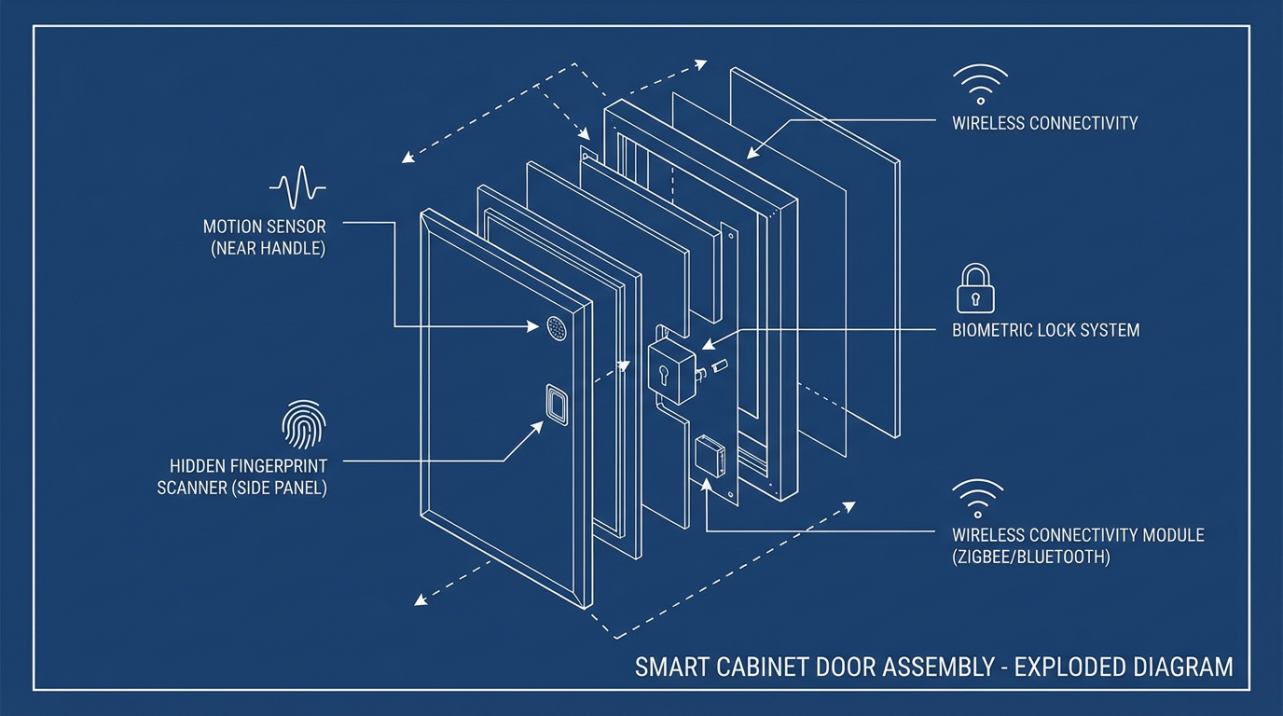
Kitchens use motion and voice to cut down on messy handle touches, as explored in smart LED cabinet lighting. In a figure room, that means fewer fingerprints on glass and less wear on hinges from constant opening just to admire one pose. It also makes the cabinets more accessible for collectors with mobility or grip challenges, who might otherwise struggle with tall or heavy doors.
Hidden Power and Charging for Turntables and Tablets
Many smart cabinets now treat power and charging as part of the furniture, tucking USB ports, outlets, and wireless charging pads into drawers and shelves, as documented in tech-integrated cabinet design. Collectors can take the same approach by running power rails along the back of cabinets and hiding them behind removable panels so rotating bases, RGB plinths, and display tablets get clean wiring without visible cord spaghetti.
Kitchen-focused designs often hide charging drawers and “appliance garages” with integrated power strips so counters stay clear, as described in smart home cabinetry ideas. A display-room version might be a shallow drawer under the cabinets that holds spare LED controllers, extra figure bases, Bluetooth remotes, and a charging station for your cell phone and handheld console, while the hardware itself remains invisible when the drawer is closed. Concealed charging also keeps electronics away from dust and the occasional drink spill that can sneak into a display area.
Inventory and Scene Management for Big Collections
In the smart kitchen world, cabinets increasingly use sensors, cameras, weight pads, and NFC labels to track what items are inside and send alerts when you are running low, as seen in inventory-aware smart kitchen cabinet design. Some smart cabinet platforms also sync to cloud dashboards to log usage and patterns over time, similar to connected smart cabinet deployments in logistics and public spaces.
For a large figure collection, you can repurpose these same ideas. Shelves or drawers with NFC tags and simple sensors can sync to a collection database so you always know what is in each cabinet without opening every door. Scene-based lighting and door controls can then respond to that data: a “Mecha Wall” button could light only the shelves tagged with your mechs and open the right cabinets for easy rearranging, while a “Grail Lockdown” scene could lock specific sections and dim their lighting when you are away.
A simple way to think about the jump from manual to intelligent cabinets is in terms of what you control and how quickly you can reset your space.
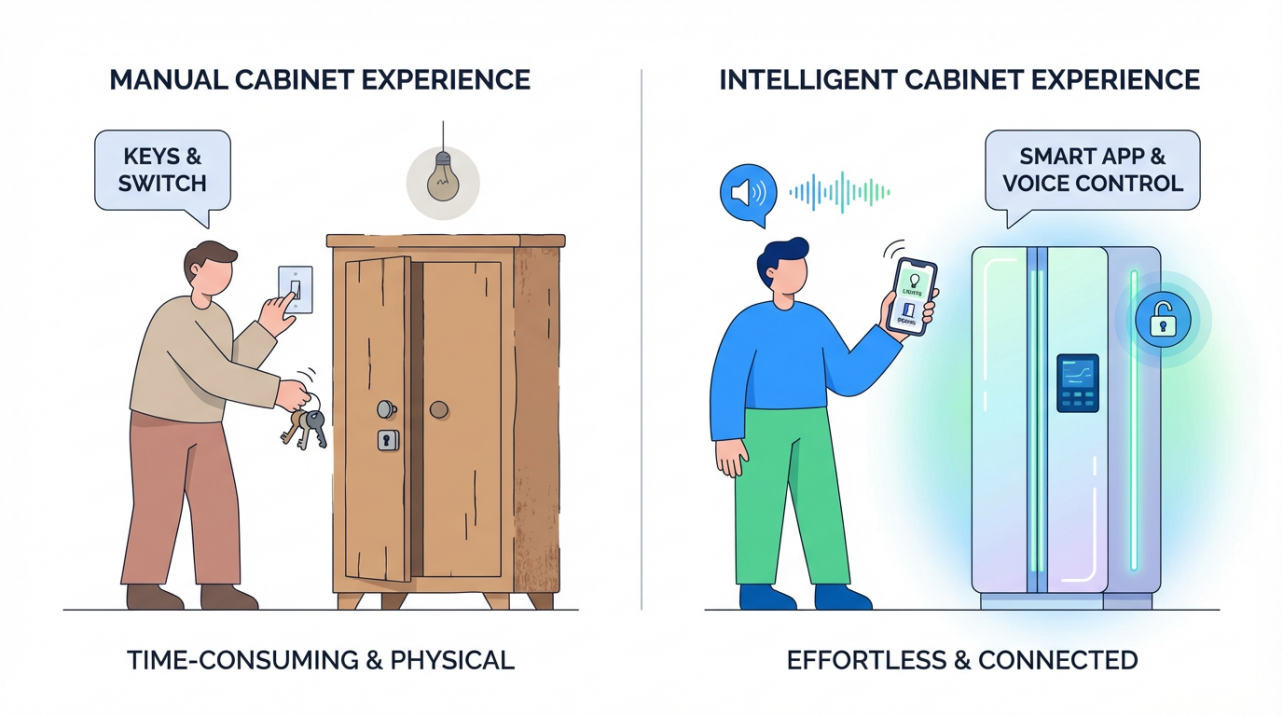
Capability | Manual cabinet experience | Intelligent cabinet experience |
|---|
Lighting | Flip individual switches, uneven brightness | One-tap or voice scenes that change brightness and color across all cabinets |
Door access | Mechanical keys or magnets | Touchless open, scheduled auto-lock, biometric or app-based control |
Power and charging | Visible cords and power strips on shelves | Hidden rails, charging drawers, wireless pads integrated into the cabinetry |
Inventory and scenes | Spreadsheets or memory, manual reconfiguration | Sensors, tags, and automations tied to lighting and access for specific groups |
The Brain: Hubs and Control Panels
Choosing a Hub for Your Cabinet Lineup
Smart kitchens often start by choosing a central hub or control panel that ties lighting, appliances, and sensors into one interface, using platforms such as Home Assistant, Apple Home, or major voice assistants, as outlined in smart kitchen integration. That same architecture works for a figure room: treat your cabinets like a connected ecosystem, not a pile of one-off gadgets.
A well-placed wall tablet or small screen on a shelf can act as your command console, much like the dedicated smart displays recommended for kitchen control centers in smart home design. You can dock a tablet in a subtle frame near the door, keep it always charging from a hidden cable path, and use it to trigger cabinet scenes, check sensor status, or review a quick map of what is stored where. Strong, reliable Wi-Fi in the room remains crucial, because scene changes lose their magic if half the lights fail to respond.
When a Custom Control Panel Makes Sense
In industrial and commercial spaces, custom control panels bundle multiple functions—motion control, temperature monitoring, process recipes, and data logging—into a single engineered box so systems run safely and predictably. Research on such panels shows they significantly improve uptime, reduce errors, and often pay for themselves in about a year through energy and operational savings, especially when they are designed for a specific environment. Translating that mindset to collecting cabinets is overkill for a small bedroom but surprisingly relevant for a dedicated display room, store, or gallery-style basement.
If you are running dozens of cabinets, multiple power-hungry lighting zones, motorized doors, and possibly climate control for higher-value pieces, a small custom control enclosure can centralize breakers, transformers, and automation hardware behind a clean front. Instead of scattering power supplies and hubs in random cabinets, everything lives in one service bay with labeled switches, surge protection, and easy upgrades. That reduces the risk of overloaded outlets and makes future expansion—adding a new cabinet, swapping in higher-end LED drivers, or updating the automation hardware—much less chaotic.
Designing or Retrofitting: Practical Steps for Collectors
In kitchen projects, designers often start by mapping habits, layouts, and electrical infrastructure before choosing technology, as emphasized in tech-forward cabinet design. Collectors should follow the same order instead of starting with the flashiest gadgets. Begin by sketching your room: where you naturally stand to admire displays, where you sit to build model kits, and where door swings or windows might cause glare. That layout will guide which cabinets need touchless access, which need stronger lighting, and which should stay darker to protect more fragile pieces.
Many cabinet manufacturers now promote modular systems and smart storage elements—pull-out units, hidden compartments, and multi-functional designs—to squeeze more utility from the same footprint, as shown in smart storage innovations. For collectors, that might mean designing deeper lower cabinets with pull-out trays for accessories and boxes, while upper glass-front cabinets stay shallower and lighter for the figures themselves. Integrating smart drawer lighting, hidden charging, and lockable sections into those lower units lets you keep backstage items organized without sacrificing wall space for the actual display.
Retrofitting existing cabinets is often cheaper and less disruptive than starting from scratch, especially in finished rooms. Smart home designers recommend starting with wireless lighting, plugs, and voice assistants, then upgrading appliances later as budgets allow, a gradual approach echoed in kitchen-focused smart LED cabinet lighting. You can mirror that path by adding smart strips, door sensors, and a shared hub to your current glass cabinets before investing in a fully custom wall unit.
If you are planning a full renovation or a new room, you have more freedom to hardwire LED channels, run dedicated power circuits, and build in tablet mounts and hidden service bays, as in the more cohesive tech-first projects highlighted in smart home cabinetry ideas. In that case, it is worth coordinating with a cabinet shop or fabricator who uses precise CNC machining, since modern precision CNC cabinetry techniques make it easier to integrate tracks for lighting, ventilation slots, lock cutouts, and access panels with tight tolerances and repeatable quality.
Pros and Cons for Figure Collectors
Benefits You Actually Feel
When cabinet makers talk about smart designs adding up to 22% more usable storage in the same footprint, as reported in 2025 smart kitchen cabinet trends, that is not just about pantries. Pull-out units, lift-up doors, and deep smart drawers reclaim space in corners and tight gaps, and those principles work just as well for figure storage. A cabinet wall that once held three fixed glass cases can, with smarter hardware and layout, hold more tiers, better access, and concealed storage without looking busier.
Aesthetic upgrades are equally tangible. Designers highlight the way layered cabinet lighting—under-cabinet strips, interior accent lighting, and toe-kick glow—can transform a kitchen from purely functional to warm and gallery-like, as shown in smart storage innovations. In a collector room, that same layered approach means your favorite lines can take the spotlight while background pieces still look intentional, and your space reads more like a curated exhibit than a random shelf wall.
On the safety and usability side, integrated locks and touchless doors give you more control over who can touch what without turning the room into a maze of keys. Smart cabinet designs for kitchens and baths already use app-controlled locks and touchless access to protect children and guests from cleaning supplies and medicines, as seen in technology-integrated cabinet design. Reusing that hardware for figures lets you protect pricey or fragile characters with the same level of nuance: some sections open freely, others demand a fingerprint.
Intelligent control systems can also support property value and long-term flexibility. Homebuyers increasingly see smart cabinets and integrated tech as a premium feature, and combining them with durable materials and energy-efficient lighting is promoted as a long-term lifestyle upgrade in connected cabinet design. If your display wall is built-in rather than freestanding, these systems can make the room more attractive even to a future owner who is not an anime fan, while still delivering everyday convenience now.
Trade-Offs to Be Honest About
Smart cabinet systems do come with higher upfront costs and more planning. Articles on tech-heavy cabinets emphasize the need for better cabinet boxes, reliable hardware, and professional electrical work when you start hiding power strips, lifts, and controllers inside cabinetry, as described in smart home cabinetry ideas. For a collecting room, that means budgeting not just for the cabinets and figures but also for transformers, hubs, and possibly an electrician to ensure everything is safe and code-compliant.
Complexity and maintenance are the other big trade-offs. Smart kitchen designers warn that device interoperability, software updates, and occasional troubleshooting are part of the package when you tie many components together, as discussed in broader smart kitchen integration. In a figure room, that could look like a scene that fails because a hub lost connection or a servo door that needs recalibration. Leaving service loops in wiring, keeping a small kit of spare connectors, and scheduling firmware updates during low-use times are best practices borrowed from sophisticated cabinet projects.
There is also the question of future-proofing. The smart kitchen market is projected to grow rapidly through 2030, reflecting strong demand and fast iteration in devices and standards, a trend echoed in smart home articles like smart LED cabinet lighting. For collectors, that means accepting that some parts of your system will age out sooner than the woodwork. Designing cabinets with easily replaceable light channels, accessible controller bays, and standard wiring paths helps you swap the “brains” later while the physical cases remain timeless.
FAQ: Smart Cabinets for Collectors
Do You Need a Full Smart Home Hub to Enjoy Intelligent Cabinets?
Not necessarily. Many cabinet-specific upgrades—such as motion-activated lights, soft-close hinges, or simple keypad locks—work as stand-alone devices and already provide big quality-of-life improvements similar to those used in kitchen-focused smart storage innovations. A dedicated hub becomes more useful once you have multiple cabinets, want complex scenes across the room, or plan to integrate the display wall with voice assistants, streaming setups, or whole-home routines.
Is It Better to Retrofit Existing Cabinets or Start Over With Custom Smart Cabinets?
If your current cabinets are sturdy, well-sized, and already in the right place, retrofitting with smart lighting, simple locks, and a hub is often the most budget-friendly path, mirroring the gradual upgrade approach recommended for modern smart kitchen cabinet trends. Starting over with custom cabinets makes sense when you want a built-in, wall-to-wall gallery or need structural changes like deeper drawers, hidden service bays, and precise cutouts for lighting and hardware that are easier to achieve with CNC-based fabrication, as in precision CNC cabinetry.
Will Smart Cabinet Lighting Damage Figures Over Time?
Most cabinet-focused smart lighting solutions are LED-based and designed to run cool and efficient compared with traditional bulbs, a key benefit highlighted across many tech-integrated cabinet design projects. Intelligent control helps further by letting you dim lights, run scenes only when you are in the room, and keep sensitive shelves on gentler settings. It is still wise to avoid unnecessarily harsh, always-on lighting directly against any display item and to favor indirect light and moderate brightness when in doubt.
Closing Thoughts
An intelligently controlled cabinet wall turns your collection from things on shelves into a living, responsive gallery that evolves with every new pre-order and convention haul. Start with the upgrades that make daily viewing and care easier—smart lighting, better access, and a touch of hidden power—and layer in locks, sensors, and control panels as your lineup grows. Your favorite characters already look like they stepped out of another world; the right control system finally gives them a stage worthy of the story they tell every time you switch the lights on.