Understanding UV Protection Performance of Display Cabinets
Display cabinets can slow UV damage but rarely stop it completely; real protection depends on cabinet materials, room light, and placement working together.
You finally unbox that grail-scale figure, pose it in a glossy case by the window, and a few months later notice the hair color looking just a little washed out. Many collectors discover the same thing: even behind “clear protective” panels, light keeps sneaking in and breaking down plastic and paint over time. With a bit of UV know-how, you can choose better cabinet materials, spot sketchy marketing claims, and set up your displays so colors stay vibrant for years instead of quietly fading on the shelf.
What UV Light Is Doing to Your Figures
Ultraviolet light sits just beyond visible violet and is usually split into UVA, UVB, and UVC bands, each with different biological effects and risks to eyes and skin. Lab safety groups treat UV as a serious radiation hazard rather than just “bright light” when they write guidelines on ultraviolet exposure in workplaces and research labs. Ultraviolet light safety materials explain that UVA occupies roughly 315–400 nm, UVB 280–315 nm, and UVC 100–280 nm, with UVC mostly absorbed high in the atmosphere before it ever reaches your room.
Workplace UV guidance notes that the same radiation that burns skin and contributes to cancers and cataracts is powerful enough that occupational exposure limits are set very low over an 8-hour shift, reinforcing that you are dealing with a dose‑driven hazard even at levels that do not feel hot or painful. Those workplace UV exposure guidelines also highlight that most overexposure risk indoors comes from UVA and UVB, since UVC is mainly an artificial, germicidal‑lamp issue.
For collectibles, one acrylic display‑case maker points out that wavelengths in the approximate 285–400 nm band are particularly hard on inks, plastics, and signatures, and they emphasize that even indoors there is enough UV in this range to cause visible fading if you only put an item behind clear plastic. Their discussion of display cases and UV protection stresses that UV damage rides in alongside normal light, even when you are far from direct midday sun.
Anime figures and model kits are typically PVC and ABS blends with painted surfaces. UV light in the ranges just mentioned can break chemical bonds in those polymers, gradually turning once‑flexible plastic stiff and brittle and slowly bleaching dyes so shading loses contrast and whites drift toward yellow. The same fundamental photodegradation shows up in furniture: cabinet manufacturers talk about UV‑resistant PVC edge banding because ordinary banding chalks, cracks, and peels when these bonds are repeatedly broken by sunlight, forcing repairs and making high‑gloss finishes look tired long before the core structure fails. Their notes on UV resistance of cabinet PVC edge banding underline how color stability and mechanical strength both depend on slowing that damage.
UV is also sneaky because there is usually no instant feedback. Safety teams emphasize that sunburn‑like skin reactions and eye irritation often show up hours after overexposure, so people do not realize how strong the dose was at the time. The same thing happens to your figures: you rarely notice any change day to day, but a year later you compare to an untouched spare in the box and suddenly see the difference.
UV is only one part of the aging story.
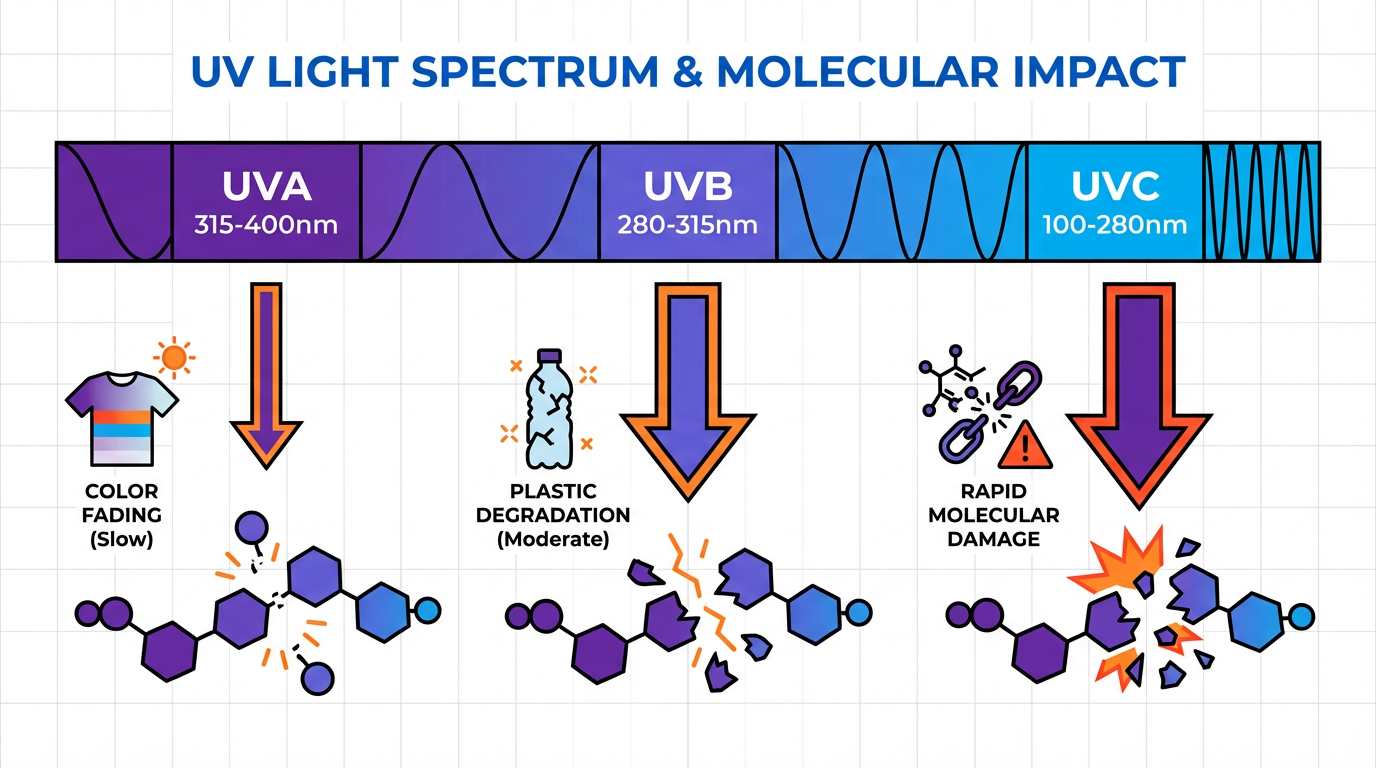
That same acrylic case maker points out that humidity, air quality, and plain old time also degrade documents and collectibles even in high‑budget museum environments, which is why they refuse to “guarantee no fading” even in enclosed cases in their overview of display case protection. If professional archives can only slow the clock, the goal for a figure shelf should be smart risk reduction, not chasing an impossible zero.
How Cabinet Materials Actually Block UV
When you see “UV protection” in cabinet marketing, what really matters is which wavelengths are blocked and how much of that harmful 285–400 nm band still reaches your figures.
Acrylic display‑case makers commonly state that their clear acrylic provides meaningful UV filtering yet still allows enough of the higher‑energy rays through that fading remains possible, which is why they avoid marketing blurbs like “blocks 98% of UV” and refuse to promise that autographs or paint will never fade in their product explanations. They also note that truly high‑UV‑filter acrylic, often sold as museum‑grade, tends to cost at least about double and appears slightly dimmer than standard sheets.
Cabinet glass makers describe a spectrum of glazing options with very different UV performance profiles. Ordinary tempered glass is strong and shatter‑safe yet only blocks somewhere around a third of UV. Laminated glass sandwiches a plastic interlayer and can absorb roughly 97–99% of harmful UV while holding together if cracked. Multi‑laminate assemblies can push UV blocking close to 99% while also improving security and comfort. They point out that low‑iron glass, which collectors sometimes choose for extra clarity, typically has high visible transmission but still lets the majority of UV through unless you add a dedicated UV‑blocking film or coating across the surface.
Standard acrylic behaves differently again. A typical clear acrylic sheet used in display cabinets will stop most of the shorter‑wave UVB range but may only filter a modest fraction of UVA, which means much of the “slow fading” band still lands on your figures. Modified UV‑resistant acrylic is formulated with extra UV‑absorbing additives so it can filter nearly all the damaging UV range while staying transparent to visible light, but that tuning and the resins involved are what push the price up relative to commodity acrylic panels.
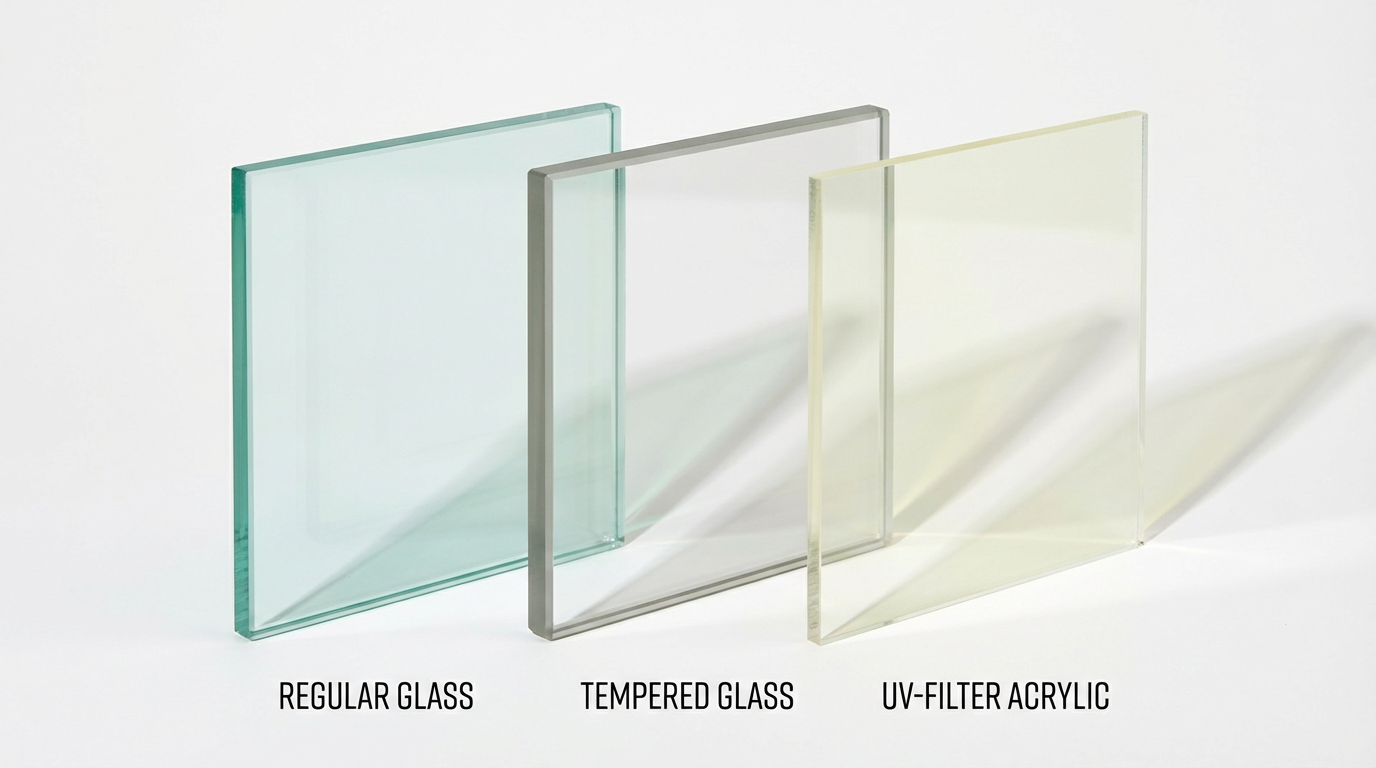
Specialized UV‑filter acrylics used in technical and industrial applications reveal how far this can go when performance, not cost, is the top priority. Some cast acrylic sheet lines are designed so that the base material blocks almost all radiation below about 375 nm in their standard grade, and specific UV‑cut versions extend that cutoff further into the spectrum, with certain products pushing the filter point up into the blue region. That extra reach means not only the classic UVB and most UVA but also some near‑visible radiation is suppressed, and manufacturers achieve this by embedding UV absorbers directly into the casting recipe so the shielding is uniform through the thickness rather than just sitting on the surface.
Independent testing of UV‑filter acrylics with spectrophotometers and UV radiometers shows how small performance differences matter. In one set of third‑party measurements over the 280–400 nm band, a baseline UV source was measured at just under 8,000 µW/cm²; when that beam passed through competing acrylics, about 1.7–2.0% of the UV made it through, while a more aggressively filtered acrylic transmitted only about 1.2%. Other tests highlight weak spots where some acrylics are less effective between about 265–285 nm or lose effectiveness near the long end of UVA above roughly 370 nm, leaving a slice of damaging light unfiltered. Those gaps help explain why broad‑spectrum blocking across the entire damaging band is more important than a single big percentage claim.
When Manufacturers Say “Tested for UV” – What That Really Means
A lot of serious UV protection work happens long before a display cabinet reaches your room, inside testing labs that specialize in accelerated weathering. One widely used standard, ASTM G154, describes fluorescent UV lamp setups that bombard materials with controlled UV radiation, moisture, and temperature swings to simulate months or years of outdoor exposure in a compressed time frame. Testing labs use these fluorescent UV chambers to compare how different polymers, coatings, and glazings hold up under repeated cycles and explain that ASTM G154 is a core practice for many industries trying to predict color change, cracking, and surface degradation under UV stress. Their overview of ASTM G154 fluorescent UV testing describes how specimens sit in a chamber where lamp type, intensity, temperature, and condensation or water spray cycles are all dialed to match the intended real‑world use.
Cabinet hardware and PVC edge banding makers often rely on both natural sunlight exposure and lab tests to gauge how quickly color shifts and mechanical properties change. In their review of edge‑banding performance, a cabinet component manufacturer explains that UV resistance is commonly quantified with accelerated exposure where color, gloss, tensile strength, and elongation are measured before and after standardized UV doses, and they point to widely used plastic weathering standards such as ISO 4892 and ASTM D1435 as benchmarks in their discussion of UV‑resistant edge banding. The key takeaway for collectors is that when you see a cabinet or acrylic advertised as “UV tested to ASTM…” you are really being told that its material recipe survived an agreed‑upon punishing regimen without unacceptable fading or embrittlement.
Testing labs also stress that there is no magic conversion between a certain number of test hours and an exact number of real‑life years, because the actual dose hitting your shelf depends on local sun angle, window glass, weather, and even how often you open curtains or blinds. That concept mirrors official explanations of sunscreen ratings: SPF is defined as how much solar energy it takes to produce sunburn on protected skin versus bare skin, and regulators emphasize that SPF is not a simple “multiply your safe sun time” number because solar intensity varies so much with time of day, latitude, and cloud cover. The Food and Drug Administration makes this clear when it explains that SPF is a measure of UV energy needed, not a precise hour count you can bank on.
In other words, “ASTM‑tested” on a product page and “SPF 50” on a sunscreen bottle are both relative performance markers, not promises that your figures or your skin are invincible for a fixed number of hours. You still have to pay attention to where the light is coming from and how long things sit in it.
Practical Ways to Boost UV Protection for Anime Displays
Think about UV protection for your collection the same way skin‑cancer groups talk about protecting people: you combine better materials with smarter coverage. Guidance on sun‑protective clothing stresses that tightly woven, darker, and specially treated fabrics with high UPF ratings block more UV than thin, light, or stretched garments and that more coverage always helps. Your figures benefit from a similar layering mindset.
The first layer is the cabinet material itself. If you are using a standard glass detolf or a basic acrylic case, assume you are getting partial UV reduction, not a force field. Commodity tempered glass is great for safety but mediocre for UV; clear acrylic filters some of the dangerous band but still leaves figures exposed to a significant fraction of UVA. Upgrading to a cabinet with laminated glass or museum‑grade acrylic for shelves housing signed shikishi boards or ultra‑rare resin kits can meaningfully cut the damaging wavelengths while keeping visibility high, even though it will cost more and may slightly dim the view compared with the brightest low‑iron glass.
The second layer is room setup. Display cabinets under direct sunbeams are the equivalent of sitting on a beach at noon without sunscreen: the UV dose accumulates very quickly. Occupational guidance for outdoor workers notes that UV levels tend to peak between late morning and mid‑afternoon in spring and summer and that guideline limits can be exceeded in a matter of minutes on clear days, which is why they urge people to limit midday exposure, seek shade, and cover up skin in their UV safety advice. Sliding your cabinet a few feet away from a sunny window, closing blackout curtains during the brightest hours, or placing figures on interior walls where sunlight never hits them directly can drop their daily UV dose dramatically even if the cabinet glazing itself is unchanged.
The third layer is add‑ons. Clear UV‑blocking films and aftermarket coatings can help when you cannot replace the cabinet glass, but glass‑industry experts warn that tinted films tend to absorb heat and can increase thermal stress on insulated glass units, with some manufacturers even excluding glass‑breakage warranty coverage when films are applied. They also note that any film or low‑emissivity coating added to an insulated unit should be placed on the correct surface to avoid excessive heating and seal failure and stress that tempered or heat‑strengthened glass is more tolerant of dark films than regular annealed glass. Those cautions, from decades of window‑industry testing experience, mean it is worth checking both your window and cabinet glass type before layering heavy films in front of a prized figure wall.
Finally, you can run your own low‑tech “does this actually block UV?” experiments, just as the acrylic display‑case maker describes when they share a customer’s test of a UV‑sensitive rock glowing under a UV flashlight outside the case but not glowing when the flashlight beam passed through the case wall in their description of UV filtering tests. A small black‑light flashlight and a known fluorescent item, like certain rocks or security features on cards or bills, can give you at least a qualitative sense of how much UV your cabinet material is intercepting.
Balancing Protection, Aesthetics, and Budget
Perfect protection is not realistic, but you can decide where to go all‑out and where “good enough” is actually fine. For inexpensive prize figures, keychains, or rotating seasonal displays, a standard glass or acrylic cabinet positioned away from direct sunlight, with curtains closed during the brightest hours, will usually slow fading enough that you will move pieces around before serious damage happens. For signature boards, limited‑run resin kits, or irreplaceable vintage PVCs, it makes sense to invest in higher‑grade glazing, tune room lighting toward LED sources with lower UV output, and limit how long they sit in the brightest spots.
Just like picking sunglasses, where ophthalmologists emphasize that the important question is whether the lenses truly block UV rather than just looking dark, eye‑health experts remind people that UV can also damage your eyes even on. Darker does not automatically mean safer. A dim cabinet with no tested UV filtering sitting in a sunny bay window can be harsher on your figures than a bright‑looking cabinet with verified UV‑blocking acrylic a few feet back from the glass.
In the end, protecting a collection is about stacking small advantages: pick cabinet materials with honest, broad‑spectrum UV filtering, place them where direct sunlight never quite reaches, tame the room’s midday brightness with shades or curtains, and reserve the best protection for the shelves that hold your absolute favorites. Do that, and years from now your shelf of pastel hair gradients, pearlescent armor, and neon effect parts will still look more like the promo photos and less like a sun‑bleached flashback.