Evaluating the Investment Value of Climate Control Systems for Anime Figure Collections
This article explains when climate control is worth paying for in an anime figure room and how to choose practical, museum-informed options that actually protect your collection.
Climate control becomes a smart investment once the cost and irreplaceability of your collection, combined with your local heat and humidity, outweigh the price of right-sized equipment and the energy to run it.
You know that gut punch when you notice your favorite scale has started to lean, a pale skin tone has quietly yellowed, or a rare artbook smells a little musty when you crack it open. Those are the same slow-motion damage patterns museums fight every day in their vaults, just translated into figure shelves and manga walls. The good news is that the same science museums use to keep paintings and film stable for decades can help you decide when climate control is worth it, which options actually protect your collection, and how to do it without turning your room into an overbuilt vault or a money pit.
How Climate Quietly Damages Figures and Other Collectibles
Long before a figure face melts or a box grows visible mold, temperature and humidity are quietly changing the materials you love. Museums treat those two factors as primary “agents of deterioration” because they drive chemical aging, mechanical stress, and biological growth across entire collections, not just a few pieces. As a result, they focus on environmental control rather than one-off rescue jobs for already damaged items. Guidance on collection environments emphasizes that cooler, more stable conditions with controlled humidity are among the most cost-effective preservation tools available for books, textiles, and mixed media. That same logic applies directly to PVC, ABS, resin, and the paper goods that live alongside them on your shelves, as laid out in preservation guidance on temperature, relative humidity, light, and air quality and in discussions of temperature and relative humidity.
Temperature: the fast-forward button on aging
Higher heat acts like a time-skip for aging. Research on film, paper, and other collection materials shows that chemical decay speeds up dramatically as temperatures rise. One study of acetate film found that lowering storage temperature from around 75°F to about 30°F at a given humidity stretched expected life from a few decades to many centuries, highlighting how powerful temperature is as a driver of deterioration. This relationship is summarized in work on how temperature and relative humidity affect collection deterioration and reinforced in environmental guidance that recommends keeping collection spaces as cool as human comfort and the building allow, typically somewhere in the mid‑60s°F for shared rooms and even cooler for dedicated storage where people do not linger.
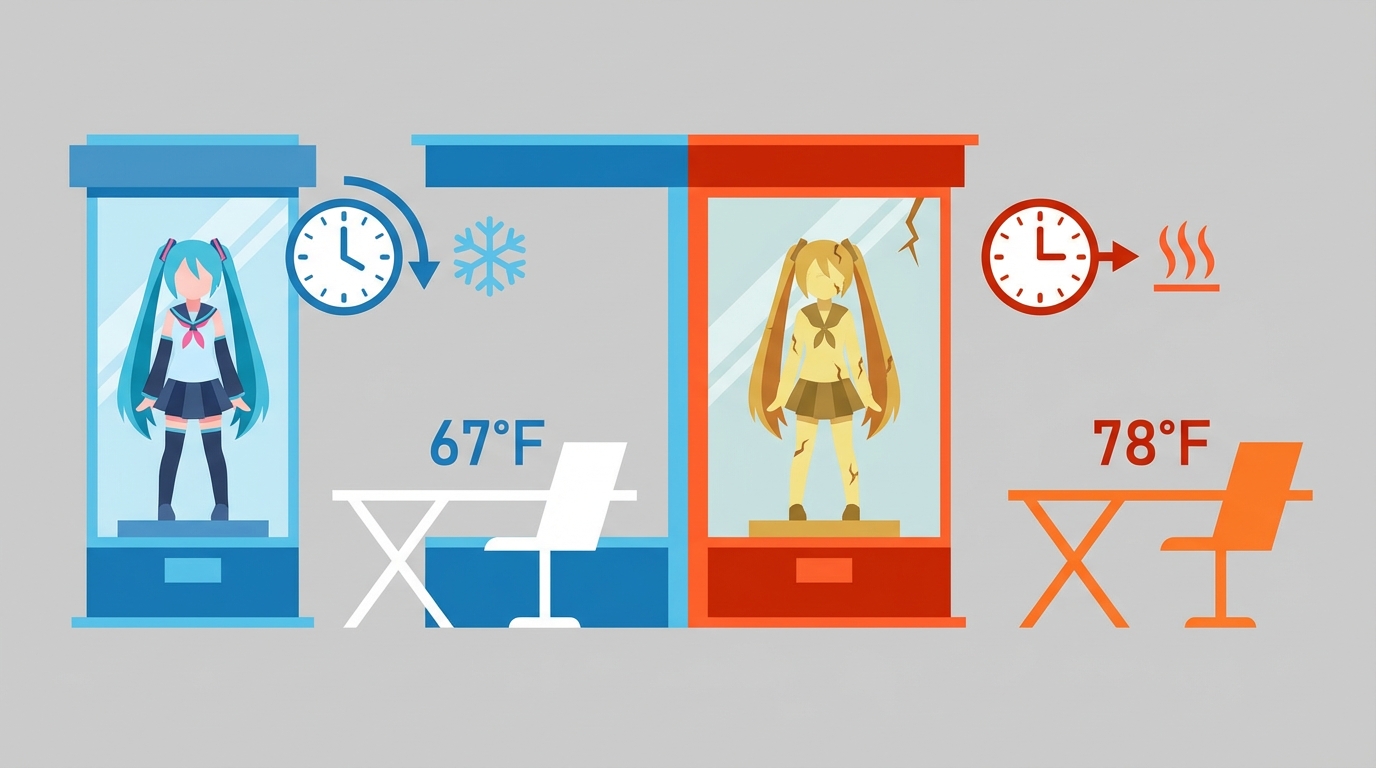
Translated to a figure room, this is the difference between a small home office that cruises around 67°F most of the year and a sun-baked upstairs bedroom that sits at 78°F or more all summer. In the cooler room, paints, plasticizers, and adhesives are aging in slow motion; in the hot room, you are effectively fast-forwarding the lifetime of your plastics, which makes yellowing, surface tackiness, and joint failures show up years earlier than they had to.
Humidity, dew point, and the mold and warping zone
Humidity is how much moisture the air is holding, but the number on your hygrometer is only half the story. Collection care guidance points out that high relative humidity increases chemical decay, corrosion, and dye bleeding, while low humidity makes hygroscopic materials like paper and wood shrink and embrittle. Repeated swelling and shrinking is especially brutal on layered or composite objects. That balance and its impact on chemical, biological, and mechanical decay is laid out in detail in how temperature and relative humidity affect collection deterioration.
Real-world targets for mixed collections tend to cluster around moderate humidity. Many institutions try to keep storage somewhere between about 30% and 60% relative humidity, with particular warnings about staying below roughly 60–65%, where mold outbreaks and corrosion risks start to climb, and above roughly 30%, where very dry air makes organics crack and warp more easily. Those ranges show up in practical guidance on temperature, relative humidity, and dew point for collections and in long-term monitoring programs that keep archaeological vaults around 50–75°F and between about 30% and 65% relative humidity, as described in temperature and relative humidity monitoring.
The twist is that air conditioners alone can quietly push you into the danger zone. When you cool hot, humid outdoor air to a comfortable room temperature without removing enough moisture, the relative humidity actually rises. A preservation example from a hot, humid summer day shows that air at 85°F with a muggy dew point around 65°F sits under 50% relative humidity outside, but if you cool that same air down to 70°F without dehumidification, the relative humidity jumps above 80%, which is prime mold territory. That is basically the “my AC feels great but my figures smell funny and my boxes are curling” scenario.
Dew point, which is the temperature at which the air becomes saturated and water condenses, is useful here because it tells you how much moisture is in the air independent of temperature. Collections guidance uses simple dew point calculations to spot when building envelopes or HVAC systems are not keeping moisture in check and to avoid situations where cold objects moved into warm, moist rooms “sweat” on the surface, just like a soda can. That risk and the value of dew point as a diagnostic tool are highlighted in temperature, relative humidity, and dew point for collections and echoed in broader environmental recommendations on temperature, relative humidity, light, and air quality.
For a figure collector, this means that a cool but damp basement or a room where the AC cools but does not dry the air can be more dangerous than a slightly warmer but drier space.

It is not about making the room cold; it is about keeping humidity in a steady, moderate range and preventing condensation on your plastic and paper surfaces.
Matching Climate Control Level to Your Collection and Space
Before you spend money on hardware, it helps to understand that climate control is not a binary choice between “do nothing” and “museum vault.” Preservation guidance divides buildings into categories from fully uncontrolled barns to tightly controlled storage vaults and emphasizes that the right environment is a data-driven balance between the building, the people using it, and the collections, not an unrealistic chase for one magic setpoint. That building-first approach is spelled out in guidance on realistic preservation environments, which describes everything from partially controlled homes to small “intensive care” storage areas with near-constant conditions around the high‑60s°F and roughly 40–50% relative humidity.
At the same time, museum energy studies highlight that fully conditioning entire buildings to tight temperature and humidity bands is extremely energy-intensive, and that targeted control around the most sensitive objects can dramatically cut both energy use and cost. Case studies of microclimate systems—small controlled spaces like sealed display cases or frames—show that moving strict humidity control into cases while relaxing conditions in the surrounding galleries dropped energy use by almost half in one museum and saved around $13,420 per year and roughly 60,573 kWh in another, as documented in work on microclimates for collection care. Together, those ideas map neatly onto an anime collector’s world: most of the room can be reasonably comfortable and stable, while the rarest grails live in their own “boss room” conditions.
A practical way to think about options is to group them by how much of the environment they control at once. Room-level control uses a combination of your home HVAC, possibly a better thermostat, and a dehumidifier or humidifier to keep an entire figure room within a target band. Microclimate control focuses on the space immediately around the objects, like sealed cabinets, cases with good gaskets, or high-end transport cases that include insulation and active humidity and temperature control. Portable or temporary solutions add a flexible layer: rolling dehumidifiers for seasonal spikes, portable AC units in a particularly brutal room, or even climate-controlled storage lockers for parts of a collection that cannot live safely at home.
A small, well-sealed room that already stays near 68°F with modest humidity swings might only need a dehumidifier and consistent monitoring to stay inside the 40–55% relative humidity zone that many mixed collections use, aligning with the ranges described in temperature and relative humidity monitoring and temperature, relative humidity, and dew point for collections. By contrast, an attic display space that swings from 55°F in winter to 85°F in summer with wild humidity is closer to an uncontrolled building type, and the same guidance on realistic preservation environments would flag that kind of envelope as suitable only for robust materials unless you either upgrade the building or move sensitive items into smaller, better controlled microclimates.
Here is a simple way to compare the options in terms of what they control and where the value tends to show up:
Climate option | Cost tier (relative) | What it controls best | Ideal use case | Main limitation |
|---|
Room-level HVAC plus humidity control | Medium to high | Temperature and humidity across a whole room | Dedicated figure or media room in a stable house | Upfront system cost and ongoing energy use |
Microclimate cases or cabinets | Medium | Humidity and short-term buffering around specific objects | Top-value figures, signed pieces, delicate books or artwork | Limited volume; still need general room control |
Portable dehumidifier or seasonal gear | Low to medium | Humidity during problem seasons or events | Humid summers, basements, or short display runs | Needs active monitoring and manual adjustment |
The ROI sweet spot for many collectors is a mix of modest room-level control with a few targeted microclimates. That mirrors the museum strategy of using small, tightly controlled spaces for the most vulnerable pieces while letting less sensitive items live in more relaxed yet still stable conditions, as reflected both in the Type V and Type VI building types in realistic preservation environments and in the microclimate case studies in microclimates for collection care.
Thinking About Return on Investment, Anime-Collector Style
Climate control is ultimately an investment decision: you are trading upfront cost and monthly energy spend for a reduced chance of losing value—financial, aesthetic, and emotional—over time. Preservation research gives a useful framework for thinking about that trade: temperature and humidity shifts change the effective “life expectancy” of materials by factors of two or more, and even small improvements within human-comfortable ranges can extend that life significantly. Analysis tools like the Time Weighted Preservation Index combine temperature and humidity data into a single measure to show that modest environmental tweaks can deliver one-to-three-fold improvements in collection life, as outlined in how temperature and relative humidity affect collection deterioration, while broader guidance on temperature, relative humidity, light, and air quality confirms that realistic, stable setpoints often beat idealized but unstable ones.
For a collector, it helps to think through a few concrete questions. First, ask how much value is at risk in the room you are trying to protect, counting both current market value and how hard it would be to replace limited editions, signed prints, and out-of-print artbooks. If a single grail could sell for more than the cost of a basic dehumidifier or data-logging thermostat, it only takes one badly warped or mold-stained piece for that gear to pay for itself.
Second, consider how harsh your climate and building conditions are. A humid coastal city, an older house with leaks, or a basement with occasional dampness will challenge even sturdy materials, and the physics of dew point and condensation mean that simply cooling the air is not enough. Preservation examples where cooling hot, humid air to a comfortable temperature pushed relative humidity into the eighties highlight how easy it is to create mold-friendly air in a room that feels fine to you, as shown in temperature, relative humidity, and dew point for collections. Combining that with the mold-growth thresholds and seasonal humidity considerations from how temperature and relative humidity affect collection deterioration makes a strong case that serious humidity control is non-negotiable in damp climates once your collection value climbs beyond a small handful of pieces.
Third, think about how long you plan to keep this collection. Museums think in decades or centuries, which is why they worry about whether warmer setpoints might cut expected lifetimes in half. If you intend to keep or slowly build your collection over many years, your time horizon starts to look more like theirs, and the payoff window for climate control gets longer. Environmental guidance that encourages cooler temperatures and modest humidity bands for long-term storage, including recommended ranges for combined-use spaces and cooler storage rooms in preservation guidance and the vault-style environments described in realistic preservation environments, is built on that extended timeline.
There is also the energy and sustainability side of the equation. Museums are among the most energy-intensive building types partly because of strict HVAC requirements, and case studies show that loosening whole-building humidity control while tightening control in cases and small rooms can cut energy use by around half and save significant yearly operating cost. Those results are documented in microclimates for collection care and align with broader calls for realistic, data-driven environments in realistic preservation environments. For a home collector, that translates to aiming for good-enough comfort-plus-preservation ranges in the main room rather than over-cooling year-round, then adding small, tightly controlled cases or cabinets for the very highest-stakes items.
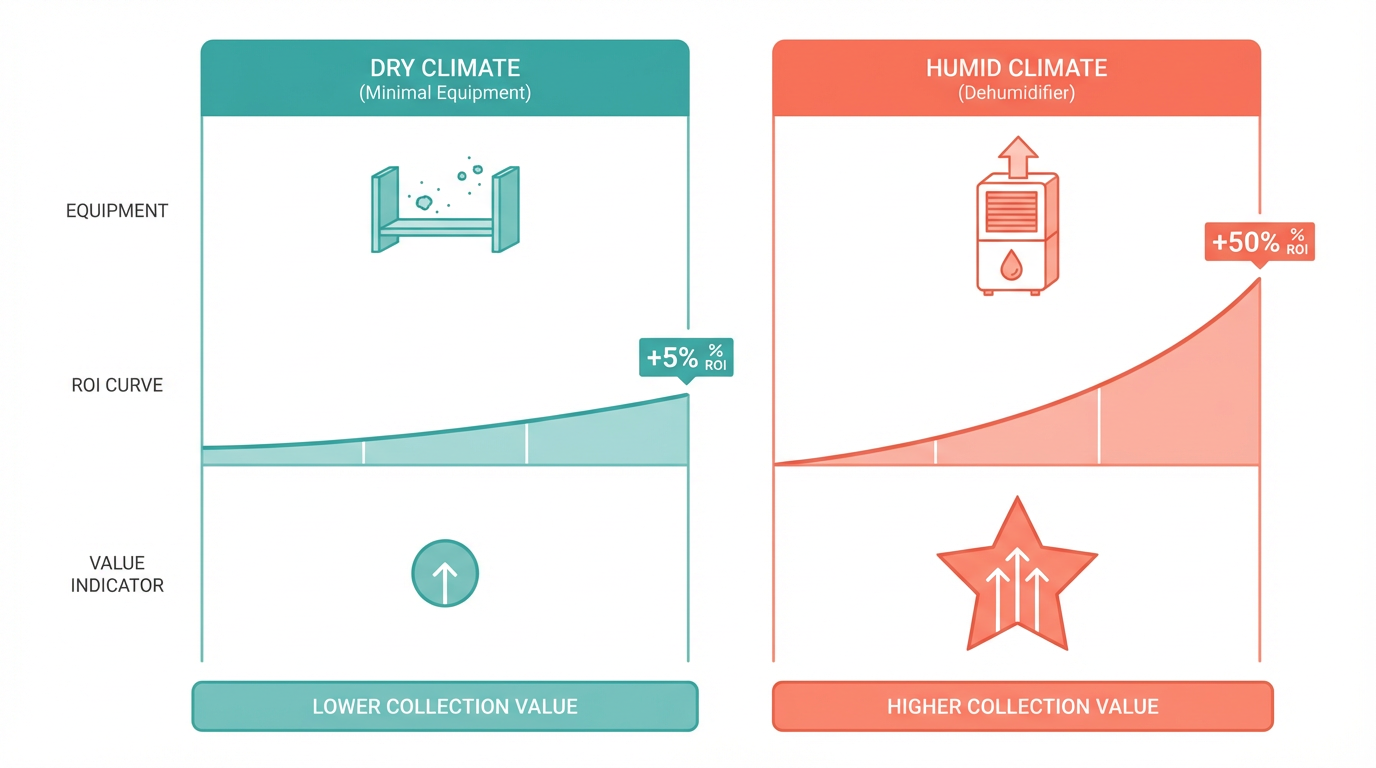
A simple thought experiment can help. Picture two collectors with similarly valuable figure walls. One lives in a dry, relatively cool inland city in a well-insulated apartment; they use their standard HVAC, keep blinds closed during the hottest hours, and occasionally run a small humidifier in winter. Their conditions probably hover near the mid‑60s°F and 40–45% relative humidity most of the year, which lines up well with the practical ranges suggested for mixed collections in how temperature and relative humidity affect collection deterioration and in monitoring programs like temperature and relative humidity monitoring. The other collector lives in a humid coastal city in an older house with a leaky window, a basement display area, and summer days where outdoor dew points are high. Without a dehumidifier, their cooled basement may sit at 70°F but 80% relative humidity, putting them squarely in the mold-risk zone identified in temperature, relative humidity, and dew point for collections. The second collector is going to see a far better ROI from humidity control than the first, even if their AC bills are similar.
Practical First Steps Before Spending Big
Museums rarely jump straight to ripping out HVAC systems; they start by measuring, watching patterns, and tightening the space itself. That same approach pays off for a figure room. One archaeology center’s program logs temperature and humidity every day across storage vaults and galleries, graphs the data weekly, and uses annual comparisons to guide improvements, all while holding overall conditions in a moderate band between about 50–75°F and 30–65% relative humidity, as described in temperature and relative humidity monitoring. Broad preservation advice echoes this, urging realistic targets based on your building and climate and stressing that stable conditions matter more than a single perfect number, as outlined in temperature, relative humidity, light, and air quality.
In practice, that means starting with a digital thermometer and hygrometer or a small data logger placed where your figures actually live, not just on the other side of the room. Let it run through at least one tough season and watch for patterns: maybe humidity spikes during storms or when a nearby bathroom is used, or temperatures creep up on sunny afternoons. With those patterns in hand, you can match solutions more precisely. If temperatures are fine but humidity spikes above 60–65% for long stretches, a dehumidifier plus some basic building maintenance, like sealing window gaps and routing outside water away from the foundation, may be enough. That combination of mechanical control and low-cost building fixes is a core strategy in preservation advice on temperature, relative humidity, light, and air quality and complements the dew point-based diagnosis techniques described in temperature, relative humidity, and dew point for collections.
If your whole building is challenging, consider moving the highest-value or most sensitive items into microclimates before attempting a full room retrofit. This can be as simple as upgrading to sealed cabinets with good gaskets and buffering materials inside, an approach that aligns with the buffering role of enclosures described in how temperature and relative humidity affect collection deterioration, or as sophisticated as dedicated, climate-controlled display cases for your absolute crown jewels, which mirror the controlled microclimate cases and frames used in museum examples in microclimates for collection care. These targeted moves often deliver more preservation value per dollar than over-conditioning a whole, leaky space.
As you make changes, keep tracking the data. Museums look at multiple years of monitoring before calling an environment realistic and stable, and the concept of a realistic preservation environment itself is built on combining envelope classification, heat and moisture inventory, and achievable setpoints, as described in realistic preservation environments and reinforced by practical measurement programs like temperature and relative humidity monitoring. For you, that might simply mean checking your room and case readings each season and adjusting as you learn how your space behaves.
FAQ
Is a dehumidifier enough to protect a figure room?
A dehumidifier can be a powerful tool, especially in humid climates or basements, but it works best as part of a package. Research on collections shows that keeping relative humidity below roughly 60–65% is important for avoiding mold and metal corrosion while also avoiding very low humidity that can crack organic materials, as explained in temperature, relative humidity, and dew point for collections and how temperature and relative humidity affect collection deterioration. If a dehumidifier gets you into that range and your temperatures stay in the mid‑60s to low‑70s°F with reasonable stability, you are in a good zone. If temperatures still swing wildly or parts of the room stay damp, you may need to pair it with building fixes, better airflow, or microclimate cases.
Do boxed figures still need climate control?
Boxes buy time but not immunity. Preservation guidance emphasizes that enclosures and microclimates slow humidity changes and buffer short-term swings but do not protect against long-term exposure to poor conditions, and that concept shows up both in the discussion of buffering enclosures in how temperature and relative humidity affect collection deterioration and in the broader treatment of enclosures and air quality in temperature, relative humidity, light, and air quality. A boxed figure in a room that spends summers at 78°F and 70% relative humidity is still aging faster and facing mold risk than it would in a cooler, drier space. Boxes are best thought of as a second line of defense layered on top of a reasonable room environment, not a replacement for it.
Closing
Climate control is the quiet support character in your collection story: you rarely notice it when it is working, but it decides whether your favorite grails are still crisp and vibrant in ten years or leaning and sticky in the back of a closet. By borrowing the same evidence-based strategies museums use—moderate, stable temperature and humidity, targeted microclimates, and data-driven tweaks—you can turn your display room into a long-term safe zone where your figures, artbooks, and merch level up in value instead of slowly losing HP to the environment.