Glass vs Acrylic Display Cases: Which Really Guards a Million-Level Anime Collection?
For six- or seven-figure anime collections, a backbone of tempered-glass cabinets plus targeted acrylic cases around your true grails usually delivers the strongest mix of protection, security, and display impact.
Ever stare at a wall of scale figures and resin statues and think, “If that shelf fails, there goes a house down payment”? When you dig into museum case specs and collector-focused cabinet guides, a pattern emerges fast: the materials around your collection do as much to preserve value as the sculpt and paint on the figures themselves. This guide breaks down how glass and acrylic really behave in real homes so you can choose a setup that keeps a million-level collection safe, beautiful, and flex-ready for years.
What a “Million-Level” Figure Collection Actually Needs
Once a collection crosses into six or seven figures in value, the goal stops being “looks cool on the bookshelf” and becomes “near-mint, museum-style preservation that still feels like fandom, not a bank vault.” Serious display and conservation guides converge on the same core needs: stable temperature around 65–70°F, moderate humidity in the 40–50% range, and ruthless avoidance of direct sunlight that fades paint and fabrics over time, especially on plastics and vinyl.
Collectible-storage experts emphasize that plastics and painted surfaces are especially vulnerable to light, heat, and pollutants, and that UV exposure causes irreversible color loss, yellowing, and brittleness. Museum and cabinet makers echo this by prioritizing UV-filtering glass or acrylic, sealed enclosures, and gentle LED lighting so the figure, not the light source, takes center stage without cooking in the spotlight.
Weight and structure matter just as much. Home display guides recommend matching total collection weight to shelf capacity, using tempered glass or heavy wood shelves, and keeping the heaviest pieces low and near supports. For a shelf full of 1/4-scale polystone or large diorama bases, that load-bearing detail can be the difference between “gallery wall” and “gravity wins.”
High-value collections also demand security. Cabinet makers stress lockable doors, sturdy frames, and wall anchors for tall units. That is especially relevant if your collection lives in a shared household, you host guests frequently, or you live in an area prone to earthquakes or frequent bumps.
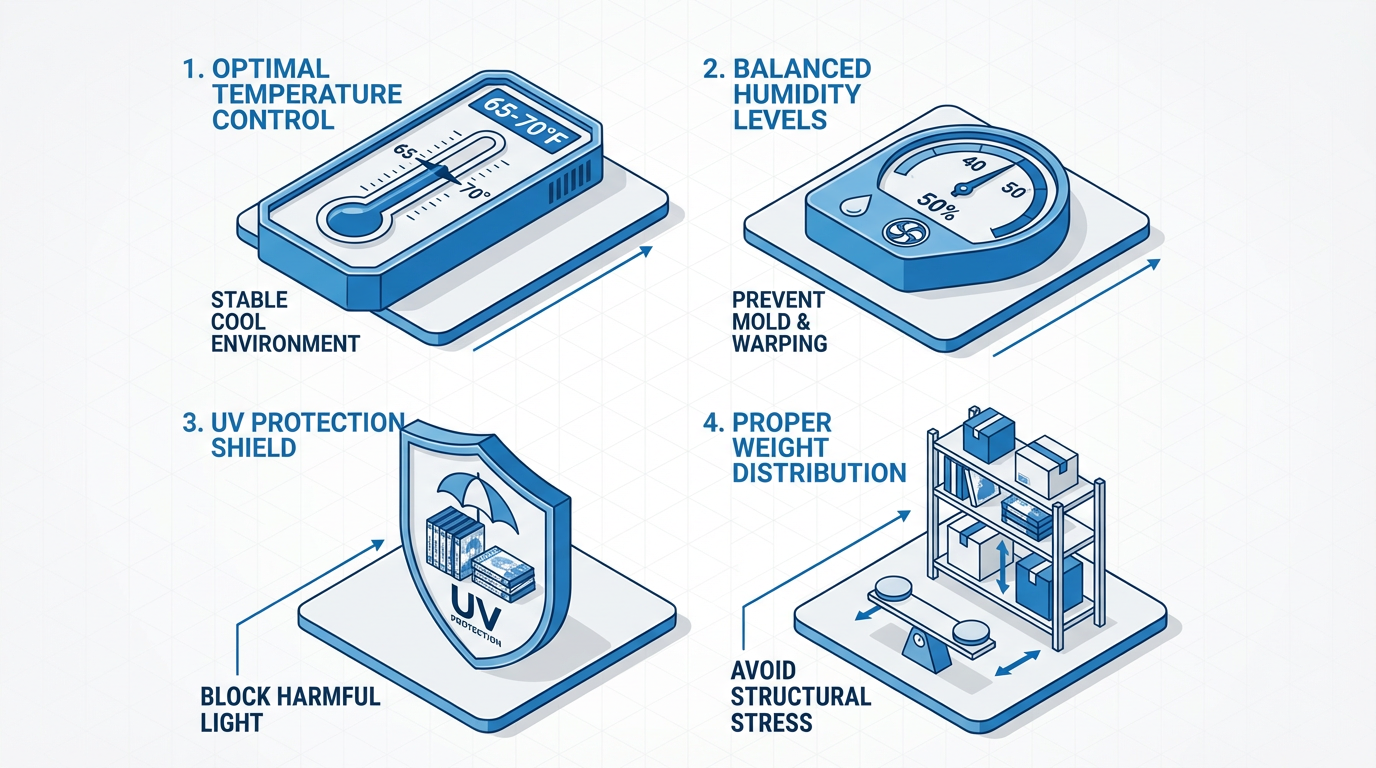
With those needs in mind, glass and acrylic each bring very different strengths to your display.
Glass Display Cabinets for High-Value Figures
Strength, Safety, and Security
Modern display-cabinet guides consistently recommend tempered glass for serious cabinets, describing it as roughly four to five times stronger than regular glass and far safer when it does fail because it crumbles into small, less dangerous pieces rather than jagged shards. High-end art and jewelry display makers often pair tempered glass with multi-point locking systems and thick frames designed to resist impact and casual theft.
In practice, a tall glass curio with tempered shelves can comfortably support rows of PVC scale figures or even heavier resin statues, as long as the manufacturer’s shelf ratings are respected and the heaviest pieces stay on lower shelves. Many sources also recommend anchoring tall glass cabinets to wall studs, especially in homes with kids, pets, or earthquake risk, so an accidental tackle does not turn into a full-on avalanche of merch.
Visibility, UV Control, and Lighting
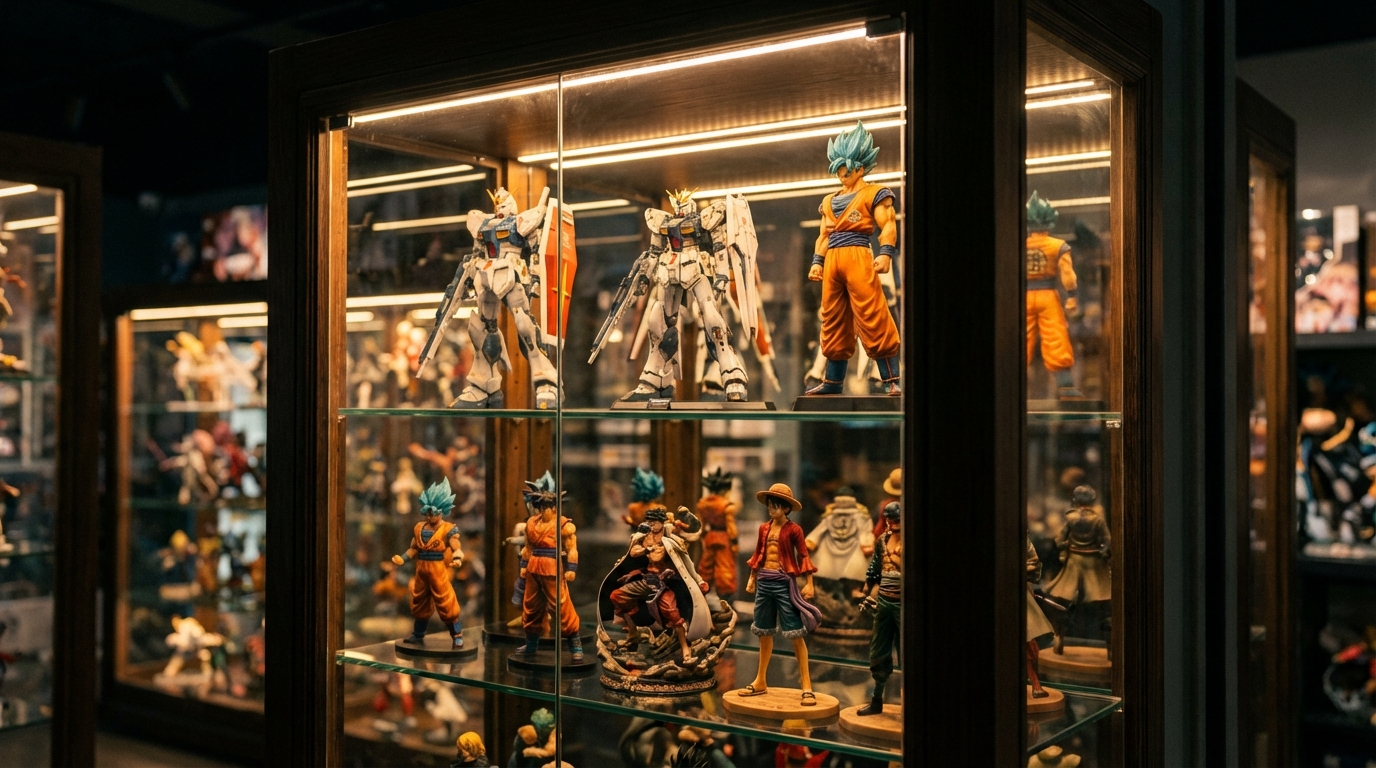
Glass cabinets excel at making a collection feel like a gallery. Display and museum-case specialists point out that anti-reflective glass increases light transmission compared with standard glass, reducing glare so paint gradients and eye decals read clearly even from across the room. Some premium glass options integrate UV-filtering layers that act like sunscreen for your figures, slowing fading on printed bases, fabrics, and autographed pieces.
Lighting is the next big advantage. Cabinet makers highlight integrated or add-on LED strips and spotlights as the go-to choice because they are bright, low-heat, and energy efficient. With glass shelves, light can pass through levels, creating that floating effect where Nendoroid-style chibis on the top shelf cast a soft glow on the grail statue below. Museum-focused sources suggest choosing color temperature intentionally: cooler whites flatter metallic and sci-fi pieces, while warmer whites suit fantasy sculpts, wood bases, and skin tones.
Real-World Use Case
Imagine a collector with a room-width glass cabinet dedicated to one shonen franchise: upper shelves for mid-size PVCs and effect-heavy prize figures, mid shelves for main-character scales, and the bottom shelf for two heavy polystone dioramas. Using tempered glass shelves, locks on the doors, and a wall anchor, this collector gets open sightlines to every pose while still limiting dust, curious hands, and wobble risk. With UV-protecting glass on the front and side panels plus LED lighting on timers, the display reads like a boutique shop window while quietly doing conservation work in the background.
Drawbacks of Glass for Figurine Collectors
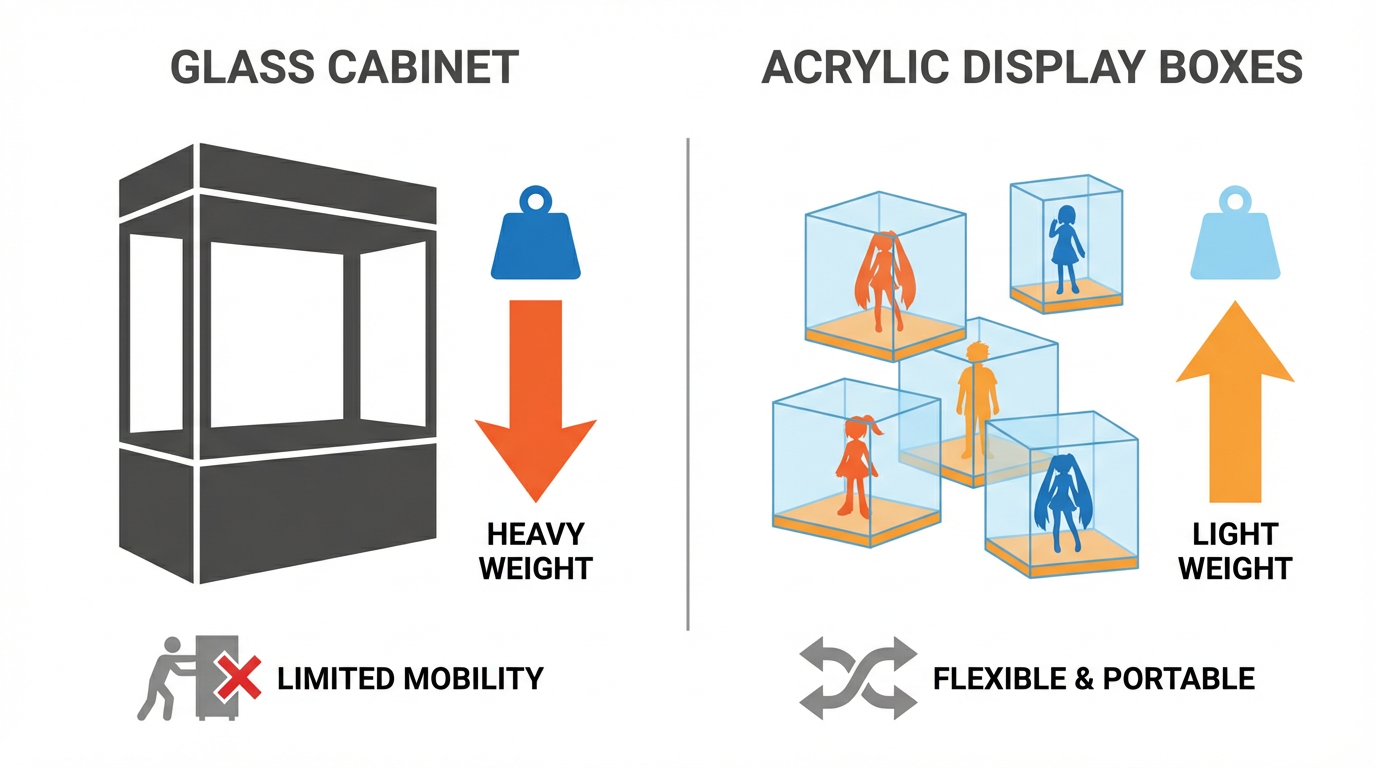
Glass cabinets do have pain points. They are heavy, harder to move, and generally more expensive than simple acrylic cases; antique and designer units can run into the thousands of dollars depending on wood, glass type, and craftsmanship. Doors and panels can introduce glare if you do not spring for anti-reflective glass, and you need to think carefully about door swing and room layout so viewers do not bump into the unit.
There is also a psychological factor: once a large glass cabinet is in place and full, rearranging a collection becomes a mini project. For collectors who love frequent re-posing and photo shoots, that friction can be annoying.
Acrylic Display Cases: Lightweight Armor for Your Grails
Clarity and Everyday Protection
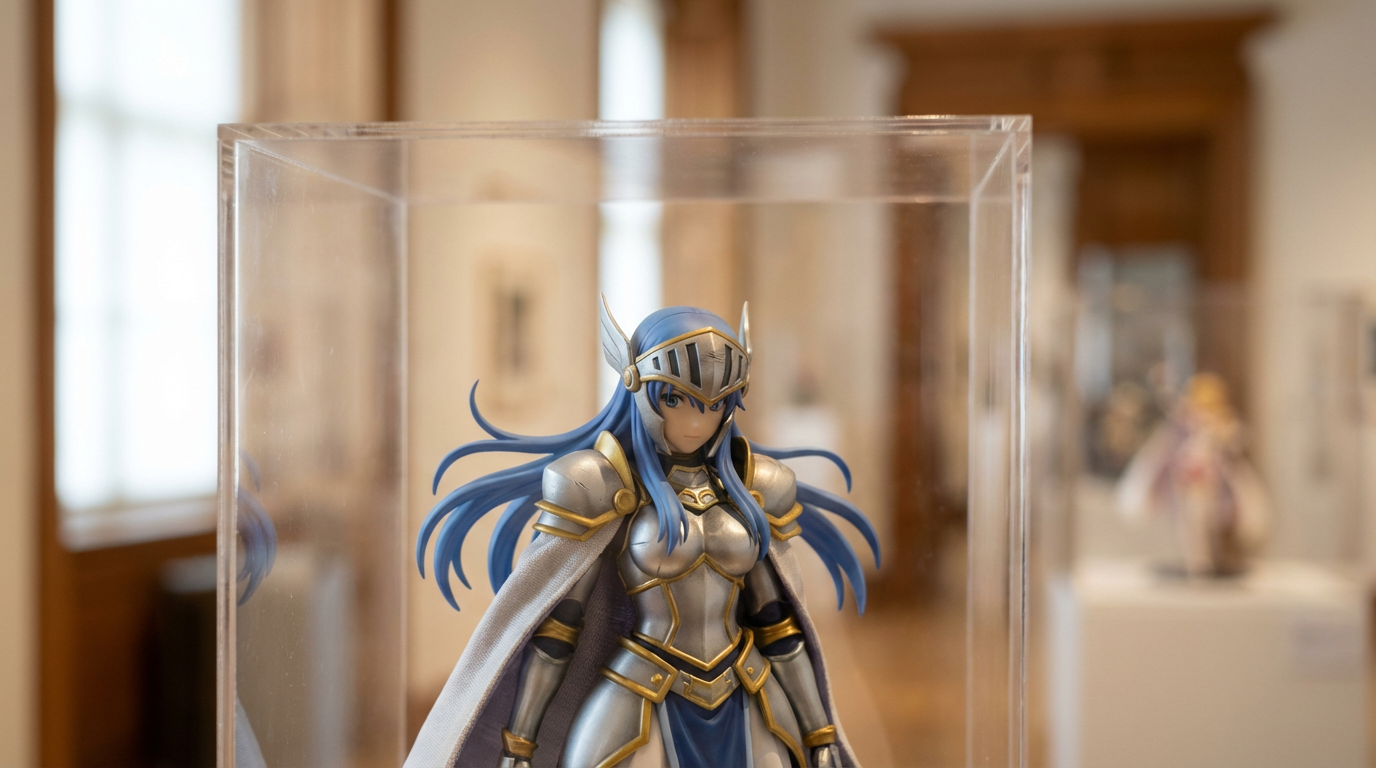
Retail and collectible-display brands describe acrylic display boxes as lightweight, highly transparent enclosures that behave almost like invisible armor. Quality acrylic has exceptional clarity and less green tint than standard glass, with museum-grade acrylic reaching very high light transmission and low haze. Collectible display companies argue that this higher transparency and lower surface reflectivity keep the focus on the figure, not on reflections of the room.
Functionally, acrylic boxes and cabinets shield figures from dust, fingerprints, and casual bumps. Guides aimed at collectors emphasize that once a figure is in a well-fitted acrylic box, day-to-day maintenance drops sharply; you mostly dust the outside with a microfiber cloth, leaving delicate paint, hair strands, and weapon tips untouched. This also cuts down on handling, which conservation resources repeatedly flag as a major source of micro-scratches, paint rub, and broken pegs.
Impact Resistance, Weight, and Cost
Compared with glass, acrylic is much lighter, which matters when you are moving cases around a room or stacking multiple tiers on an existing shelf. Retail fixture guides highlight that acrylic display cases can often be shipped and installed more cheaply than glass equivalents, with typical countertop units running roughly in the 200 range while many glass cases start above $100 and can climb past $500, especially for larger dimensions and thicker glass.
Safety-wise, acrylic shines because it tends to crack or craze rather than exploding into sharp shards. For collections in busy living rooms or near gaming setups where controllers occasionally go flying, that shatter resistance is a real comfort. Acrylic’s impact tolerance also makes it popular in shops for jewelry, comics, and small models, where customer traffic is constant.
One nuance is scratch behavior. Some home-decor sources warn that basic plastics scratch more easily than glass and position acrylic as better suited to lower-value or temporary displays. At the same time, museum and display manufacturers point out that higher-grade acrylic formulations can offer improved scratch and impact resistance compared with ordinary glass. Quality varies, so for million-level collections it is worth choosing thicker, museum-grade acrylic rather than the thinnest budget boxes.
Long-Term Limits and Material Aging
Conservation experts who study artifact storage offer an important caution: many plastics have what they call “inherent vice,” meaning they slowly break down under light, temperature, and humidity stress and can off-gas chemicals that harm nearby materials. That does not mean acrylic is unsafe for figures, but it does mean you should avoid mixing unstable vintage plastics or paper props inside the same sealed acrylic environment without some ventilation or archival barriers.
Over decades, lower-grade acrylic can craze, yellow, or become brittle if exposed to intense light and heat. For a million-level collection, that argues for using acrylic strategically: as modular protection for individual grails or high-risk pieces, not necessarily as the only wall-to-wall enclosure in a sunny room.
Glass vs Acrylic: Side-by-Side for Anime Grails
Factor | Tempered Glass Cabinet | Acrylic Cases and Cabinets |
|---|
Impact and tip-over safety | Very strong, especially in tempered form; heavy units must be anchored to walls for stability. | More impact-resistant and less likely to shatter; lighter weight reduces damage if bumped or knocked. |
Scratch behavior | Resists minor scratches but can chip or crack if hit hard. | Lower grades scratch easily; higher-grade, museum acrylic improves scratch resistance but still needs gentle cleaning. |
UV and light control | Can be upgraded to UV-filtering and anti-reflective glass, excellent for paint and fabric preservation. | Some specialty acrylics block high percentages of UV; basic boxes protect from dust but not necessarily from UV unless specified. |
Dust and access | Enclosed, lockable doors greatly reduce dust and unwanted handling. | Individual boxes are almost dust-proof and reduce direct handling, but open-shelf acrylic cabinets vary by design. |
Weight and mobility | Heavy, harder to move, best as semi-permanent room anchors. | Very light, easy to rearrange, stack, and reconfigure on existing furniture. |
Cost for large setups | Higher, especially for tall, wide cabinets with premium glass and wood. | More economical per small enclosure; cost scales with quantity if boxing every piece. |
Best use in anime collections | Whole-wall “museum” displays, heavy statues, single large hero cabinet. | Grail boxes, signed pieces, high-risk poses, and modular grids on shelves or inside larger cabinets. |
How to Choose for Your Own Collection
One helpful way to decide is to picture how you actually live with your figures, not just how they look on display day.
If the collection sits in a shared family space and includes very heavy statues, a lockable tempered-glass cabinet anchored to the wall is often the safest backbone. You get a stable structure that can support serious weight, keep kids and pets out, and present the collection as a single, dramatic focal point. A freestanding glass curio in a dining room or living room can double as both an art piece and a conversation starter.
If you love constant photo sessions and re-posing, acrylic’s flexibility becomes priceless. Individual acrylic cases let you rearrange shelves, stack boxes in grids, and move sets to different rooms or backdrops without ever touching the figures themselves. For someone who rotates seasonal lineups, themed shelves, or dioramas inspired by current anime episodes, modular acrylic makes experimentation low-risk and fun.
If you treat the collection like a mini museum, a hybrid approach is usually the sweet spot. Conservation resources repeatedly emphasize environmental control, UV protection, and reduced handling. That translates into a strategy where a large glass cabinet with UV-filtering panels, LED lighting, and locks acts as the outer shell, while the rarest or most fragile pieces live inside individual acrylic boxes or risers within that cabinet. The outer glass handles room-level dust, traffic, and security; the inner acrylic shields paint and tiny parts from accidents during rearranging.
Practical Setup Tips for Million-Level Protection
No matter which material wins for you, a few shared best practices show up again and again in collector and museum guides.
Keep light under control. Storage and display experts stress that direct sunlight is a long-term enemy of paper, textiles, plastics, and paint. Position cabinets away from bright windows, use curtains or shades, and rely on LED strips or spotlights to make the collection glow without the UV blast. Rotate especially sensitive or signed pieces out of the brightest zones occasionally so no single grail takes all the damage.
Manage environment quietly in the background. Conservation-focused sources recommend keeping display rooms at roughly 65–70°F with relative humidity around 40–50%. That usually means avoiding attics, damp basements, and rooms that swing wildly in temperature. A small hygrometer on a shelf and, if needed, a dehumidifier in the room can help keep things stable.
Respect weight and physics. Home and commercial cabinet guides advise checking manufacturer shelf ratings and placing heavier items on lower shelves for both safety and visual grounding. A row of heavy polystone at ankle height not only lowers the center of gravity but also looks more intentional than balancing giant bases at eye level.
Design for access without extra handling. Several display resources encourage placing frequently handled or swapped items on more accessible shelves and leaving rare or fragile pieces slightly higher or deeper. Within acrylic boxes, labels or small name cards outside the enclosure allow you to identify figures without opening cases. Digital inventory tools suggested by collector guides are especially useful once you hit dozens or hundreds of pieces.
Finally, think like an insurer. Best-practice resources for valuable collectibles recommend maintaining an inventory with photos, purchase dates, and rough values, and considering specialized insurance or policy riders for top-tier pieces. That sounds dry until a shelf is knocked or a pipe bursts; at that point, the few hours spent documenting your fleet of limited runs and exclusives feels very small.
So, Glass or Acrylic for a Million-Level Collection?
For a truly high-stakes anime collection, pure acrylic or pure glass rarely wins outright. Tempered-glass cabinets with UV-aware design and solid hardware are hard to beat for structural safety, security, and that gallery vibe. Acrylic shines as the nimble, hyper-clear armor wrapped around your most fragile or irreplaceable grails and as a playground for constant display experiments.
The combo that tends to age best is simple: a rock-solid glass stage for your fandom, lined with carefully chosen acrylic boxes and risers for the stars of the show. Treat your cabinets as part of the collection’s armor set, not just furniture, and every time you switch on the LEDs you will see exactly what you are protecting—and why it is worth doing right.
References
- https://www.catalinaclosets.com/display-cabinets-for-collectibles
- https://smartbuy.alibaba.com/buyingguides/antique-display-cabinet
- https://www.shopfittingsdirect.com.au/why-acrylic-display-cases-are-a-good-alternative-to-glass/#:~:text=Acrylic%20is%20actually%20more%20transparent,a%20display%20offering%20visual%20clarity.
- https://displaycaseart.com/display-cabinet-for-collectibles/
- https://www.displays2go.com/Guide/How-Decorate-Display-Case-156
- https://info.gaylord.com/resources/tips-for-collectible-artifact-storage#:~:text=Choose%20a%20storage%20area%20away,in%20the%20attic%20or%20basement.
- https://homeworlddesign.com/how-to-choose-the-perfect-display-cabinet-for-your-collectibles/
- https://www.houzz.com/magazine/collective-wisdom-display-ideas-for-collections-of-all-kinds-stsetivw-vs~20592978
- https://www.spaceageclosets.com/how-do-you-store-your-collectables/
- https://texaspatiobuilder.com/put-inside-a-display-cabinet/