Grinding Beans and Ghouls: Contrasting Designs in Tokyo Ghoul Figurines and Coffee Culture
I have lost count of how many mornings I have started the day the same way: kettle on, beans grinding, and my Kaneki shelf staring back at me from across the room. For a series as brutal as Tokyo Ghoul, it is strangely comforting that some of its most iconic moments happen in a quiet coffee shop. And if you are a figurine fan, you know that the best Kaneki sculpts feel less like merch and more like tiny altars to that mix of warmth and horror.
This piece is for the fans who live at the intersection of caffeine and collectibles. Drawing on documented figure catalogs, store listings, and reviews, I want to look closely at how Tokyo Ghoul figurine design contrasts with, echoes, and sometimes softens the series’ coffee culture. Along the way, I will share what has actually worked on my own shelves and desks, plus some practical advice on choosing figures that fit both your budget and your brewing ritual.
Tokyo Ghoul, Coffee, And The Art Of Duality
Tokyo Ghoul is often described as a seinen anime that fuses action, horror, and psychological drama. A longform review on Poggers underlines just how intense it is: explicit violence, torture, cannibalism, all set in present-day Tokyo with human-like ghouls who must eat human flesh to survive while hiding among humans. At the center is Ken Kaneki, a bookish college student who becomes the first known one‑eyed half‑ghoul after receiving transplanted organs from the ghoul Rize Kamishiro. He ends up stranded between humans and ghouls, never fully belonging to either side.
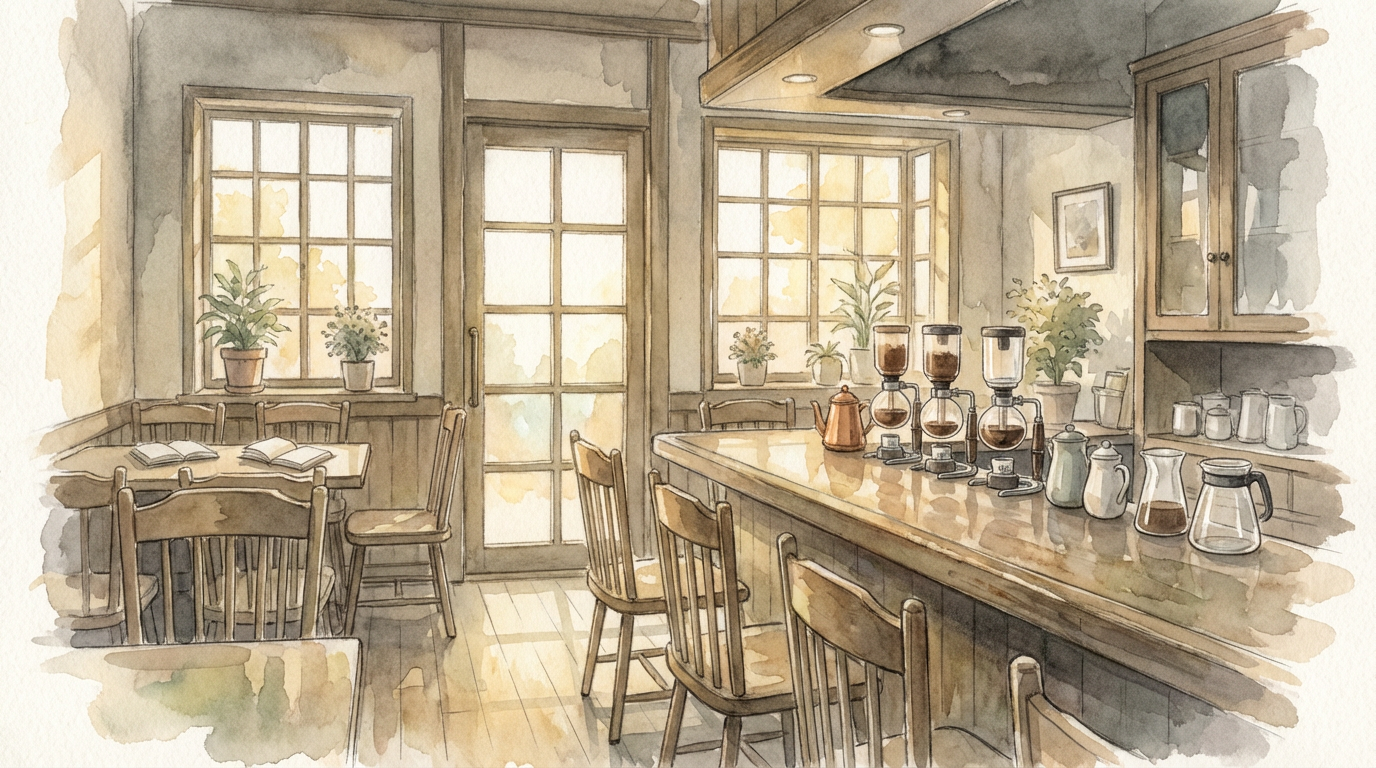
In the middle of all this blood and moral ambiguity sits a coffee shop: Anteiku. That same review describes Anteiku as a ghoul‑run café that shelters ghouls and helps Kaneki adapt to his new existence. For all the fights and screaming outside, Anteiku is where characters talk, heal, and negotiate fragile coexistence. It is also where coffee becomes a kind of ritual: a way for ghouls to share something that is not human flesh, and for Kaneki to cling to a last scrap of his old, quiet life.
This duality is the heartbeat of Tokyo Ghoul. On one side, you have the gentle barista vibe, the friendships, the messy found family. On the other, you have the CCG, torture chairs, and kaneki’s evolution into the “One‑Eyed King.” When you collect Tokyo Ghoul figures or build a coffee-themed display, you are basically curating how much of each side you want to feel every time you glance at that shelf.
From Screen To Shelf: What The Figurine Data Shows
If you zoom out from your own display and look at the broader market, the variety of Tokyo Ghoul figures is not just a vibe; it is documented. A Tokyo Ghoul figures catalog on a fan wiki logs thirty‑three distinct products released between 2015 and 2018. That snapshot already shows a surprisingly rich ecosystem.
Most of those items are static display pieces rather than toys. The catalog notes that the majority are categorized as statues, with only a minority explicitly labeled as action figures, ball‑jointed dolls, or Nendoroid‑style chibi characters. Roughly three‑quarters of the lineup are non‑articulated statues. That ratio matters if you are deciding whether you want a dynamic diorama locked into one perfect pose, or something you can re‑pose between coffee breaks.
The heights range wildly. At the tiny end are super‑deformed keychain or swing figures around 45 millimeters tall, which is roughly one and three‑quarter inches. At the giant end there is a sixty‑centimeter ball‑jointed doll, close to twenty‑three and a half inches. In between, you get common ranges like six to almost seven inches for prize and scale figures, about eight and three‑quarter inches for many one‑eighth scale statues, three to three and three‑quarter inches for Funko vinyls, and seven inches for Western‑style articulated action figures.
Materials are mostly PVC and ABS plastic for mainstream statues and action figures. Soft vinyl shows up in the Funko POP and Dorbz lines. Higher‑end items bring in polyresin or full resin, including the tall character doll and premium statues. Those material choices have real consequences for weight, fragility, and the kind of details sculptors can capture.
Kaneki dominates the catalog. He appears in nearly half of the listed products: Banpresto prize statues, chibi Aoshima swings, Kotobukiya ArtFX J one‑eighth scale statues (including a repaint), multiple Funko POP and Dorbz versions with glow‑in‑the‑dark and store exclusives, Medicos and McFarlane articulated figures, a premium incomplete‑kakuja statue, and a sixty‑centimeter doll. Other characters get love too, especially Touka Kirishima, Shuu Tsukiyama, Juuzou Suzuya, and Haise Sasaki, but Kaneki is clearly the visual anchor.
The catalog even offers a practical takeaway: if you want breadth and affordability, target Banpresto prize statues and Aoshima SD lines; if you want higher‑end articulated or large centerpiece items, prioritize Kotobukiya, Medicos, McFarlane, and the large character dolls. That is advice born from actual product tracking, not just collector mythology.
Kaneki In 3D: How Different Figures Brew Different Emotions
Once you start comparing specific Kaneki figures, the contrasts become more emotional than technical. Each sculpt gives you a different flavor of Kaneki, not unlike choosing between a mellow pour‑over and a brutal espresso shot.
A mainstream one‑tenth scale PVC action figure from ABYSTYLE, sold as a boxed collectible on Amazon, leans into accessibility. It is pre‑painted, ready to display, and marketed as both a shelf piece and a ready‑to‑gift item. Figures like this often capture a “default” version of Kaneki: recognizable mask, clear silhouette, solid pose that works whether you are a casual anime watcher or deep in the fandom.
Kotobukiya’s ArtFX J line pushes further into collector territory. The one‑eighth scale Ken Kaneki awakened repaint is documented on an Amazon listing as a pre‑painted PVC figure. The ArtFX J brand is already known among collectors for dynamic sculpting and strong paint work; here, the “awakened” and “repainted” labels suggest a deliberate attempt to refine how Kaneki’s transformation is portrayed. You are not just buying Kaneki; you are buying Kaneki at a very specific psychological breakpoint.
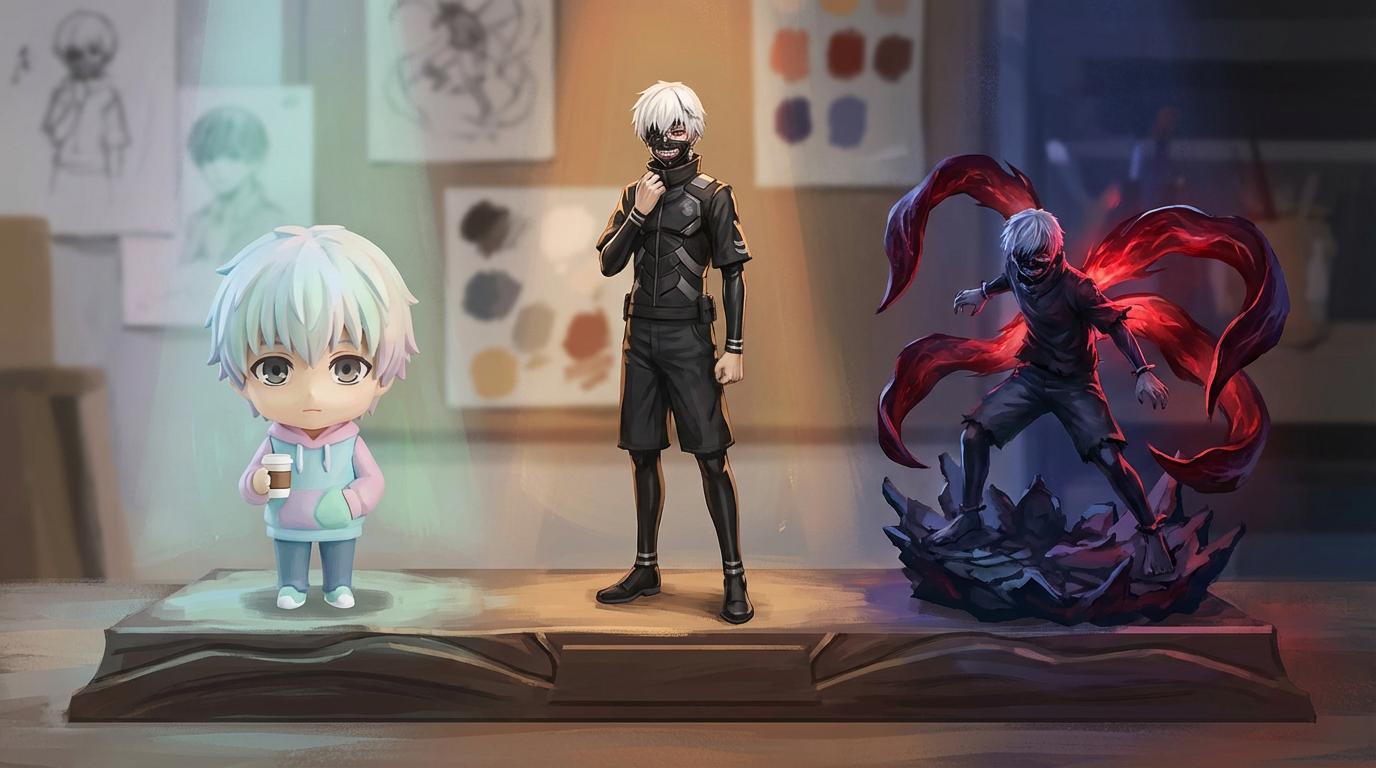
On the opposite end of the spectrum, SD (super‑deformed) swings and Nendoroids compress all of that darkness into adorable proportions. The Aoshima swing collections and Haise Sasaki Nendoroid mentioned in the figure catalog emphasize breadth of characters and playful articulation over hyper‑realistic gore. A three‑inch chibi Kaneki on your desk next to a latte is a completely different emotional experience than a twelve‑inch resin statue with kagune spikes curling around his victims.
Then there are Western‑style action figures. McFarlane’s seven‑inch Color Tops Kaneki, plus a Tsukiyama prototype with fifteen points of articulation, represent another design tradition entirely. Here, joints and posing options matter as much as sculpted detail. If you are the type who fiddles with a figure between sips of coffee, re‑posing Kaneki to match whatever track is playing in your headphones, this style feels like a natural fit.
Underneath all of this is a simple truth: the same character can feel like a gentle tragic hero or a walking nightmare depending on how the sculptor frames him. Choosing figure styles is really choosing how you want Tokyo Ghoul to live in your space.
Premium Resin, Limited Runs, And Display As Ritual
If PVC figures are your everyday drip coffee, premium resin statues are the single‑origin pour‑over you plan your Sunday around.
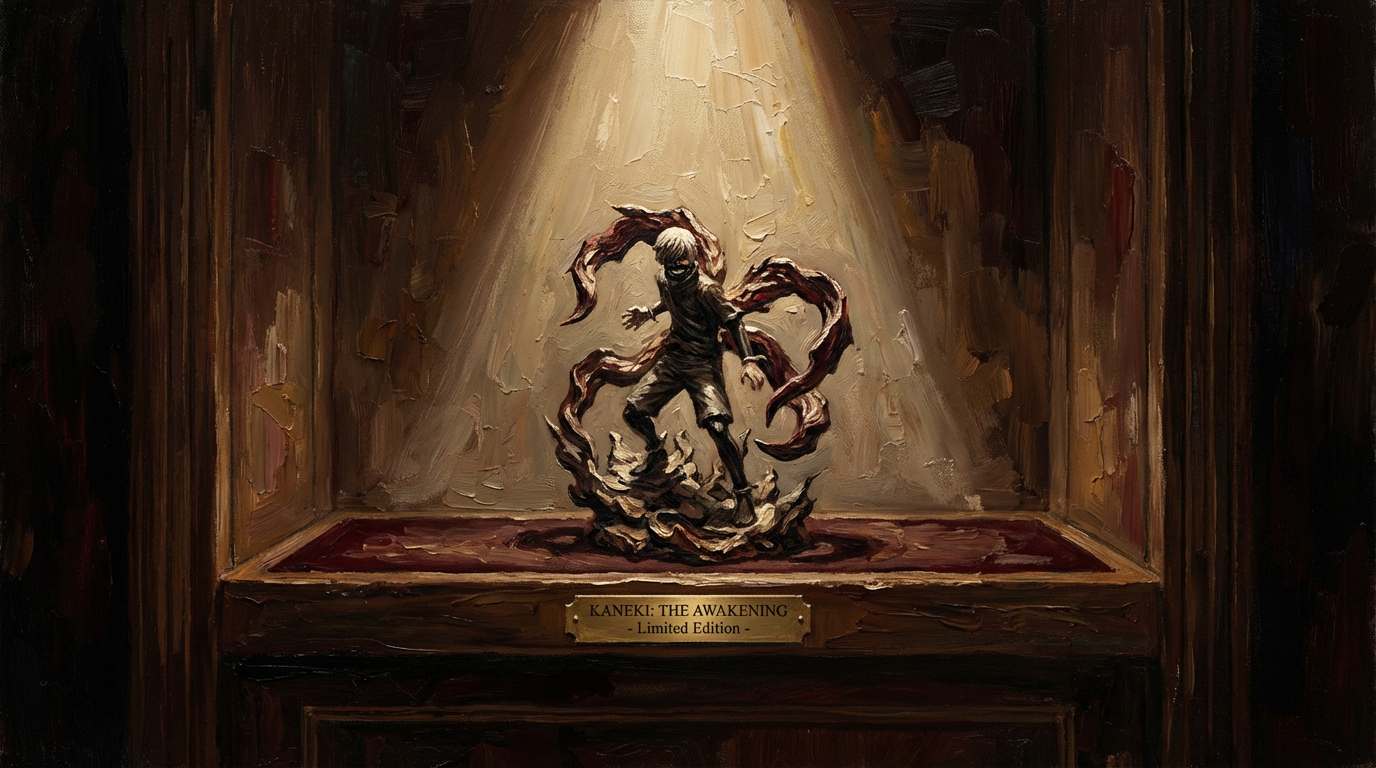
A FigureArt Store listing documents a one‑sixth scale resin Ken Kaneki statue from Kura Collectibles with a list price of $577.00. It offers a six‑month payment plan with six payments of $99.50, and treats the final payment as the shipping fee after Kura confirms your address and freight costs. The piece is limited to six hundred units worldwide and comes with a certificate of authenticity. In other words, this is not impulse‑buy merch; it is a long‑term collecting commitment.
The statue’s dimensions are given as about 33.4 by 33.4 by 34.8 centimeters, which works out to roughly thirteen by thirteen inches at the base and almost thirteen and three‑quarter inches tall. It depicts Kaneki in a dynamic combat pose drawn from his milestone fight with CCG inspector Koutarou Amon, with heavily sculpted kagune arcs emphasizing motion and power. The creative credits are detailed: concept art by Marco Albiero, digital sculpt by Claudio Saavedra Iriarte, paint by Michaël Coupez, with overall direction by Kura Collectibles. That level of attribution feels closer to art than to product.
A separate eBay listing describes a one‑sixth scale GK resin Kaneki figure from ThreeArtisan Studios, promoted to users based on browsing behavior. While the excerpted text focuses more on how eBay’s promoted listings and AdChoice personalization work than on the statue itself, it is still a useful reminder: purchasing high‑end resin is now deeply entangled with algorithmic advertising. Your dream Kaneki might appear because the platform thinks your location, previous clicks, and saved searches match this exact kind of horror‑themed luxury.
Resin polystone, as the FigureArt description notes, allows fine detail but is relatively heavy and fragile. That fragility changes how you live with the piece. You do not casually dust a six‑hundred‑piece limited statue with the same indifference you give a crane‑game prize. You clear space, you plan lighting, you think about where your coffee steam goes. Display becomes a ritual, and the statue becomes the centerpiece of that ritual.
On the other side of the price spectrum, Banpresto prize statues and Aoshima SD figures are documented as “prize only,” often tied to crane games or lottery‑style promotions. The fan catalog’s recommendation to seek these out for affordability and breadth is exactly right in practice. I have had entire shelves built around prize figures and one or two “grail” resin pieces, and the balance feels more sustainable than trying to go all‑resin, all the time.
Consent Banners, Price Forms, And The Data Behind Your Shelf
Buying Tokyo Ghoul figures online is not just about aesthetics; it is also about how much data and friction you are willing to accept.
A pre‑order page for a Miduo Studio Kaneki resin statue on a specialty store is documented only through its cookie‑consent overlay. The recorded text shows a full‑screen banner explaining that the site uses cookies and similar technologies to improve the shopping experience. Users get three clear options: accept all cookies, reject all, or open a settings panel to customize categories. Privacy‑conscious collectors might click reject all, then tune individual settings, but the practical effect is obvious: until you make a choice, the actual statue details are literally hidden.
On mainstream platforms, the friction shifts from cookies to pricing controls. Amazon listings for both the ABYSTYLE Kaneki action figure and the Kotobukiya ArtFX J awakened repaint include a “found a lower price?” form. Amazon is clear that it cannot match every reported price, but it will use the information to keep its offers competitive. The form asks where you saw the lower price, separates website reports from physical store reports, and requires the date of the cheaper price in a month‑day‑year format. For physical stores, some localized versions even require you to select a province or municipality. You are effectively doing unpaid market research for the platform in exchange for the possibility, not the promise, of a better deal.
eBay’s promoted ThreeArtisan Kaneki listing illustrates another layer. The text explains that promoted items are chosen based on predicted user interest, using signals from pages you visit and items you view, plus seller attributes and your location. Ad personalization can be adjusted through an AdChoice setting, but by default, your Tokyo Ghoul browsing is part of the algorithm’s training data.
Even high‑end boutiques play this game differently. Sideshow Collectibles has a dedicated Tokyo Ghoul brand page where the emphasis, in the captured content, is not on a specific statue but on getting you to sign up for a mailing list with a twenty‑dollar discount offer. The message is simple: if you want early access and deals, give us your email and let us into your inbox.
For a collector, none of this is abstract. It affects how soon you see pre‑orders, how often you are tempted by ads while you are just trying to scroll, and how much of your personal information you trade away for a slightly more affordable Kaneki.
Coffee Culture Inside And Outside The Story
Tokyo Ghoul’s coffee culture is not a background prop; it is a narrative counterweight to the violence. Anteiku is where Kaneki learns the ghoul side of coffee, but also where he learns compassion from people like Yoshimura and Touka. The Poggers review notes that Touka eventually rebuilds the café and helps form the Goat organization later in the story, which keeps that coffee shop symbolism alive even as the conflict escalates.
If you compare this to broader anime scholarship, there is a pattern. Research on cultural representation in series like One Piece, discussed in media studies work cited in the Global Media Journal, often highlights how Japanese cultural motifs meet global, hybrid settings. Tokyo Ghoul plays a similar game, but its “cultural motif” is a Western‑style coffee shop in a Japanese city, infused with themes of community, hospitality, and hidden otherness. Coffee becomes a way for ghouls and humans to share space without immediately devouring each other, literally or metaphorically.
In my own routine, that translates surprisingly well. There is something grounding about making coffee while a Kaneki figure quietly stares from a shelf. It echoes the anime’s rhythm: horror and calm, brutality and small kindnesses. When I rearrange figures around my brewing station, I am not just decorating. I am choosing which side of Tokyo Ghoul I want my morning to remind me of.
Designing A Tokyo Ghoul Coffee Nook That Actually Works
If you want to bring that Anteiku feeling into your real‑world coffee space, the goal is to balance three things: the emotional tone you want, the physical constraints of your setup, and the realities of figure materials.
A small vinyl or SD figure around three to four inches tall is perfect for cramped apartment kitchens or office desks. The catalog notes that Funko POP and Dorbz Tokyo Ghoul figures sit in that size range and use soft vinyl. They are light, relatively durable, and visually bold even from a distance. Put one on a floating shelf above your grinder and it will read clearly without crowding the space.
Prize and scale PVC figures around six to almost seven inches are better for a sideboard or a dedicated coffee cart. They give you more dramatic poses and sculpted detail, especially in kagune effects, but still feel casual enough that you do not panic every time you wipe down the counter. A Kotobukiya one‑eighth scale statue around eight and three‑quarter inches becomes more of a focal point; give it breathing room and, ideally, keep it away from direct steam lines from kettles or espresso machines. Resin statues, especially tall ones like that thirteen‑inch Kura Kaneki, belong on shelves safely away from heat and splashes, where the lighting can be controlled and cleaning is gentle and deliberate.
Material matters as much as size. The FigureArt listing is explicit that the Kura statue uses resin polystone, which is heavy and fragile, while most mass‑market statues use PVC and ABS. I treat my resin pieces like porcelain mugs: beautiful, weighty, not something I want near a sink full of dishes. PVC, on the other hand, handles everyday environments better as long as it is not baked under direct sun or scorched by constant heat.
Thematically, you can lean into contrast. A chibi Kaneki near your sugar jar plays up the gentler, meme‑able side of the fandom. A blood‑red, awakened Kaneki ArtFX J near your darker roast beans leans hard into the horror. If you really want to echo the series’ duality, pair a softer piece like Touka’s SD swing with a more intense resin Kaneki on a higher shelf, letting your eye move from tenderness to terror as you move through the room.
From Drawing Kaneki To Displaying Him
One thing I love about Tokyo Ghoul fandom is how seamlessly it flows between mediums: anime, manga, figures, and fan art all inform each other. A Lemon8 art post about Kaneki, for example, describes an illustration where “gentleness is his nature, madness is his weapon.” The artist leans on delicate black and gray dotwork to capture every strand of hair and uses a single splash of crimson in Kaneki’s eye to punch straight through the viewer. The piece uses dual brush and ink pens to balance subtle texture with dramatic contrast.
That design logic shows up in figures too. Many Kaneki sculpts follow the same pattern: restrained black and gray for the outfit, pale skin, and then a violent accent in the eye, mask, or kagune. The best figures feel like three‑dimensional adaptations of exactly the kind of artwork that Lemon8 post describes, just translated into PVC or resin instead of ink on paper.
If you enjoy drawing, digital platforms hosting how‑to‑draw manga guides and Kaneki‑focused tutorials can become part of your ritual as well. You brew coffee, sketch Kaneki’s mask, glance up at the figure that inspired the pose, and suddenly your shelf is not just decoration; it is reference material.
Pros And Cons: Matching Figure Types To Your Coffee Life
Every kind of Tokyo Ghoul figure has trade‑offs, and it helps to think through those in practical terms rather than just chasing the next pre‑order.
Static PVC statues usually offer the best sculpted detail for the price. According to the fan catalog and various listings, they dominate the market in both number and variety. The downside is zero articulation: once you choose the pose, you are committed. That is perfect if you want a stable anchor for your coffee nook, less ideal if you get bored easily and love to tinker with your setup.
Articulated figures like Medicos’ Super Action Statue line or McFarlane’s Color Tops Kaneki give you posing flexibility. A McFarlane Tsukiyama prototype is specifically noted as having fifteen points of articulation, which hints at how dynamic these toys can be. They are fun to adjust, but visible joints can break the illusion of realism, and over‑posing can stress small parts over time, especially if your figure sits somewhere you bump it while reaching for mugs.
Chibi formats such as Nendoroids, Funko POPs, and SD swings are compact, expressive, and usually cheaper than large scale statues. They are also forgiving in casual spaces. A tiny Kaneki swing around one and three‑quarter inches tall can hang on a hook near your coffee filters without dominating the room. The trade‑off is less dramatic sculpting; they lean into cuteness over terror.
Resin statues and large dolls bring unmatched presence. The Kura Kaneki’s limited run of six hundred pieces, detailed creative credits, and substantial size make it a centerpiece, not a filler item. The cons are obvious: high cost, shipping complexity, fragility, and the stress of living with something that feels closer to fine art than to merch. These are pieces you plan a room around.
Finally, digital commerce layers a different set of pros and cons. Cookie consent overlays, price report forms, personalized ads, and email sign‑ups can genuinely help you find the right figure at a tolerable price. They can also flood your feed with temptations and quietly collect data about your habits. Using the reject‑all or AdChoice options and being selective with email sign‑ups lets you stay informed without turning every coffee break into a micro‑shopping session.
Frequently Asked Questions
What size Tokyo Ghoul figure works best on a coffee bar or desk?
Based on documented product ranges, figures around three to four inches tall, such as Funko vinyls or SD swings, are ideal for tight spaces because they stay visible without crowding your gear. Six to seven‑inch PVC statues work well on wider shelves or carts, while eight to nine‑inch scale figures and larger resin pieces are better for dedicated display areas away from heat and moisture.
Are prize figures really worth it compared with premium statues?
The fan catalog’s recommendation to target Banpresto prize and Aoshima SD lines for breadth and affordability matches what many collectors experience in practice. Prize figures give you a lot of character coverage for relatively low cost, which is great if you want multiple ghouls around your coffee corner. Premium statues like the Kura one‑sixth Kaneki offer richer detail and presence but demand more money, more space, and more care. In a coffee setting, a mix of the two often feels more relaxed and sustainable than going only high‑end.
How can I keep figures safe around my coffee setup?
Try to avoid placing any figure directly in the path of steam, splashes, or constant sunlight. Keep resin polystone statues, in particular, on higher shelves or in display cases away from kettles and sinks, since they are heavy and fragile. PVC and vinyl can live closer to the action as long as they are not sitting right next to hot equipment. A quick dusting habit, maybe while your water heats, goes a long way toward keeping both figures and coffee space feeling intentional rather than cluttered.
There is a special joy in sipping something warm while a tiny Kaneki watches over your morning, embodying both the comfort of Anteiku and the chaos outside its doors. When you understand how figure design, materials, and marketing shape that experience, you can build displays that do more than look cool; they tell the same complicated, bittersweet story that made you fall in love with Tokyo Ghoul in the first place.
References
- https://www.academia.edu/43097497/Moreno_Javi_2019_The_Craft_Riffs_adolescence_and_witchcraft_En_In_a_Stranger_Field_Studies_of_Art_Audiovisuals_and_New_Technologies_in_Fantasy_SciFi_and_Horror_Genres_Association_of_Development_and_Dissemination_of_the_Fantastic_Gender_Black_Unicorn_pp_267_287_ISBN_978_84_09_16300_7
- https://www.senate.illinois.edu/2023-2024/20240205senate/EP24055_FINAL_20240205.pdf
- https://gmj.manipal.edu/issues/JUNE2021/S6Odyssey%20of%20the%20cultural%20narrative%20Japan%E2%80%99s%20cultural%20representation%20in%20Eiichiro%20Oda's%20One%20Piece.pdf
- https://repository.library.northeastern.edu/files/neu:bz617n27k/fulltext.pdf
- https://jxnmsapps.jacksonms.gov/browse/X6FdnS/7OK128/art_of-japan__carol-finley.pdf
- https://dev.mabts.edu/uploaded-files/vqy9ro/2OK049/how__to__draw-manga-volume-1.pdf
- https://old.ntinow.edu/book-search/vqy9ro/2S9049/how_to_draw__manga__volume__1.pdf
- https://asset.library.wisc.edu/1711.dl/KLZTY5XU43TP78D/R/file-e58ad.pdf
- https://mail.yuin.edu/virtual-library/vqy9ro/2S9049/How__To__Draw__Manga__Volume_1.pdf
- https://sites.bc.edu/mcmullenmuseum/wp-content/uploads/sites/240/2025/05/RWB-didactics.pdf