How Contemporary Artists Use Figurines in Their Work
From Shelf Candy to Serious Sculpture
If you have ever stared at a PVC anime figurine and thought, “This pose is better than half the stuff in the local gallery,” you are already standing at the doorway to a much bigger conversation. Around the world, contemporary artists are treating figurines, toys and miniature characters as full-blown sculptural materials, conceptual tools and even political agents.
What used to live only on our bookshelves, desks and monitor stands now shows up in museums, biennials and major gallery shows. According to resources from Tate and toy‑focused exhibitions highlighted by Handshucked and Corey Helford Gallery, toys and figurines have moved from being “kid stuff” to being one of the sharpest ways to talk about identity, consumer culture and nostalgia.
In this article I will walk through how artists actually use figurines in their work today, from Pop Art giants and hyperrealist sculptors to art toy customizers and digital sculptors working for the film, game and collectibles industries. I will also look at why figurines are so powerful as an artistic language, and how you can borrow these strategies whether you are a studio artist or a fan with a cutting mat and a backlog of model kits.
A Short History: Toys Crash the Art World
Before we zoom in on today’s figurine scene, it helps to see how we got here. The idea of using toy‑like forms in “serious” art has been brewing for more than a century.
Early modern painters such as Pablo Picasso and Paul Klee were fascinated by children’s drawings and the raw energy of play. Sculptor Alexander Calder turned that playful energy into kinetic sculpture. His “Cirque Calder,” documented by Handshucked, was literally a miniature circus built from wire and scrap materials, animated by the artist like a toy theater. When Marcel Duchamp coined the term “mobile” for Calder’s moving abstractions, he was effectively blessing toy-like motion as a legitimate sculptural strategy.
By the 1950s and 1960s, Pop artists made toys central to their critique of consumer culture. Tate’s learning resource on toys points to Eduardo Paolozzi’s collages and Peter Phillips’s arcade‑inspired paintings, which filled the picture plane with toy imagery, logos and bright, simple shapes. Andy Warhol went all in on this idea in 1983 with a Zurich show of 128 toy paintings hung at child height. Pandas, spaceships and parrots painted in three bold overlaid colors became both a love letter to childhood and a sly question about how brands colonize our earliest memories.
Sculptors followed suit. Jeff Koons scaled up inflatable pool toys into glossy aluminum giants, including his Popeye‑era works where a cartoonish caterpillar interacts with heavy chains. Tate emphasizes how this tension between lighthearted forms and industrial materials turns a “silly” object into a monument to consumer desire and the weight of debt and labor behind it.
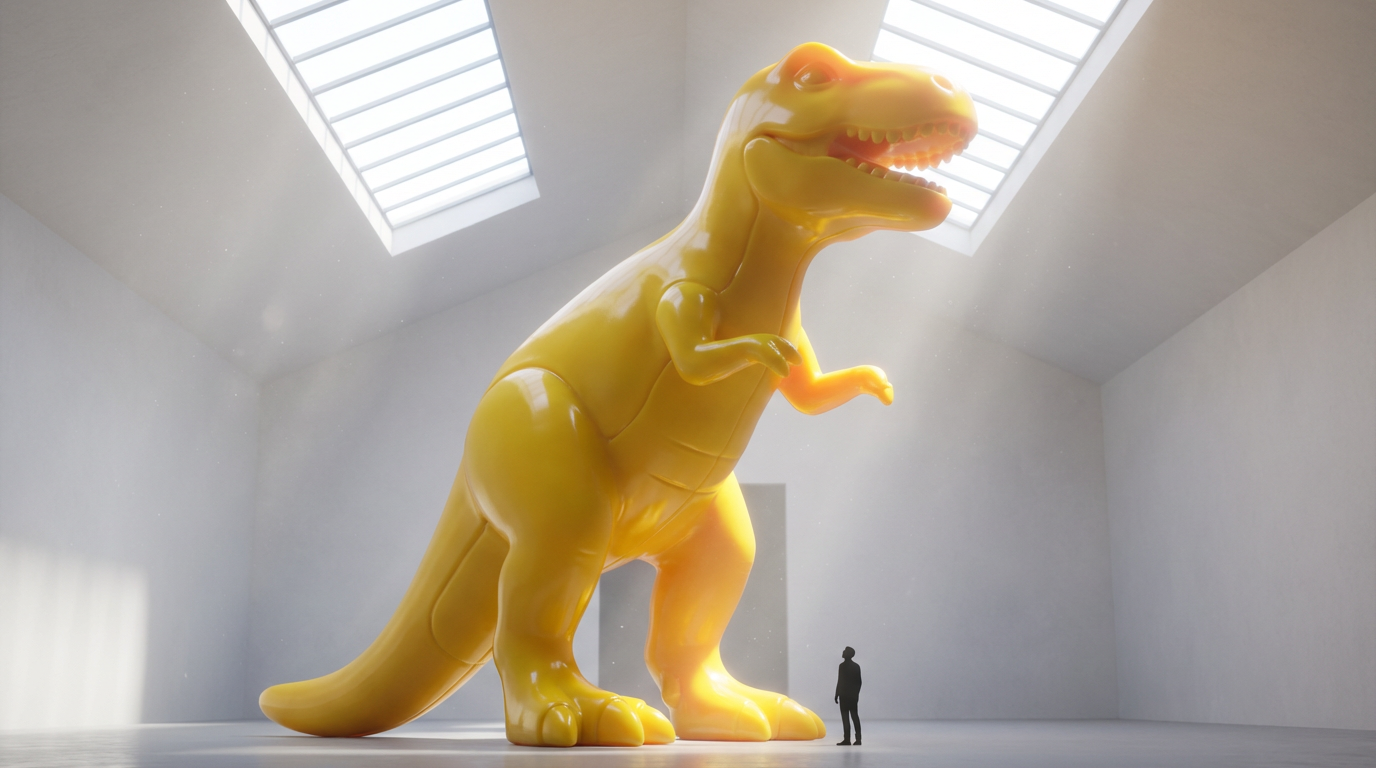
At the same time, artists outside the Western Pop narrative were already thinking about mass‑produced objects. The Denver Art Museum notes that in the early 1990s, Chinese artist Sui Jianguo visited the city of Shenzhen, where cheap plastic toy dinosaurs were being mass‑produced. He began recreating those tiny toys as huge, brightly colored sculptures. The jump in scale did two things at once: it made the dinosaur look awe‑inspiring again and forced viewers to confront the reality that these icons of prehistoric nature were being churned out by machines for pennies apiece.
By the 1990s, a distinct “art toy” culture took shape. A survey from Alexdood describes how artists rooted in street art and illustration started designing or customizing figurines as a new kind of canvas. Designers such as Michael Lau, often referred to as a father of the movement, helped transform vinyl figures from child’s play into limited‑edition artworks that blurred the line between toy, sculpture and fashion.
Today we are living in the aftershock of all of this.
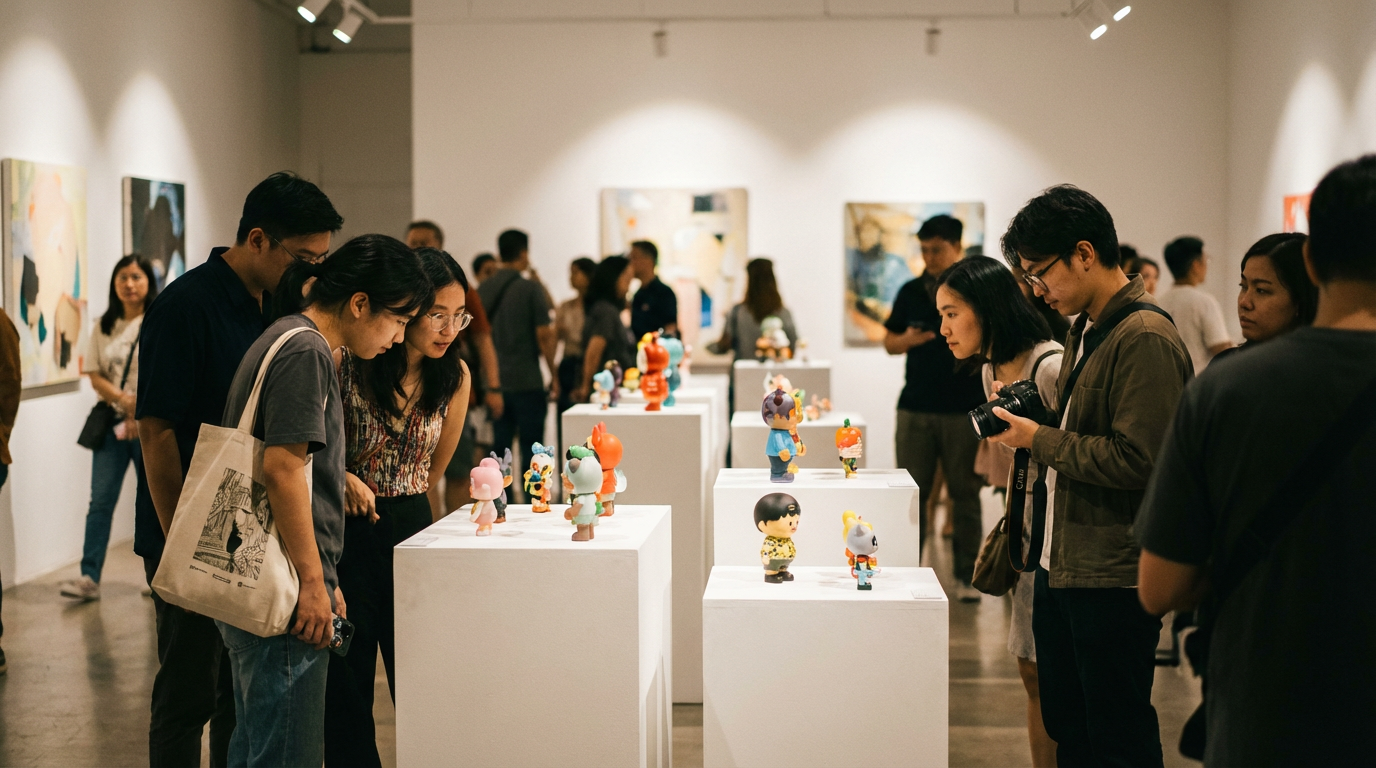
Art toys, figurines and miniatures have become a common language shared by museums, galleries, toy expos and fandom spaces.
How Artists Use Figurines Now: Key Strategies
Super‑Sizing the Small: Scale Games
One of the simplest but most powerful ways artists work with figurines is by messing with scale. Sui Jianguo’s monumental toy dinosaurs are a perfect case study documented by the Denver Art Museum. He takes a cheap plastic dinosaur, scales it up to the size of a car or a small room, and paints it in bright colors. Suddenly the mass‑produced figure feels important, even threatening. You feel small again, the way you might have as a kid when toys loomed large in your imagination.
Jeff Koons uses a similar logic from another angle. Handshucked’s survey of toy‑inspired art points out that his famous balloon dogs start from something you could twist at a kid’s birthday party. By turning that into a mirror‑polished steel sculpture around ten feet tall, he flips a fragile, throwaway object into something heavy, permanent and extremely valuable. That contrast between what your brain expects (a soft balloon) and what you see (rigid metal at heroic scale) is the emotional punchline.
For anyone who collects anime figures or Gunpla, this is a familiar thrill. A character that exists at three or four inches suddenly drops as a two‑foot premium statue and feels “real” in a different way. Contemporary artists are deliberately weaponizing that feeling.
Art Toys and Custom Culture: Re‑Skinning Icons
The most obviously figurine‑centric world right now is art toys. Alexdood’s overview defines Art Toys as artist‑created or customized figurines born out of street art and counterculture in the 1990s. They emerged partly in rebellion against standardized, mass‑produced toys. Instead of repainting the same superhero in infinite colorways, artists began inventing characters or reimagining existing ones as small‑batch sculptures.
Within that world, Los Angeles‑based artist Josh Mayhem has become a key figure. Haute Living and ZK Gallery both profile his “Blown Away” series. Mayhem starts with designer toys and pop culture figures, including authentic platforms such as KAWS Companions and Chums, Bearbrick 400 percent figures, Sonic the Hedgehog, Gundam kits, Uamou vinyls and even a James Jean x Disney Mickey. He then covers these bases in strands of resin and layers of acrylic and clay, creating gravity‑defying drips that look as if a psychedelic wind is tearing the figure apart.
He likes to say, quoted by ZK Gallery, that “all toys are miniature sculptures.” In his hands, that is not just a slogan. A twelve‑inch vinyl figure becomes an eleven‑inch or twenty‑one‑inch one‑of‑a‑kind sculpture, with the underlying character still recognizable but visually overwhelmed by motion and color. The show “Art Toys: La Pietà of Toys or Incarnation as Art” at ZK Gallery demonstrated how many pop icons can be reinterpreted this way, from “Blown Away Balloon Dog” on a Koons‑inspired form to “Blown Away Gundam – Galactic Splash” and “Fantasia Dreamstorm Mickey.”
Handshucked’s research on Mattel’s eightieth‑anniversary exhibition at Corey Helford Gallery shows the same logic at a group‑show scale. Over eighty artists were invited to reimagine Barbie, Hot Wheels, Fisher‑Price toys, Masters of the Universe characters and UNO cards. Some turned them into paintings, some into sculptures, some into immersive installations. From a figurine fan’s point of view, it is like seeing the entire toy aisle suddenly filtered through a hundred different fanart styles, then polished to museum level and hung in one space.
Figurines as Agents of Identity and Power
Tate’s toy resource uses the phrase “Power Toys” for a reason. Dolls, mannequins and toy bodies are not neutral; they encode messages about gender, class and who is allowed to look powerful or vulnerable. Contemporary artists use figurines to expose and challenge those messages.
Photographers and sculptors including Cindy Sherman, Claude Cahun, Sarah Lucas and Rose Wylie all work with doll‑like forms. Tate notes that Sherman, in her series “Doll Clothes,” manipulates dolls to blur lines between plastic and human, suggesting that femininity itself is a kind of costume. Lucas uses rag‑doll and soft toy bodies to address sexual politics with deliberately awkward, sometimes confrontational poses. Wylie paints toy‑like figures that fragment and reassemble the female body, poking at beauty standards by making them cartoonish and almost clumsy.
In each case the figurine or doll is a stand‑in for a person whose identity is being staged, constrained or pulled apart. For anyone who has ever noticed how many mass‑market female characters default to the same face, the same proportions and the same “cute but passive” pose on a shelf, this critique lands hard.
Figurines also appear in work about war and violence. Tate and Handshucked both discuss how Paula Rego’s toy‑like rabbits, Jake and Dinos Chapman’s reconstructions of Goya’s “Disasters of War” using toy soldiers, and Cold War pieces by Malcolm Morley and Colin Self use miniature bodies and model planes to intensify the horror. Putting atrocities into miniature form does not trivialize them; if anything, it forces us into a voyeuristic position, like a child playing war games, and then slams us with the realization that these “games” echo real suffering.
Figurines and Cultural Storytelling
Beyond identity politics, figurines are powerful vehicles for cultural memory.
Meschac Gaba, in his “Game Room” described by Tate and Handshucked, enlarges board games, chess sets and puzzles into a gallery‑scale installation. Visitors are encouraged to play. The oversized pieces operate like figurines you can inhabit, turning the museum into a social space where African and European visual traditions mingle on equal footing.
Iranian sculptor Parviz Tanavoli, highlighted in toy‑art surveys, makes colorful robot‑like figures that often reference stories from the Shahnameh, Iran’s national epic. One work features characters from a famous love story, translated into toy‑adjacent forms that feel as approachable as an action figure while carrying centuries of literary weight.
On the environmental front, Causeartist profiles British sculptor Robert Bradford, who builds life‑size and larger‑than‑life human and animal figures from up to three thousand discarded plastic toys per sculpture. Clients sometimes send him their children’s old toys to incorporate, merging personal family histories with broader commentary about waste. The resulting figures have the visual punch of a giant collectible and the emotional charge of a memory collage.
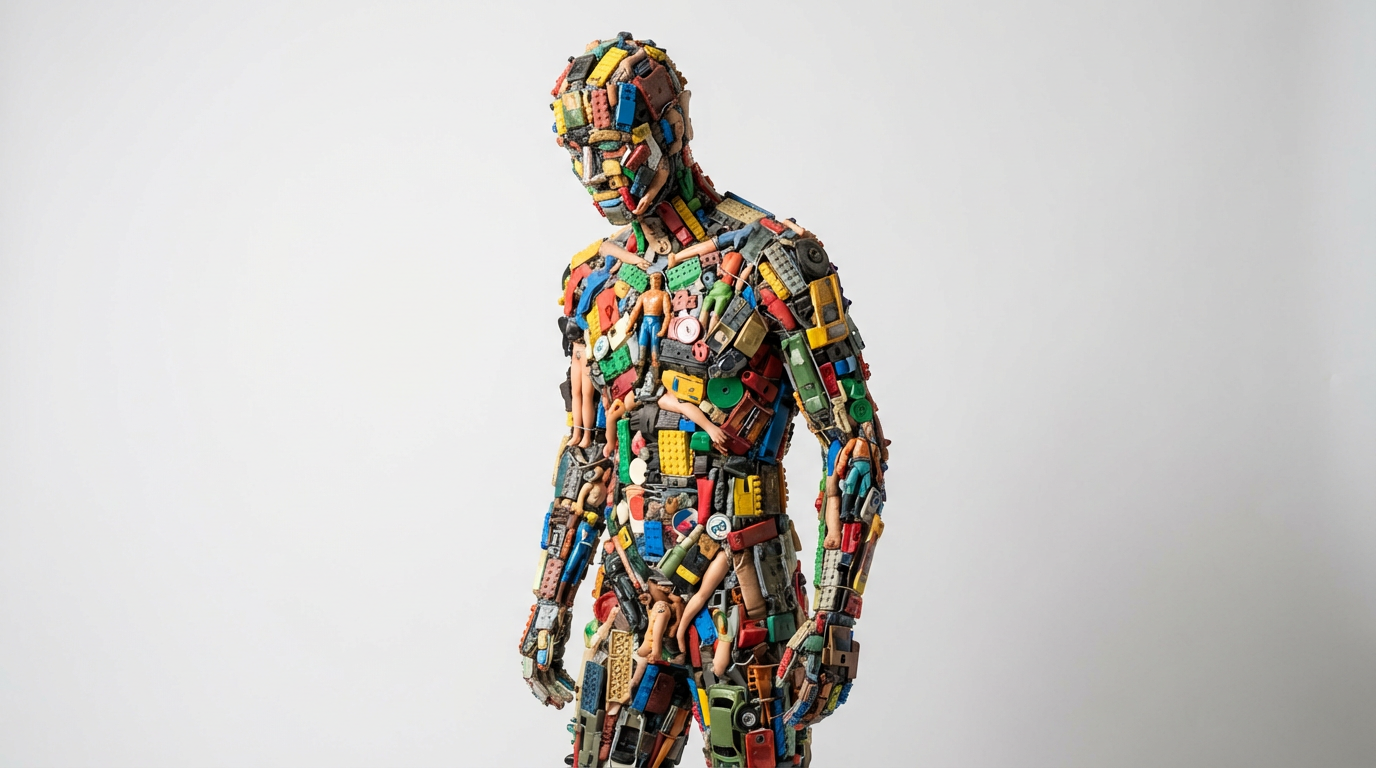
Singapore‑based artist Tan Zi Xi (also cited by Causeartist) used approximately twenty‑six thousand pieces of cleaned plastic to create “Plastic Ocean,” an installation that makes visitors feel as if they are walking through the Pacific Garbage Patch. Many of those pieces are toy fragments. The work essentially says, “Here is where all those forgotten figurines end up,” and it says it not in a lecture but in an overwhelming, body‑scale experience.
Miniature Worlds and Diorama Dreams
On the opposite end of the scale spectrum, many artists lean into the intimate appeal of miniature figures. DesignMantic’s overview of miniature art introduces Japanese artist Tatsuya Tanaka, whose long‑running “Miniature Calendar” series stages tiny human figures among everyday objects. Mango slices become islands, circuit boards become golf courses and rolled magazines become waves. With a few figurines and good lighting, he turns the sort of storytelling toy photographers do for fun into a daily conceptual practice.

Other artists build entire model worlds. Thomas Doyle and Matthew Albanese construct highly detailed miniature landscapes and then photograph them so they read as full‑scale scenes, sometimes of natural disasters or surreal events. Even when figures are small or implied, the logic is very similar to posing a group of six‑inch anime figures in a detailed diorama and then shooting cinematic photos: the miniature becomes a story engine.
Miniature figurines can also be deeply personal. DesignMantic notes that Lucy Francis Maloney has created more than one hundred fifty thousand tiny, lifelike dog replicas based on photographs, using wire armatures and fibers such as cashmere, alpaca and real dog hair. These miniature creatures often help owners grieve pets they have lost. It is not a big leap to imagine similar practices emerging around beloved characters and OCs in fandom spaces.
Digital fabrication is part of this miniature ecosystem too. Miguel Zavala, for example, designs and 3D‑prints an extensive library of tabletop miniatures based on role‑playing game bestiaries, sharing the files for others to print. His work sits at the intersection of fan creativity, sculpture and open‑source distribution.
Digital Sculpting, 3D Printing and the Figurine Pipeline
If you love anime and game figures, you already know that today’s collectible shelves are powered by digital workflows. What is interesting is that fine art sculpture is now openly admitting that it needs the same skills.
An article from the Academy of Art University’s School of Fine Art in San Francisco describes how their sculpture program deliberately combines traditional clay modeling with digital tools such as ZBrush, handheld 3D scanners and 3D printers capable of twenty‑four‑inch outputs. Students first sculpt from life in clay, then scan their work, refine it in ZBrush, view it from multiple angles, rescale it and sometimes print new versions. Faculty emphasize that technology is “only as good as the artist using the tools,” but they also define professional readiness as having both traditional and digital competencies.
The reason is spelled out very clearly: sculptors working in film, gaming, collectibles and animation need to be fluent in both worlds. The article cites Mark Newman, who sculpts for companies like Sideshow Collectibles.
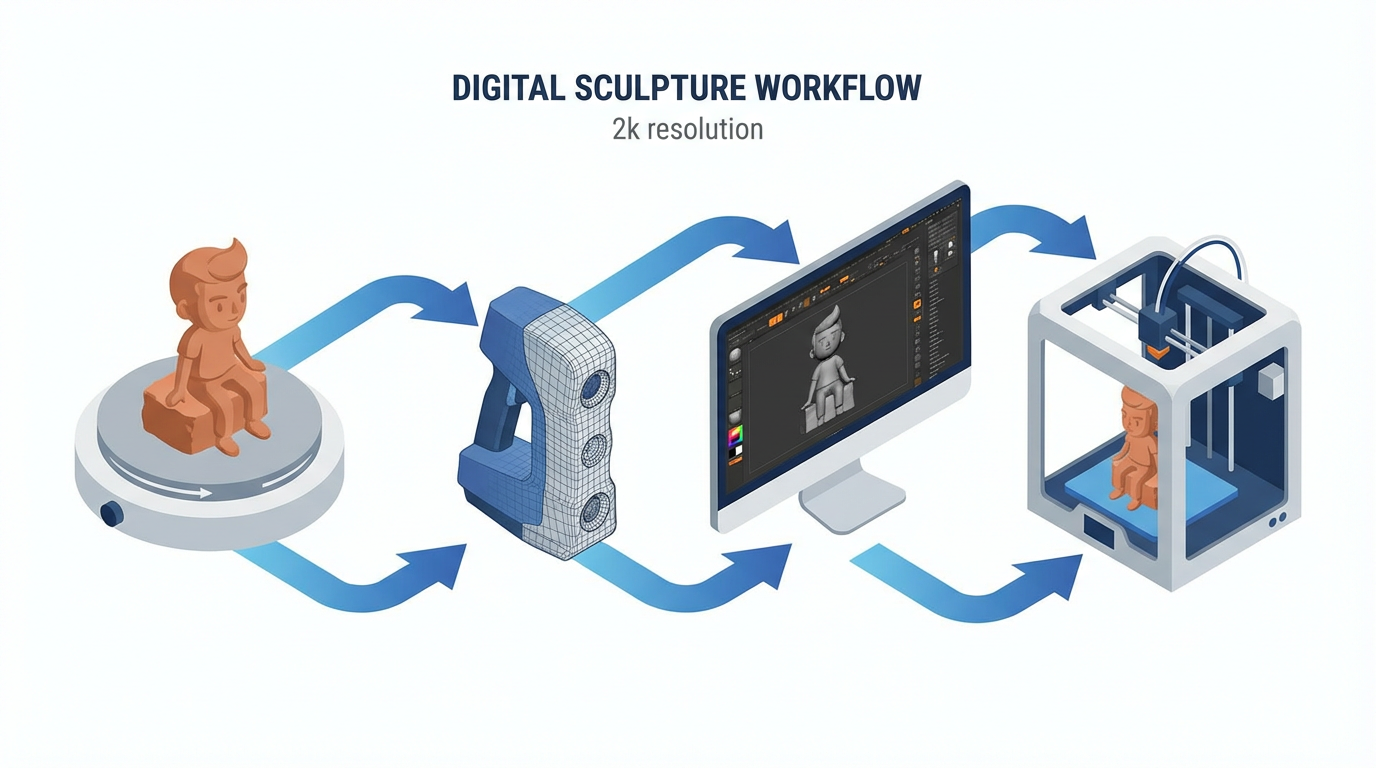
He initially resisted digital tools but eventually found that they dramatically increased his efficiency, especially for multi‑part figurines produced in volume. Even bronze foundries are starting to incorporate 3D printing into their casting workflows.
Alexdood’s overview of Art Toys echoes this trajectory. New materials, 3D printing and even eco‑friendly plastics are expanding what designers can do. Some contemporary art toys incorporate QR codes or NFC chips that link physical figurines to digital experiences. Meanwhile, Handshucked points out that exhibitions like the Mattel anniversary show at Corey Helford Gallery are full of pieces that could not exist without digital sculpting and fabrication, even when the final object is hand‑painted.
From an anime figurine fan’s perspective, this is all very familiar. The workflow of sculpting a character in ZBrush, cutting it into keyed parts, printing a prototype, then mass‑producing painted PVC is standard industry practice. What is changing is that more artists and art schools are acknowledging that this is not “lesser” craft; it is the contemporary evolution of sculpture.
Why Figurines Work So Well in Contemporary Art
The Psychology of Play and Nostalgia
Educational research on play gives us a good lens for understanding why figurines have so much power as art materials. Harvard’s Project Zero, through its Art|Play initiative, argues that playful engagement with art helps children imagine the world from multiple perspectives, a skill John Dewey considered essential for democracy. Rocky Mountain College of Art + Design likewise stresses that play is not optional in creative development; it is how the brain experiments, discovers and stores new patterns.
Artfully Learning’s discussion of “learning through play” notes that play helps people persist through challenges, manage impulsivity and take responsible risks. Psychologist Peter Gray, quoted there, summarizes research showing that play builds intrinsic interests and competencies, teaches decision‑making and self‑control, supports emotion regulation and social skills, and produces joy.
Now map that onto figurines. When artists bring toys and figures into the studio, they are importing objects that are already encoded with play. A Gundam kit, a Bearbrick or a doll is an invitation to handle, pose and imagine. When a sculptor enlarges a toy dinosaur, dissects a Barbie, or resurfaces a KAWS Companion with dripping resin, they are hijacking that playful impulse and redirecting it toward reflection. You feel safe enough to approach the work because it looks like something from the toy shelf; then the content hits you.
For viewers who grew up with anime, games and collectibles, that emotional shortcut is especially strong. A figurine is not an abstract shape; it is a compressed bundle of memories of late‑night binge‑watching, saving for preorders, waiting in line at cons, swapping parts with friends and maybe even drawing your own fan redesigns. Artists lean into this so that their work can talk to your inner fan, not just your inner art historian.
Toys as Ready‑Made Sculptural DNA
There is also a practical side. X‑Contemporary’s survey of artists who transform everyday objects points back to the early twentieth‑century Dada “readymade,” where an existing object becomes art simply by being framed and recontextualized. Figurines are incredibly dense readymades: they already have expressive poses, facial expressions, costumes, textures and narrative hooks built in.
Found object assemblage, a technique traced through artists like Joseph Cornell and Betye Saar, is central here. Causeartist’s and Upcyclist’s profiles of eco‑artists show how discarded toys, stuffed animals and plastic figures can be combined with other wastes to create installations ranging from Agustina Woodgate’s skin rugs stitched from deconstructed plush toys to large‑scale animal sculptures made from recycled tires or scrap metal. Each figurine fragment carries a history of play, wear and emotional attachment, which becomes part of the sculpture’s meaning.
Figurines compress all the visual decision‑making of character, pose and silhouette into a portable object. That “sculptural DNA” makes them perfect sources for collage, casting, 3D scanning, duplication and mutation.
Pros and Cons of Building Art around Figurines
Figurines are powerful, but they are not a magic bullet. Handshucked’s legal and market analysis, along with the art‑toy histories and educational essays cited earlier, let us sketch some clear advantages and trade‑offs.
Aspect | Advantages of using figurines | Potential drawbacks and risks |
|---|
Audience connection | Figurines tap straight into nostalgia, fandom and everyday life, making conceptually complex work instantly relatable for viewers who recognize the forms. | Some audiences and gatekeepers still label toy‑based work as “lowbrow” or decorative, which can limit opportunities in more conservative institutions. |
Speed and structure | Starting from a toy or art‑toy platform gives artists a strong underlying form, freeing them to focus on surface, color, context and concept. | Relying too heavily on pre‑existing figures can make work feel derivative or dependent on other designers’ aesthetics if not clearly transformed. |
Conceptual leverage | Toys naturally carry themes of childhood, consumerism, play, identity and war, which artists can foreground or subvert with relatively small visual shifts. | Because these themes are so common, it can be harder to say something genuinely new without deep research or a strong personal angle. |
Production and collectibility | Figurine‑based works translate well into small editions, resin runs and 3D‑printed series, connecting with the designer‑toy collector culture that Handshucked and Alexdood describe. | The same collector logic can create pressure to repeat popular designs, and limited editions can raise expectations about quality, packaging and market value that feel more like product design than open‑ended art. |
Legal and ethical issues | Official collaborations with brands, such as those in the Mattel anniversary show or licensed art‑toy releases, safely tap into iconic characters and logos while supporting creators on both sides. | Handshucked emphasizes that fair‑use defenses for unlicensed branded toys are legally gray; artists who parody or critique brands may face IP challenges, so working without permissions carries real risk. |
None of these are reasons to avoid figurines entirely. Instead, they are a reminder that if you want to work at the intersection of art, toys and fandom, you are entering a complex ecosystem that mixes sculpture, design, law, education and community building.
Practical Ways Artists and Fans Are Working with Figurines
If you are an artist, educator or hardcore anime‑figure collector who wants to push beyond display shelves, research from museums, art schools and toy‑focused writers offers several practical models.
The Denver Art Museum’s “Artful Transformations” activity based on Sui Jianguo’s dinosaurs suggests a very approachable Pop‑Art method. Start with a small figurine, shine a bright light so its silhouette appears on the wall, tape a large sheet of paper over the projection, and trace the outline. Then treat that oversized contour as a canvas. Fill it with real or imagined details, using bright, flat colors and a bold background that radiates around the figure. With one lamp, one toy and some paper, you have effectively given yourself a giant figurine to design on.
Educational resources from AccessArt and ArtPedagogy advocate what they call “design through making” and “purposeful play.” Instead of planning everything in advance, you start cutting, taping, gluing and posing with actual materials. For figurine‑based projects that might mean building quick cardboard maquettes of display stands, strange mechanical devices that move or support characters (drawing on the automata examples they discuss), or wearable elements inspired by the shapes of your favorite figures.
The University of Melbourne’s feature on Nabilah Nordin shows a fine‑art version of this. She creates “wearable sculptures” for a moon‑themed parade, teaching herself to sew and combining fabrics and sculptural materials into extravagant costumes. Her works sit between sculpture, costume and character, echoing the way figurines live somewhere between object and avatar. Translating that sensibility to fandom might look like designing performance costumes or masks that treat yourself as a one‑off figurine in a real‑world parade.
Haute Living’s interview with Josh Mayhem, alongside his ZK Gallery exhibition, doubles as a how‑to and a career case study. He describes discovering designer toys around age thirty, immersing himself in that subculture, customizing figures at night while working full‑time day jobs and gradually evolving from an early Gundam‑and‑war mash‑up style into the now‑distinct Blown Away aesthetic. He emphasizes following inspiration even when it means abandoning a popular style, surrounding yourself with art that pushes you, and learning the business side of galleries and licensing. For anyone dreaming of turning anime‑figure customization into a career, that trajectory is a concrete example grounded in the designer‑toy world.
On the digital front, the Academy of Art University’s sculpture program is essentially offering a recipe. Learn to sculpt from life in clay, scan your forms into ZBrush, iterate and refine, then 3D‑print prototypes that can be molded or cast. Combine that with Alexdood’s observations about 3D printing and smart figurines, and you get a roadmap: design original characters with figurine proportions, give them strong silhouettes and expressive poses (skills anime sculptors have refined for decades), then explore limited physical runs, digital collectibles or hybrid physical‑digital experiences.
For educators, Handshucked recommends leveraging toy‑inspired artworks to teach visual literacy and social critique. Using examples from Cindy Sherman, Jeff Koons, Jake and Dinos Chapman or the Mattel anniversary show, you can invite students to bring a figurine from home and then redesign it in drawings, collages or temporary assemblages that address issues they care about, from body image to climate change. Artfully Learning and Rocky Mountain College of Art + Design both stress the importance of framing these activities as play: clear enough that students feel safe, open enough that they can take real creative risks.
Underneath all of these strategies is a simple but powerful idea: figurines are not the end product. They are starting points, prompts and collaborators. The more you treat them as flexible raw material, the closer you get to the way contemporary artists are using them.
FAQ
What is the difference between a figurine and an art toy in this context?
Alexdood’s survey suggests that figurines become Art Toys when they are conceived or customized primarily as artworks rather than as mass‑market playthings. Art Toys are often designed by artists, produced in limited editions, tied to street art or contemporary art scenes and collected the way prints or sculptures are collected. A standard PVC anime figure can be raw material; once an artist significantly transforms it conceptually or formally, or designs the figure from scratch as an artwork, it moves into Art Toy territory.
Can figurine‑based work be considered “serious” art?
The research from Tate, the Denver Art Museum, Corey Helford Gallery, fine‑art schools and major publications on hyperrealist sculpture shows that many institutions already treat toy‑like figures as serious art. From Sui Jianguo’s monumental dinosaurs and Jeff Koons’s balloon animals to museum‑scale installations built from toys and Mattel‑backed anniversary shows with dozens of contemporary artists, figurine‑centered work is clearly part of the contemporary canon. The critical question is not whether the base object started as a toy, but what the artist does with it.
Do I need permission to use branded figurines in my art?
Handshucked’s article is careful to note that using branded toys raises copyright and trademark issues. Parody and critique can sometimes fall under fair use, but the outcomes are unpredictable. The safest route, especially for commercial editions, is to work through official collaborations with brands or to design original figurine‑like characters that capture the spirit of play without copying protected designs.
Closing
For those of us who already see PVC shelves and glass detolf cases as our personal museums, it is thrilling to notice how closely the broader art world has moved toward that same territory. Whether it is a hyperrealist sculpture that feels like a life‑sized figure prototype, a gallery full of customized vinyl characters, or a vast installation stitched from discarded toys, contemporary artists are proving what collectors have sensed all along: figurines are not just merch. They are one of the most vivid ways we have to sculpt who we are, what we value and how we play.
References
- https://pz.harvard.edu/projects/artplay
- https://sva.edu/features/six-plasticulture-artists-on-turning-waste-into-wonder
- https://www.rmcad.edu/blog/unlocking-creativity-through-playful-exploration-in-art-education/
- https://artuk.org/learn/learning-resources/laura-fords-mixed-media-sculptures
- https://www.denverartmuseum.org/en/edu/art-exploration/artful-transformations
- https://www.artsy.net/article/artsy-editorial-collectible-designer-toys-art-form
- https://www.artpedagogy.com/yr8tc5.html
- https://www.causeartist.com/incredible-recycled-art-materials-creations/
- https://handshucked.com/blog/art-inspired-by-toys?srsltid=AfmBOoojd2pSaF4-0eVKsxmdpEHzeXCbj0FWTltlcZfVokluQYHxrmZb
- https://www.accessart.org.uk/playful-making/