How Limited Edition Anime Items Cause Sleepless Nights for Buyers
Limited edition drops tap deep psychological levers that can turn a fun hobby into late-night refresh marathons. Once you see how the game works, you can enjoy the chase without sacrificing your sleep or your savings.
Ever stared at a preorder page at 2:46 AM, hoping your grail figure will load before the "sold out" badge appears? Maybe you swore this would be your "last big purchase," but now your cart, credit card, and schedule all feel out of control. This guide unpacks why limited editions are built to keep you up at night, how brands design that tension on purpose, and the simple habits that let you keep collecting while staying sane.
What "Limited Edition" Really Means In Fandom
Across snacks, sneakers, and shelf queens, limited edition products are released in small quantities or for short windows so they feel rare and urgent, a pattern laid out clearly in analyses of limited edition CPG products. For anime collectors, that can mean a figure capped at a few hundred pieces, a convention-only color variant, or a preorder window that closes after a couple of weeks and never reopens.
Marketers wrap this in what psychologists call scarcity: the idea that people value things more when they are harder to get, a principle that sits at the heart of modern scarcity marketing. Limited quantities and ticking clocks are not accidents; they are design choices that push you from "I like this sculpt" to "I have to buy now or regret it forever."
The effect is not limited to niche hobbies. In grocery aisles, simply adding a "limited edition" label to a flavor or package nudges shoppers to buy sooner, turning everyday items into short-term events, as explored in research on limited edition labels and food purchases. When a basic cookie or soda can gain that much pull from a small text badge, imagine how much extra power that label has when it is sitting under your favorite character in full dynamic pose.
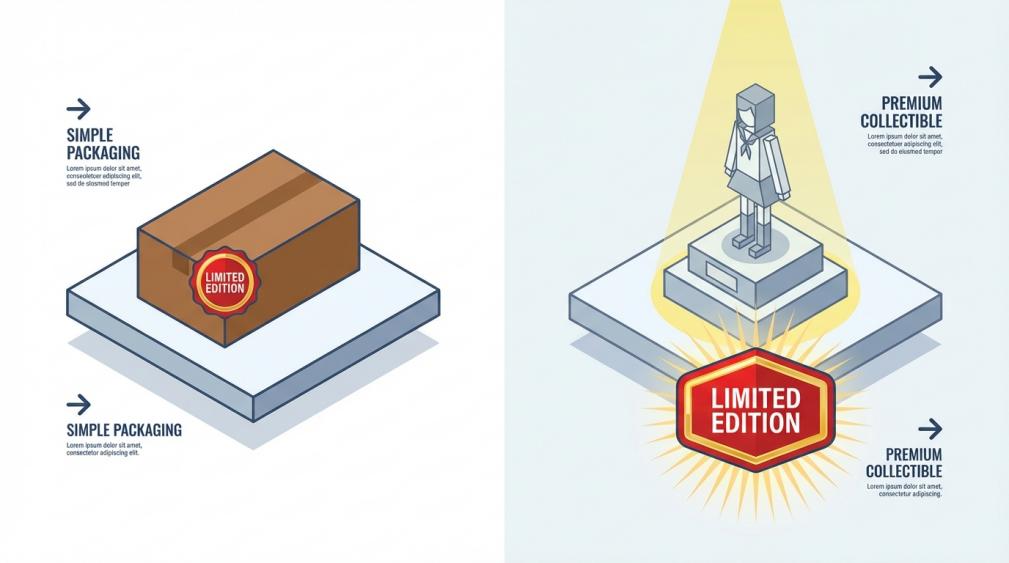
Retailers also lean on "exclusive" language. Academic work on retailer-exclusive products shows that "only at this store" labels are meant to reduce comparison shopping and justify higher prices, especially when a product adds small extra features or cosmetic tweaks. Follow-up studies of retailer exclusives find that the label alone does not always boost desire and can even hurt evaluations when the exclusive attribute is trivial. For collectors, that means not every "store exclusive faceplate" is automatically worth losing sleep over.
Why Limited Editions Flip Your Collector Switch
Scarcity, urgency, and that racing heartbeat
Scarcity marketing increases perceived value and urgency by constantly reminding you that time, quantity, or access is limited. When a product page says "only a few left" or a timer counts down the last minutes of a preorder, your brain quietly shifts from careful comparison to "decide now before it disappears."
A large meta-analysis of more than a hundred studies on product scarcity finds that these signals reliably raise purchase intentions across categories, confirming that scarcity is not just a cute idea but a robust effect on behavior. Campaign data from consumer goods show a similar pattern: in one breakdown, 14 percent of in-store shoppers say fear of missing out influences impulse purchases and about 15 percent of adults are willing to pay more for exclusives, according to an analysis of limited edition CPG launches. Translate that to figure drops and it is no surprise that a countdown banner can override your usual rule of "wait and think."
In anime collecting, this looks like camping in front of a screen as a Japanese preorder opens at midnight your time, watching stock bars plummet, and feeling your pulse spike when checkout hangs for half a second.

The product did not change in that moment; only your perception of its rarity did.
Status, belonging, and the velvet rope effect
Exclusivity taps into a deep desire to feel "inside the velvet rope," a dynamic luxury brands rely on when they deliberately restrict access to products and events, as explained in work on exclusivity in luxury brand campaigns. Owning something few others can get is not just about the object; it is about what it says about you.
Exclusivity marketing frameworks emphasize how scarcity, rarity, and limited access make offerings feel prestigious and more desirable, especially when combined with strong storytelling and community experiences, as discussed in guides to exclusivity marketing for premium brands. For fans, that might mean showing off an event-only acrylic stand on your shelf or posting a photo of a low-numbered figure base, signaling that you were early, determined, or just lucky.
Brands actively use these feelings to build loyalty and trust. Thoughtful exclusivity programs are framed as ways to make customers feel uniquely valued rather than shut out, with clear criteria and future access paths so broader audiences remain engaged. In practice, that might look like VIP early access for long-time buyers or lottery entries for members, turning your fandom loyalty into earlier, easier chances at limited runs.
Social proof and the hype feedback loop
Humans also take cues from each other. When a collaboration snack or drink sells out instantly and ends up on resale sites for several times the original price, the product becomes social currency as much as food, a dynamic highlighted in coverage of limited edition CPG collaborations. The same playbook runs through anime and streetwear: weekly drops, tiny batches, and "sold out in minutes" headlines that feed the next wave of hype.
Scarcity-driven launches using teasers, countdowns, and rigid drop times turn shopping into an event, reinforcing that only the most committed or plugged-in fans will win. Every time you see a timeline full of "got it!" posts and haul photos, it quietly reinforces the idea that this piece is worth chasing, even if you were on the fence a day earlier.
That loop cuts both ways. When you score a rare variant and post your own photos, you are not just sharing joy; you are also, without meaning to, helping set the stage for someone else’s 3:00 AM scramble on the next drop.
The reseller economy and "investment brain"
Limited editions also awaken a different motivation: the sense that you are not only buying for yourself today but possibly investing for tomorrow. A survey of hundreds of limited edition buyers in reselling markets found that economic motivations, such as expected resale value, significantly drive continued purchasing and trading, while pure emotional appeal alone does not fully explain repeat behavior.
In figure collecting, that can look like treating certain pieces as "stock" rather than characters you love, grabbing extras because you expect prices to climb once preorders close. Sometimes that bet pays off, especially when drops are truly small and demand stays high. Other times, the market cools, restocks appear, or tastes shift, and you find yourself with boxes you never really wanted taking up space and mental energy.
When Limited Editions Steal Your Sleep (And Your Joy)
The most obvious cost of this system is literal sleep. Many anime figure drops, especially Japan-first preorders and global lotteries, launch at awkward hours. Even when you could wait for local retailers, the fear that allocations will vanish pushes you to set alarms, break up your night, and glare at brightly lit screens in the dark.
Then there is financial stress. Scarcity and urgency cues are designed to accelerate decisions, and campaign breakdowns of limited edition launches show that well-timed urgency can spike short-term sales by sizeable percentages during a campaign window. That sales lift is good for brands but can translate into overspending for individual fans who abandon their usual "do I really want this?" checklist when a timer hits the last minute.
There is also a quieter psychological toll when "exclusive" turns out to be underwhelming. Experiments on retailer exclusives report that an "exclusive" label by itself does not significantly increase willingness to pay or purchase intention and, in some cases, pairing it with trivial cosmetic features can even lower product evaluations. That maps cleanly onto the deflating feeling of unboxing a "store exclusive" figure only to realize the only difference is a barely visible color tweak.
Ethically grounded scarcity frameworks emphasize that limited offers should come with real added value and honest limits and warn that overusing scarcity language or relying on fake limits erodes trust over time. For collectors, constantly discovering that "limited" did not really mean limited can turn a joyful hobby into a cycle of suspicion and regret.
How To Hunt Limited Editions Without Losing Sleep
Decide your grail rules before the next drop
The most powerful move is deciding your own rules before you see a timer. Studies on exclusivity promotions show that exclusivity messaging is most effective when it comes bundled with added attributes that actually matter to the buyer and much less effective, or even harmful, when the "exclusive" feature is trivial or misaligned. Translate that into simple questions you ask yourself every time: would you still want this figure if it stayed in stock for a year, and would you buy it tomorrow at the same price without any "limited" badge?
If the honest answer is no, that is a sign you are buying the label, not the character. On the other hand, if this is a sculpt of a character that got you through a rough season, from a studio whose paint work you already trust, that emotional and practical value is real, and scarcity can be a tiebreaker rather than the main reason.
Sort drops by what they mean to you, not by how rare they are
It helps to mentally sort releases into three loose buckets. Some items are forever grails, the ones you will happily dust and repose five years from now. Others are fun maybes, pieces you enjoy but would not miss if you skipped. A third group exists mainly as hype: collaborations or variants you would never glance at if they were common.
Limited edition campaigns that perform best tend to combine scarcity with storytelling, emotional resonance, and added value, a mix highlighted in breakdowns of limited edition desire and scarcity marketing. Apply that standard yourself. If a drop comes with a strong story that matters to you, unique sculpting or accessories, and a character you care about, it belongs closer to the grail bucket. If it only offers a slightly different box and a louder timer, it is pure hype, and your sleep is probably worth more.
Use scarcity tactics against themselves
Most scarcity guides tell brands to use countdown timers, "low stock" notices, and tightly hyped product drops to create urgency, as described in strategies built on the scarcity principle in marketing. As a buyer, you can flip that script by treating these cues as information, not commands.
If a preorder is time-limited but not obviously quantity-choked, you can decide in advance that you will not stay up; instead, you set a reminder during normal hours, revisit the page once, and ask your grail questions.
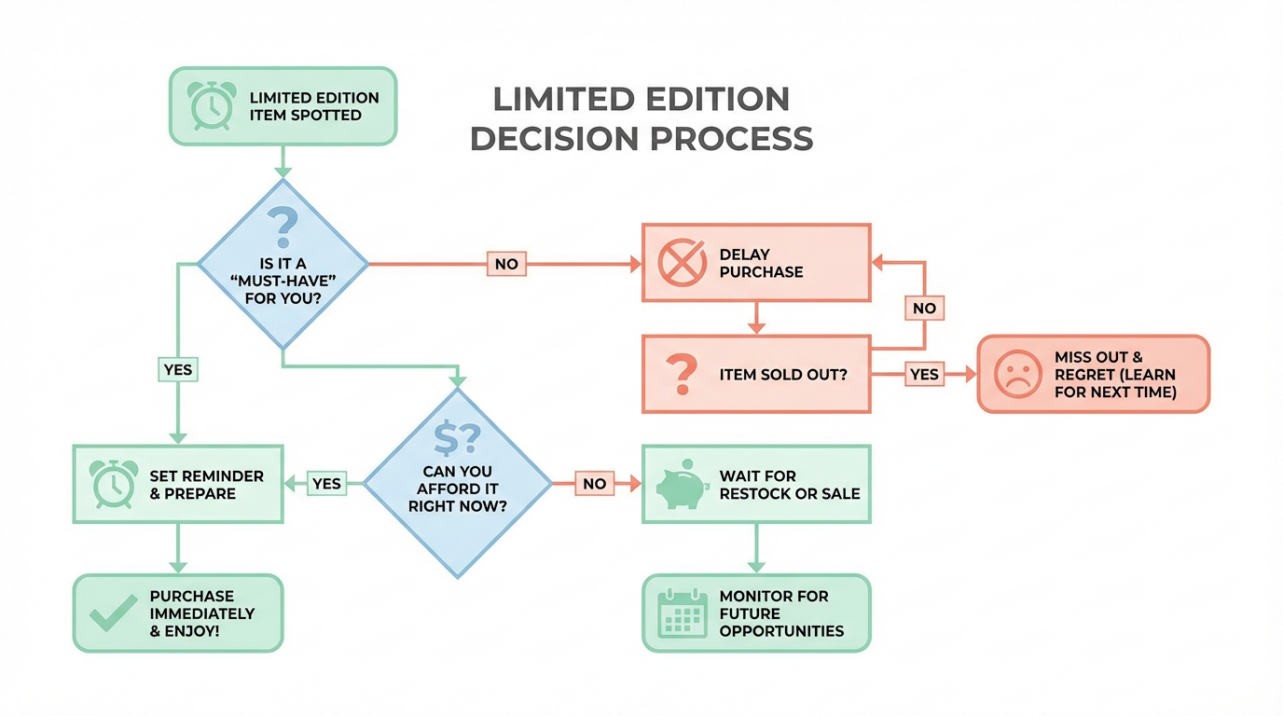
If something is both time- and quantity-limited and truly matters to you, plan for it like an event: clear the slot, prepare payment details, and commit to logging off immediately afterward so you are not tempted by "while you’re here" add-ons.
When a brand runs "last chance" messaging every week, remember that if everything is scarce, nothing feels special, and long-term loyalty erodes. If a label keeps crying "limited" without meaningful limits, feel free to demote that brand’s urgency in your mind.
Protect your budget and your sleep schedule
Collecting feels very different once your basics are guarded. Setting a monthly hobby cap and a "preorder queue" list makes each limited drop compete with your existing commitments instead of floating in isolation. If a new release appears and it would push you past your own cap, you are not saying no to a figure; you are saying yes to keeping future preorders and rent safe.
Sleep deserves the same protection. Pick which drops, if any, are worth nighttime alarms in advance based on character and sculpt, not based on how aggressive the countdown looks. For everything else, accept that some pieces will go to other fans and that this is normal and even healthy in a hobby built on scarcity. That shift—from "I must win every drop" to "I choose where to spend my energy"—does more to calm late-night anxiety than any productivity hack.
A Quick Decision Guide For Your Next Limited Drop
When you feel that familiar pre-drop tension, it can help to translate the hype into clearer signals. This simple mental cheat sheet keeps your focus on what actually matters.
What you notice on the page | What it probably means | Smart response for collectors |
|---|
Big "limited edition" or "exclusive" badge with no details | Scarcity is being used mainly as a marketing cue, not necessarily backed by strict limits | Ask if you would want the piece without that label; if not, pass and sleep |
Clear quantity cap or numbered pieces plus meaningful extras | There is real restriction and added value beyond the label | Treat as a serious candidate only if the character and sculpt already fit your grail rules |
Short preorder window but no quantity info | The brand wants faster decisions but may restock or rerun if demand is strong | Sleep on it if you are unsure; your future self will be happier than if you panic-buy |
"Only at this store" with minor cosmetic changes | Classic retailer exclusive tactic that research shows can sometimes backfire on buyer satisfaction | Skip if the change does not matter to you; do not let the logo dictate your alarm clock |
Aggressive countdowns and repeated "last chance" messaging every season | Scarcity is being overused and may not reflect real rarity | Reclassify the brand as hype-heavy; prioritize releases where limits and value are clearer |
FAQ
Do limited edition anime figures always go up in value?
No. Studies of limited edition purchases in reselling markets find that while economic motives and resale hopes are strong drivers, they do not guarantee gains, and continued buying depends on a mix of practical, social, and novelty motives rather than price alone. Some pieces climb because supply is genuinely small and demand stays high; others stagnate or drop once restocks, reissues, or new versions appear. If you would be unhappy keeping a figure forever at the price you pay today, it is a risky candidate to buy purely as an "investment."
Are store-exclusive variants worth setting an alarm for?
Not automatically. Research on retailer exclusive labels shows that the word "exclusive" by itself does not reliably increase purchase intention and can even reduce appeal when it highlights trivial features. For collectors, that means you should judge the variant by the actual change—an extra face, a significant repaint, or a new accessory—rather than the logo on the box.
How often is it healthy to chase limited drops?
Exclusivity frameworks aimed at brands suggest treating limited releases as special events a few times a year rather than constant stunts, so the sense of rarity stays intact. A similar rhythm works well for collectors. Picking a few releases per season to chase hard and letting the rest pass keeps the hobby exciting without turning every week into a sleep-depriving scramble.
Collecting limited edition anime pieces will probably always come with a bit of adrenaline, and there is nothing wrong with enjoying the thrill of a well-earned preorder. The trick is to understand the scarcity systems at work, decide your own grail rules in advance, and protect your time, money, and energy so that every box that arrives feels like a win, not the reason you were exhausted all week.