Key Features of Intelligent Environmental Monitoring Systems in Collection Rooms
Intelligent environmental monitoring systems for anime collection rooms combine accurate sensing, smart alerts, and long-term data so your figures, manga, and art stay in a safe comfort zone without constant guesswork.
You know that sinking feeling when you open the door to your figure room and the air feels thick, the glass is a little foggy, and your prized scale box feels slightly soft at the edges. After years of watching how museums, archives, and serious collectors tame tricky rooms using sensors and data instead of gut feeling, it is clear that a smart monitoring setup prevents the slow warping, yellowing, and mold that ruin collections quietly. Here is how to build an intelligent system around your shelves so you can enjoy your display and catch danger long before it reaches a single grail.
Why Your Collection Room Needs Smart Environmental Monitoring
Professional preservation programs treat continuous environmental monitoring as one of the most important preservation actions because it shows exactly how temperature, moisture, light, and air quality behave around collections over time instead of relying on how a room "feels." That same approach works well for anime rooms, where you often have a mix of painted plastic, cardboard boxes, art prints, doujin, and electronics, all of which can be damaged by heat, damp, or stale air. Library and archive guidance stresses that controlling these four factors together is one of the most cost-effective ways to extend object life, especially when staff routinely review logged data and maintain HVAC systems and filters to prevent wild swings in conditions. Environmental monitoring and basic temperature–humidity–light control are at the center of that strategy.
Temperature is the accelerator pedal of deterioration. Conservation labs note that higher temperatures speed the chemical reactions that yellow and embrittle paper, break down plastics, and fade dyes, while also boosting insect and mold activity. Storage spaces not meant for people are typically kept cooler than occupied areas, and guidance for books, paper, and textiles tends to cluster in the mid-60s°F with an upper limit around the low 70s°F for long-term safety, especially when human comfort is not the top priority. Recommendations for archives suggest that cooler still is even better for photos and some media, but for a lived-in figure room most experts advise keeping occupied areas as cool as comfort allows without exceeding roughly 75°F. These ranges appear consistently in archive and museum guidelines.
Moisture in the air is just as critical. Relative humidity is the percentage of water vapor in the air compared to how much that air could hold at its current temperature; high values cause swelling, warping, corrosion, and mold, while very low values dry materials out and make them brittle. Studies and standards for collections and storage spaces converge on a safe band of roughly 40-60 percent, with many bodies recommending something like 45-55 percent for mixed collections and specifically warning that sustained conditions above about 60-70 percent raise mold and pest risk, while very dry air below about 30 percent encourages cracking and static. Cultural heritage organizations emphasize that it is not only the exact number that matters but the stability around it, since repeated cycles of swelling and shrinking fatigue materials. That philosophy runs through both museum humidity recommendations and technical preservation leaflets.
A third piece of the puzzle is dew point: the temperature at which the air in your room would be fully saturated and water would start condensing on surfaces. Conservation scientists highlight dew point because it explains why a cold display cabinet or figure moved from a cool space into warm, moist air can suddenly "sweat," even when the room itself does not feel particularly humid. If objects or shelving are at or below the dew point, moisture can condense directly on them, risking water stains, stuck plastic bags, and mold growth. Guidance on temperature, humidity, and dew point for collections shows how cooling air without dehumidifying it can push relative humidity into mold-risk territory, and why tracking dew point alongside temperature is so valuable in air-conditioned rooms. This relationship and its risks are laid out in detail in research on temperature, relative humidity, and dew point for collections and in museum environmental blogs.
Light and air quality complete the environmental picture. Visible and ultraviolet light cause irreversible fading and yellowing in paper, textiles, leather, and many inks, which is why archives keep storage in the dark and carefully limit light levels in exhibits. Airborne dust and pollutants carry moisture, acids, and abrasive particles that can scratch, soil, and chemically attack collection surfaces. Basic preservation guidelines recommend keeping lights off in storage, using ultraviolet-filtering films, and housing items in protective boxes or cases to buffer against light and pollutants while the room's air is filtered and kept as clean as reasonably possible. These practices are central to environmental programs for archives and basic preservation guidance, and they translate directly to keeping anime art and box art from fading on the wall.

The Core Sensors Behind an Intelligent System
Museums and archives rely heavily on digital data loggers and calibrated thermo-hygrometers to track temperature and humidity in every storage space, often with readings uploaded automatically into web-based software so staff can analyze trends and respond quickly to problems. In a collection room, that means placing accurate sensors at figure height instead of just glancing at the thermostat, and understanding that the temperature by your display cases may differ from the hallway by several degrees. Good practice is to use devices specifically meant for environmental monitoring rather than cheap gadgets with unknown accuracy and to check and calibrate them periodically. Professional programs at places like the Smithsonian use exactly this kind of digital logger network with web dashboards to watch their stacks.
Humidity sensors are the other half of the baseline package. Preservation specialists explain relative humidity carefully because it is temperature-dependent: the same absolute amount of water in cooler air results in a higher relative humidity than in warmer air. Intelligent monitoring systems read both temperature and humidity simultaneously so they can calculate risks correctly rather than treating humidity as a standalone number. Conservation guidance repeatedly shows that values around 40-60 percent with small daily variation are a practical target for mixed collections, with warnings that mold becomes a serious concern above roughly 70 percent and that very dry air below roughly 20-30 percent leads to shrinkage, cracking, and failure of adhesives. These thresholds and the importance of stability appear in museum and gallery humidity discussions and technical bulletins on environmental control.
Smarter systems also compute and log dew point automatically. Conservation labs point out that dew point monitoring becomes especially important wherever cold and cool storage is used or where air-conditioned rooms sit in humid climates, because unexpected spikes in dew point can signal HVAC issues or hidden moisture sources. Intelligent monitoring software can take the raw temperature and humidity measurements and turn them into dew point data, flagging when surfaces are at risk of condensation. This concept—the temperature at which sealed air becomes so saturated that water condenses—is fundamental to understanding moisture risks and is a core theme in detailed guidance on temperature, humidity, and dew point and in museum equipment blogs.
Light and air sensors are powerful upgrades for serious collections. Preservation resources emphasize that light damage is cumulative and that ultraviolet exposure from windows and fluorescent tubes is particularly destructive, recommending UV-filtering films and sleeves, low exhibit light levels, and keeping sensitive items in boxes. Air quality guidance recommends filtration to remove dust and pollutants and warns that airborne particles, pollutants, and even internal off-gassing from paints and plastics can accelerate deterioration. Intelligent systems can include lux meters and particulate sensors, giving you a way to correlate fading, dust buildup, or odd smells with specific conditions. These concerns and mitigation strategies are a major focus of basic guidelines for temperature, humidity, light, and air quality.

Here is how these pieces fit together in a compact way:
Feature | What it measures or does | Why your collection cares |
|---|
Temperature and humidity sensor | Reads room temperature and moisture level continuously | Keeps conditions in the safe band that slows warping, mold, and embrittlement |
Dew point calculation | Shows when surfaces could reach the condensation point | Warns when cold cases or objects may "sweat" and suffer water damage |
Light sensor | Records light intensity and, in some setups, UV exposure | Helps prevent fading of box art, prints, and signatures by limiting total light dose |
Air quality or particulate sensor | Tracks dust and fine particles in the air | Highlights filtration problems that might soil figures and carry pollutants onto surfaces |
What Makes a Monitoring System Truly Intelligent
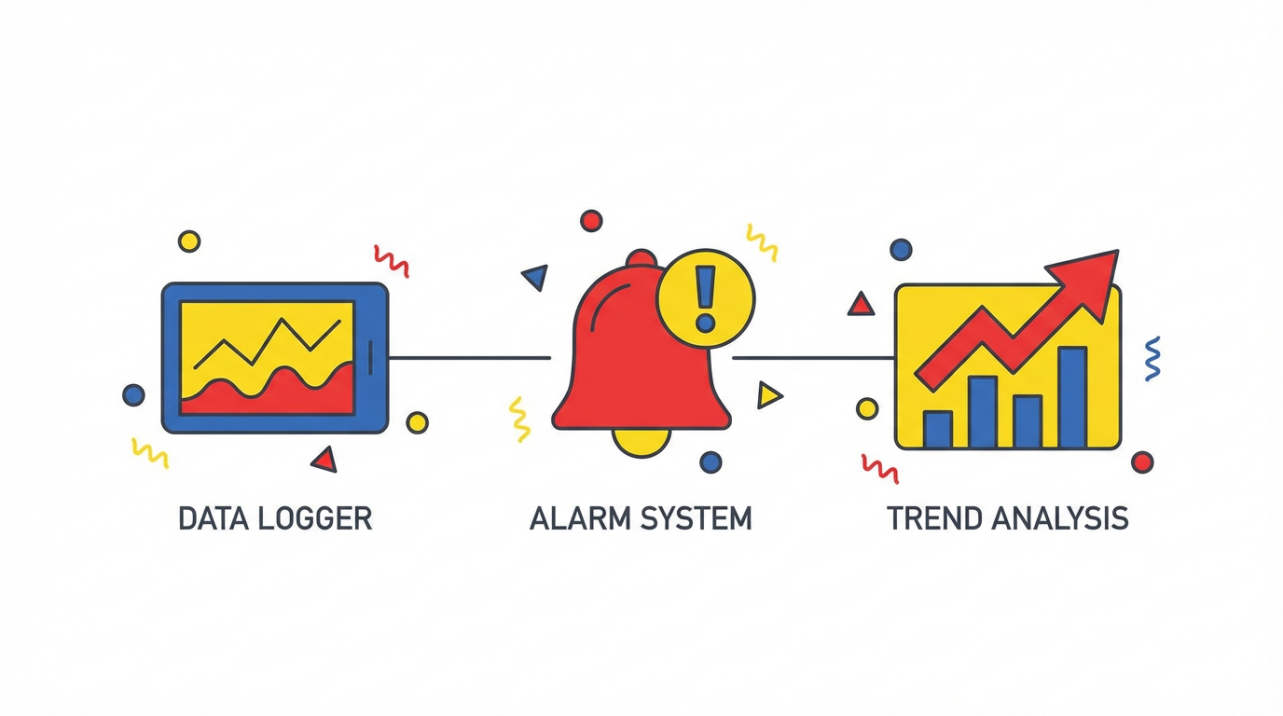
At the low end, a basic hygrometer on the wall tells you what the room feels like right now. Intelligent systems behave more like archivists with perfect memory: they log temperature and humidity nonstop, store that data safely, and help you see patterns across days, seasons, and equipment changes. Preservation programs recommend using continuous logging and reviewing data regularly, often via software that graphs trends, because it reveals nightly spikes, weekend HVAC setbacks, and problem zones that a single reading can never catch. This shift from occasional notes to ongoing, analyzed data is central to both library and archive strategies and to industry environmental monitoring programs.
Timely alarms are another hallmark of intelligent monitoring. Modern systems in regulated clean spaces like pharmacies, labs, and manufacturing cleanrooms are expected to send automated alerts whenever pressure, temperature, or humidity drift outside preset limits, with escalation paths so deviations are noticed before they cause product loss. These setups commonly include visual alarms on local touchscreens and remote notifications through networked software, helping teams respond quickly. The same model works on a smaller scale in a collection room: when humidity creeps above your mold-risk line or drops into the zone where cardboard dries and cracks, your phone should get a notification. This focus on continuous surveillance and configurable alerts is standard in clean room environmental monitoring and compliance-oriented monitoring best practices.
Data integrity and analytics are the quiet power-ups for long-term collectors. In pharma and high-grade cleanrooms, monitoring systems are designed to produce tamper-evident records with user authentication and audit trails for every event so inspectors can trust the history of conditions. Trend reports, exportable logs, and dashboards make it possible to show exactly when and how an environment stayed within limits and how quickly staff reacted to excursions. Even without regulators watching, that same architecture is valuable for personal collections: it proves to insurers that you take preservation seriously and lets you see, for example, whether adding a dehumidifier or moving cases off an exterior wall actually reduced daily humidity swings. Principles like audit trails, secure data storage, and trend-driven corrective action are core to modern cleanroom systems and are emphasized in integrated cleanroom monitoring descriptions and step‑by‑step cleanroom environmental monitoring guides.
Advanced cleanrooms also monitor particles and microbial contamination in real time, integrating laser particle counters, active air samplers, settle plates, and surface testing as a unified environmental program. While a figure room does not need that level of microbiological surveillance, the design philosophy behind it—risk-based zoning, focusing more sampling and sensing on the most critical areas, and treating environmental data as a "pulse check" of space health—scales down nicely. Mapping out the room and treating display cases, storage closets, and photo corners as separate micro-zones, each with its own sensor, mirrors how cleanroom teams structure their monitoring programs. This approach is laid out in cleanroom environmental monitoring guidance and expanded in comprehensive cleanroom monitoring guides.
Designing Ranges and Alerts for Anime Figure Rooms
Most serious collection rooms behave like small mixed-format archives: they hold paper (manga, artbooks, boxes, shikishi), plastics and resins (figures, model kits), textiles (tapestries, cosplay), and electronics. Environmental recommendations for these materials tend to land in a flexible but well-defined zone. Professional guidance for cultural materials frequently cites a relative humidity band of about 40-60 percent, with many experts recommending a nominal setpoint somewhere between 45 and 55 percent and allowing limited seasonal drift, while identifying 59-77°F as a reasonable temperature band for occupied collections spaces. The emphasis is consistently on avoiding extremes and minimizing rapid fluctuations rather than chasing one rigid number. This risk-based approach is highlighted in museum community discussions of humidity and temperature and in technical preservation guidance.
A practical target for many anime rooms is to keep the space somewhere around the mid-60s°F to low-70s°F and relative humidity near the middle of that 40-60 percent band, watching how the building responds across seasons. Preservation equipment suppliers suggest that for general museum environments, daily humidity fluctuations should ideally stay within about plus or minus a few percent to avoid repeated expansion and contraction of sensitive materials, and they document a long list of issues that appear at higher or more unstable humidity, including swelling, embrittlement, flaking paint, salt crystallization, mold, and corrosion. Keeping the room roughly in that moderate zone, with tight control on daily swings, gives figures, boxes, and prints a much calmer life. These observations are reinforced in museum-oriented discussions of managing relative humidity and temperature.
Dew point becomes your secret diagnostic tool when air conditioning runs hard or you use cool storage. Conservation case studies show that on a hot, humid day, cooling outdoor air down to a comfortable indoor temperature without removing enough moisture can drive indoor relative humidity into the mold-risk zone, even if the room feels pleasantly cool. They also show that moving cold objects into a warmer room where the dew point is higher than the object's surface temperature can cause instant condensation. An intelligent system that calculates dew point and alerts when conditions approach problem levels helps you spot hidden risks, like a chilled glass display case whose surface may fall below dew point after a long AC cycle. These moisture dynamics and their implications for storage are explained using real weather and room examples in discussions of temperature, relative humidity, and dew point for collections.
When configuring alerts, it is helpful to borrow thresholds from both preservation and technology spaces. Archives and preservation groups call environments with relative humidity below roughly 20 percent "extremely dry" and above about 70 percent "extremely damp," with mold and insect risks climbing quickly at the high end. Data center practice often targets roughly 40-60 percent relative humidity as a balance between condensation and static risk, which dovetails nicely with preservation ranges. That makes it reasonable to set early-warning alerts for your collection room when relative humidity rises into the low-60s percent or falls into the low-30s percent, and stronger alarms when it touches those extreme zones. Combining that with dew point-based alerts gives you a powerful, nuanced early warning system rooted in both preservation standards and environmental control practices.
From Data to Action: Using Your System Day to Day
Once your system is logging and alerting, the real value shows up in the pattern of responses you build around it. Preservation experts recommend starting by studying a few weeks of graphs to see how your room behaves across day and night, with and without lights, and during weather swings. If humidity regularly drifts into the upper-60s percent range, a properly sized dehumidifier for the room's square footage will usually do more good than constant thermostat fiddling. Conservation blogs describe dehumidifiers as standard tools for larger rooms, while noting practical issues like condensate disposal: some units can pump water away automatically, whereas tank-based models stop when full and are not suitable for unattended use. These tradeoffs and the role of dehumidifiers in stabilizing relative humidity are covered in museum-focused humidity management guides.
When the air is too dry, especially in winter, the graphs will show relative humidity dropping into the 20s or even lower whenever heating runs hard. Preservation guidance warns that such low values desiccate hygroscopic materials such as paper, leather, and textiles, causing stiffness, flaking, and cracking, and emphasizes the importance of moderate, stable humidity. For living spaces like bedrooms, recommendations for healthy humidity also fall around 40-60 percent, with suggestions to improve conditions through regular ventilation and, when necessary, humidifiers. Together these sources support using a combination of smart ventilation habits and dedicated humidification to pull a collection room back into the safe mid-range, instead of leaving paper goods and painted surfaces in very dry air for months. The combined message of preservation leaflets on humidity and practical humidity advice for living spaces is that gentle, regular correction beats aggressive, occasional interventions.
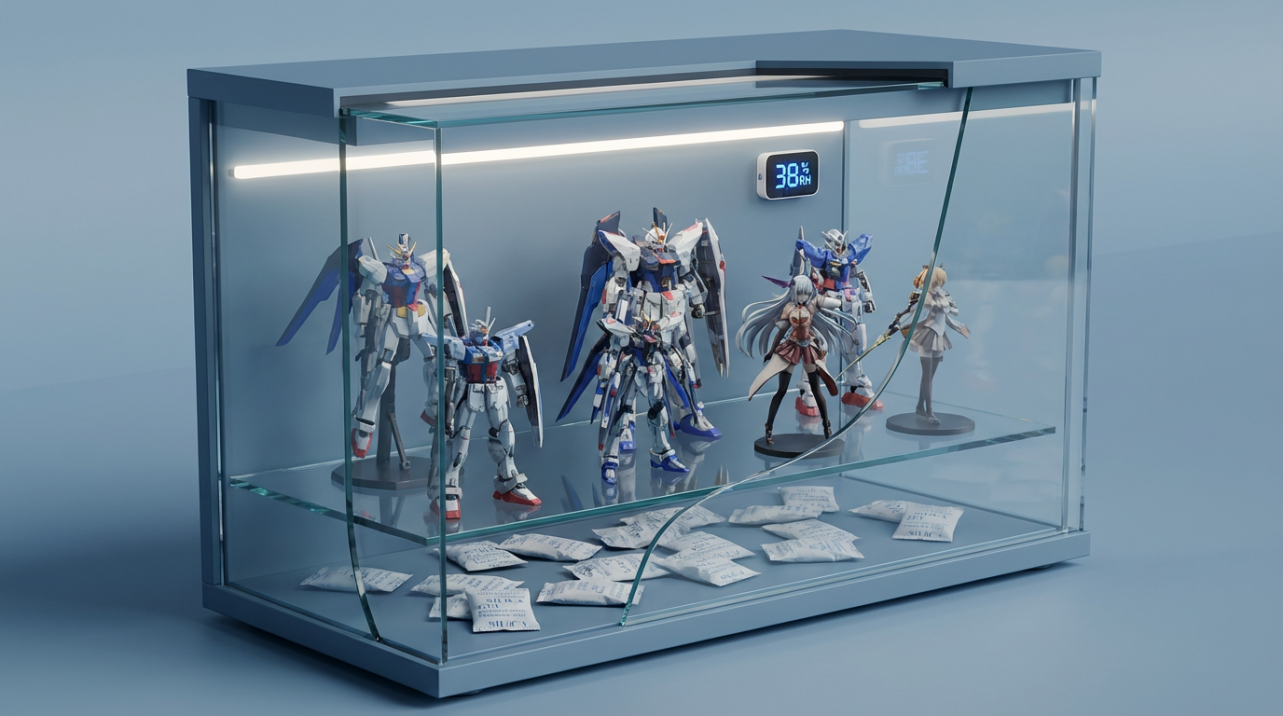
Microclimates inside cabinets and boxes are where anime collections behave most like museum exhibits. Preservation programs strongly discourage placing collections near windows, exterior walls, or directly on the floor because these spots experience bigger swings and are more prone to condensation and leaks, and they urge using well-sealed cases and protective housing to buffer objects from ambient fluctuations. For sealed display cases, conservation suppliers recommend pre-conditioned desiccants such as silica gel to hold humidity near a chosen level, noting that the case itself acts as a buffer. Hobby collectors echo this approach with desiccant pods inside gasketed storage bins for valuable items, refilling them with silica gel as needed. Monitoring humidity inside at least one or two cases often reveals that they run a bit warmer and more humid than the room, especially with lighting, making those micro-sensors and desiccant strategies more than just overkill. These techniques and cautions appear in preservation self-assessment guidance and museum equipment blogs on case humidity.
Intelligent monitoring also shines during emergencies and outages. Archive and conservation resources urge institutions to plan for HVAC failures, power loss, and water events, and to combine continuous automated logging with alarms and contingency plans. The idea is to know within hours, not days, when conditions have drifted into dangerous territory and to have pre-decided steps such as deploying portable dehumidifiers, moving the most vulnerable materials, or temporarily lowering light and activity in affected rooms. Environmental monitoring vendors similarly stress real-time alarm notifications and backup plans when conditions exceed limits, framing these systems as critical for maintaining compliance and preventing costly product losses. Translating that mindset to a figure room means using your monitoring system as both an early warning network and a recovery tool, informed by environmental monitoring best practices and preservation disaster planning guidance.
Example Setup for a Serious Anime Collection Room
Imagine a dedicated 10x12-foot room with three glass cases, a couple of wall shelves, and storage bins tucked into a closet. A practical intelligent monitoring setup there would start with at least three combined temperature and humidity sensors: one at figure height in the open room and one inside each type of case or storage microclimate. Those sensors would report not just to a local display, but to a hub or cloud platform that logs data continuously and lets you view graphs on a phone or laptop. You would define a target range around the middle of that 40-60 percent relative humidity band and a comfortable temperature range in the high-60s°F to low-70s°F, then tell the system to alert you when readings creep into the low-60s percent or low-30s percent humidity, or when dew point approaches the temperature of cooler surfaces like exterior walls or glass cases. A compact dehumidifier with continuous drain would handle summer moisture load, desiccant canisters in each sealed case would tame microclimates, and you would check trends weekly to see whether seasonal adjustments or equipment maintenance are needed. This mirrors how institutions combine dataloggers, alarmed ranges, and case-level buffering in their own stacks and exhibits.
Protecting a room full of figures, manga towers, and delicate merch is not about turning your home into a sci-fi cleanroom; it is about borrowing the smartest tricks from archives and cleanrooms so your favorite characters can stand guard for decades instead of fading, warping, or growing fuzz. With a thoughtful mix of accurate sensors, smart alerts, and simple habits guided by real data, your collection room stops being a mystery dungeon and becomes a managed environment where every shelf, case, and signed print gets the stable, comfortable climate it deserves.