The Aesthetic Value of Digital Characters in Physical Collectibles
Digital-born characters gain a new kind of beauty when they step off the screen and onto your shelf, but that magic only happens when sculpt, costume, and "digital soul" survive the jump into plastic and vinyl. Understanding how that translation works helps you choose pieces that stay visually powerful long after the preorder rush fades.
You know that feeling when a new anime figure reveal hits your feed, and suddenly the avatar you have spent hundreds of hours with is frozen mid-attack on a base that looks like it leaped out of the episode's key frame? Then you see it in person and notice the cape does not flow, the eyes are slightly off, and that once-perfect render feels oddly flat. Once you understand how digital sculpting, small-scale costume design, and "phygital" add-ons like NFTs actually shape what you see, you can tell at a glance which figures will still look incredible in five years and which ones are riding a trend. The goal is simple: give you a collector's eye that can read the aesthetics of digital characters turned physical so your shelf tells the stories you care about most.
Why Digital Characters Hit Different as Physical Collectibles
In Gelato’s overview of traditional and digital art, digital pieces are described as endlessly reproducible and flexible, but less tactile than physical paintings and sculptures. That tradeoff is baked into most anime and game characters: they are born on glowing screens, optimized for pixels and shaders, not for shadows falling across a real figure's face. A physical collectible restores that missing tangibility, letting you feel weight, see light break across sculpted folds, and read tiny textures that never show up in compressed screenshots.
At the same time, digital art itself is booming. A recent analysis of digital art trends projects the global digital artwork market to grow around 17.3% annually from 2025 to 2032, jumping from about $5.8 billion to $17.72 billion, driven by online sales and tech-enabled formats like NFTs and immersive experiences in a survey of future digital art. Another study of collectors highlights that digital art already makes up an above-average share of collections in countries like France and Japan, where tech-driven installations are widely accepted in Art Basel's report on digital art going mainstream. When you put a physical figure of a digital character into that context, you are not just buying merch; you are anchoring a fast-moving digital culture to a stable, tangible object.
Think of your favorite anime protagonist: the way their hair spikes break silhouette, how the jacket hem whips around in key frames, how their weapon arcs through space. A good figure does not just copy the model sheet; it translates the entire feeling of those frames into a pose you can walk around in 3D, from the intensity in the eyes to the subtle tilt of the shoulders.
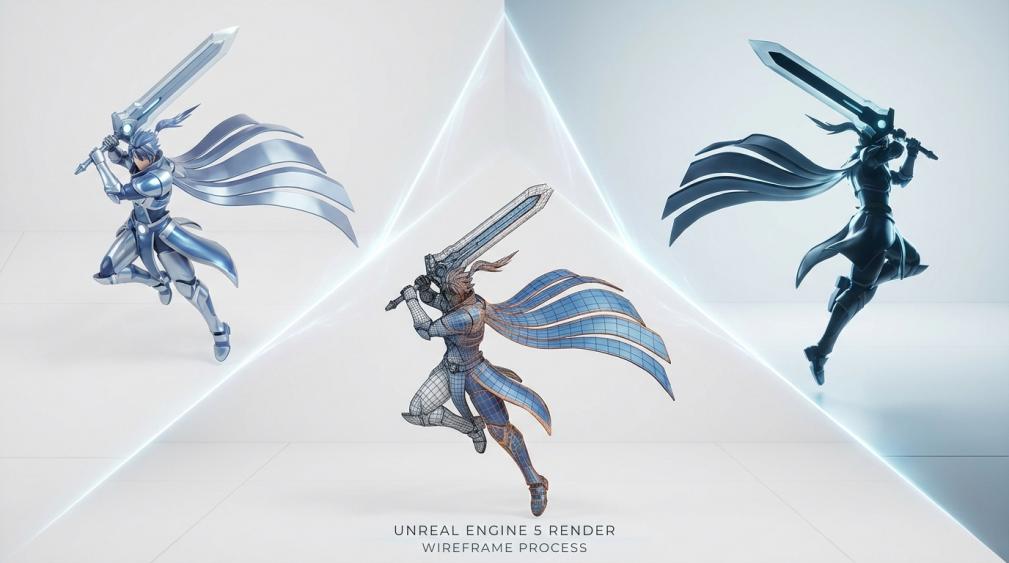
Proportion, Form, Gesture: The Secret Sauce Behind "This Sculpt Feels Right"
In Narrasoft's breakdown of digital sculpting for toys, sculptors emphasize three fundamentals: proportion, form, and gesture. Proportion is the size relationship between parts of the body; form is the overall shape revealed by light and shadow; gesture is the implied motion or flow of the pose. Digital sculpting tools let artists push and pull a polygon mesh almost like clay, then refine these three elements with remarkable precision before a single prototype is printed.
For you as a collector, those same rules explain why one figure looks alive and another feels stiff. Step back a few feet and squint at the silhouette: if the weapon, hair, and limbs create strong, readable shapes, the form is working. Check proportion: does the head feel too big or too small, or does it match the character's canonical style? Finally, read the gesture: follow an invisible line from the toes through the spine and into the fingertips or blade tip. A great anime sculpt often has one clean energy curve that echoes the best sakuga frames; a weak one feels like the character paused on a loading screen.
Miniature Costumes, Massive Impact
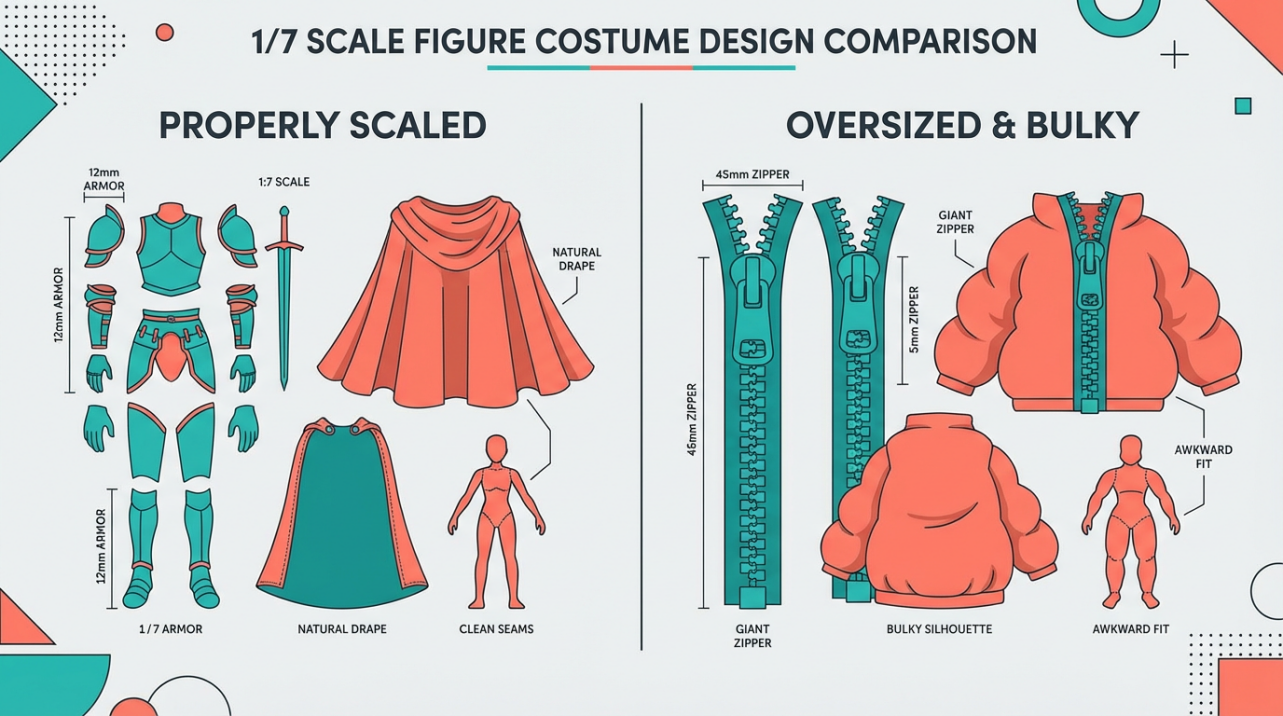
Research on action-figure miniaturization from Francis Press points out that when you shrink clothing to toy scale, seams, closures, and fabric thickness suddenly become huge visual players. At full size, a zipper is a detail; at 1/7 scale, a chunky zipper can look comically oversized, and a fabric that is too thick will refuse to drape like the anime reference. Designers have to rethink patterns so folds fall where your eye expects them, even when gravity and thickness do not cooperate.
Because these garments are planned digitally, designers can test different seam placements and cuts in software, then rely on technologies like 3D printing for accessories and even parts of the clothing itself, as suggested by the miniaturization research's references to printed garments. The best figures use that pipeline to create belts, armor plates, and tiny jewelry that feel crisp and in scale, while cheaper lines sometimes drop real fabric capes or skirts over bodies without reworking the pattern, leading to bulky, doll-like silhouettes that clash with the character's sleek digital origin.
How Digital Pipelines Shape What You See on the Shelf
Digital sculpting does not just make figures faster; it changes what is aesthetically possible. Toy and collectibles studios can now produce large quantities of highly accurate, uniform sculpts while keeping turnaround times tight, as laid out in Narrasoft's survey of digital sculpting's impact. Industry research cited there expects the global toys and games market to grow at nearly 10% per year from 2020 to 2025, reaching around $120 billion, much of it via online channels. When demand is that strong, digital pipelines are what keep fresh versions of beloved characters flowing onto shelves without sacrificing detail.
Digital sculptors typically start with a rough, blocky 3D model to lock in proportion, then layer in fine features like hair strands, facial expressions, and costume creases before settling on the final pose, as the same digital-sculpting guide describes. From there, full-color 3D printing can generate prototypes that merge shape and surface detail in a single pass, skipping hand-painting and letting teams evaluate how color schemes and shading read in real light, not just on a monitor.
From File to Prototype: Catching Aesthetic Flaws Early
Toy-prototyping studios describe digital prototyping as taking rich 3D files, complete with geometry, textures, and color, and turning them into physical samples via full-color additive manufacturing within just a few days. That speed has a quiet but huge aesthetic payoff: small errors that would haunt a full production run can be caught early. Maybe the base is too tall and steals focus from the character, or the gradient in the hair reads muddy under warm indoor lighting. A digital file can be tweaked, reprinted, and reviewed again without scrapping molds or repainting dozens of samples.
If you have ever seen convention photos where an early sample's face looks slightly "off" compared with the final release, you are seeing this loop in action. It is the same digital flexibility that makes online art easy to revise, now applied to something you can touch. For collectors, that means later production runs of digital characters are increasingly likely to nail the expression and paint, because the prototypes have already been stress-tested in real space.
Phygital Souls: When Digital Ownership Wraps Around Physical Figures
NFTs, Certificates, and Digital Twins
Picture Perfect Portfolios’ comparison of NFTs and traditional art describes NFTs as unique cryptographic tokens on a blockchain that act as digital certificates of ownership for specific files. In that framework, the object is not necessarily the image or 3D model itself; it is the record proving you own a particular instance or edition. An analysis of the NFT art ecosystem 2020 Art Gallery notes that these tokens now double as provenance infrastructure, logging creation and resale histories and enabling "phygital" projects that cryptographically link NFTs to physical works.
Digital-art trend reports like Artgas' overview of 2025 innovations highlight another side of this fusion: AR overlays that layer digital animation onto physical objects. Scan a print or sculpture with a cell phone and you unlock hovering effects, alternate costumes, or short scenes. In the collectibles world, that same logic powers "digital twins": a figure on your shelf paired with a detailed 3D model you can spin, zoom, and even drop into AR scenes. Some platforms go further, letting those twins act as playable characters in partner games, complete with unlockable animations and cosmetic upgrades.
From a pure aesthetic standpoint, these twins can deepen your relationship with the physical sculpt. You might pose the real figure in a grounded stance but keep a more dynamic, midair attack pose in your app, or use AR to photograph your mecha on the edge of a real rooftop at sunset, mixing painted PVC with live sky. The physical piece becomes the anchor; the digital twin is the ever-changing aura.
Pros and Cons of Phygital Layers for Aesthetics
2020 Art Gallery's discussion of NFT communities and utilities points out that tokens can unlock perks like access to events, merchandise, or community spaces, effectively turning ownership into a social signal. A phygital figure can tap into that energy: the sculpt on your shelf is the visible emblem, while the token ties you into drops, story updates, or behind-the-scenes art that expands the character's world. When done well, that ecosystem keeps the figure feeling "alive" as the digital canon evolves.
The trade-offs are real, though. NFT and digital-art markets are notoriously volatile, with sharp boom-and-bust cycles and speculative hype outlined in that NFT vs. traditional art comparison. Environmental concerns, phishing scams, and usability hurdles also remain, even as greener blockchains and better tools emerge in analyses of the digital art and NFT market's future. If the digital layer disappears, because a platform shuts down or a project loses momentum, the physical figure is what you are left with.
That is why it helps to treat the digital layer as bonus lore, not the core of the aesthetic value. Ask yourself a simple question before you buy: if all the apps vanished and the token turned into a pumpkin at midnight, would this figure still look incredible on your shelf purely as an object? If the honest answer is no, you are not in love with the sculpt; you are in love with the idea.
How to Train Your Collector's Eye
Sculpt First, Rarity Second
When a new digital character gets a figure, it is tempting to fixate on edition sizes, exclusive faces, and retailer bonuses. Instead, start by reading the sculpt the way digital sculptors frame it: through proportion, form, and gesture, as emphasized in digital-sculpting best practices. Look at the figure from across the room. Does the silhouette instantly tell you who it is and what they are doing, or does it collapse into an indistinct blob of hair and effects parts? Move closer and inspect joints and transitions; clean overlaps and natural flow between armor, cloth, and skin signal that the sculptor respected the character design rather than just stacking cool bits.
Surface Storytelling and Costume Design
Miniaturization research on action figures shows that construction details balloon visually at small scales, making material choice and seam placement central to aesthetics in the Francis Press analysis of figure clothing design. When you inspect a figure, let your eyes trace how fabric or armor guides your attention. Do folds frame the face and hands, or do heavy, random wrinkles distract from the character's expression? Are patterns and printed graphics sharp and in scale, or do they blur into noise? Digital tools make it easy to experiment with wild textures and patterns on screen, but the best designs are reinterpreted for physical reality so they still read clearly from a couple of feet away.
Digital vs. traditional art comparisons point out that physical pieces excel at tangibility and visible craft, while digital work shines in flexibility and easy reproduction, as summarized in Gelato's art-format comparison. A strong figure of a digital character borrows the best of both worlds: it keeps the clean color blocking and stylized shapes you love from the game or anime, but adds real-world texture where it enhances story, maybe a slightly rough base to sell a ruined street, or subtle layering in hair strands so they catch the light like a painted illustration.
Balancing Physical Presence With Digital Perks
When you are weighing a standard release against a more expensive phygital or NFT-linked version, it can help to think in terms of formats and their aesthetic strengths.
Format | Aesthetic strengths | Aesthetic risks |
|---|
Pure physical figure | Strong tangibility, visible sculpt and paint, independent of apps or platforms, easy to appreciate in any room lighting, echoing traditional art's tactile appeal | Limited built-in interactivity or evolving content; story context relies on packaging and your existing fandom knowledge |
Figure with digital twin / NFT | Deeper narrative layers, AR and animation possibilities, token-based communities around the character as described in NFT-enabled phygital projects | Reliant on tech platforms, subject to NFT market hype, potential for the digital layer to age faster than the physical sculpt |
Purely digital "figure" or avatar | Infinite poses and environments, no physical storage limits, often easier entry price in the digital art ecosystem within the growing digital art market | No physical presence, dependent on screens and software, harder to integrate into room aesthetics without dedicated displays |
Your own sweet spot might be a core shelf of beautifully made physical figures, plus a handful of phygital pieces where the digital components genuinely enrich the character's story rather than acting as a buzzword on the box.
Quick FAQ for Shelf-Decision Moments
Do digital bonuses like NFTs actually make an anime figure "better"?
They can add context, story hooks, and community perks, especially when the token tracks provenance or unlocks meaningful content around the character, as explored in NFT art infrastructure analyses. But aesthetically, the figure is still judged by proportion, pose, paint, and presence. If the sculpt is weak, no QR code or blockchain certificate will fix the fact that it looks awkward next to your favorite pieces, a point echoed in comparisons of NFT and traditional art value drivers.
Is a digitally sculpted figure always superior to a traditionally sculpted one?
Not automatically. Digital tools make it easier to achieve precise symmetry, intricate details, and consistent production quality, which is why they dominate modern toy and collectibles pipelines in Narrasoft's account of the industry shift. However, some traditional sculpts carry a unique, slightly imperfect charm that digital workflows sometimes polish away. The best results come when digital sculptors consciously apply classic principles of proportion, form, and gesture, then use the tech to refine rather than sterilize the character's personality.
When the next drop hits and group chats start buzzing, give yourself a beat before tapping that preorder button. Walk through the sculpt's silhouette, the miniaturized costume, and the way any digital extras support or distract from the character you fell for on screen. When "digital soul" and physical craft line up, you are not just buying plastic; you are capturing a fragment of your fandom's story in three dimensions.