The Evolution of Gundam Models From Toys to Engineering Tools
From TV Battles to Plastic Runners
If you fell in love with Gundam the way many of us did, it probably started with explosions on a screen, not gates on a runner. Sunrise launched Mobile Suit Gundam in 1979, and scholars writing in collections like the University of Oregon’s ScholarsBank have pointed out how it helped define the “real robot” genre: giant robots treated as war machines with politics, technology, and consequences baked in.
Just a year later, in 1980, Bandai turned that energy into something you could hold. As Hobbyco’s Gunpla 101 guide explains, Gundam plastic models, or “Gunpla,” arrived as simple snap-together kits that let kids and teens re-create those white, red, and blue heroes on a bedroom desk. At first glance they looked like toys, and for many of us, that is exactly how they were treated: something you could build in an afternoon and swoosh around the living room.

Forty-plus years, dozens of anime timelines, and a whole spectrum of kit grades later, that “toy” has quietly evolved into something much more ambitious. Between inner frames, LED systems, and specialized tools, modern Gunpla can feel less like playthings and more like a hands-on engineering lab.
The Early Toy Era: Simple Kits, Big Imaginations
Entry Grade, First Grade, and the Joy of Fast Builds
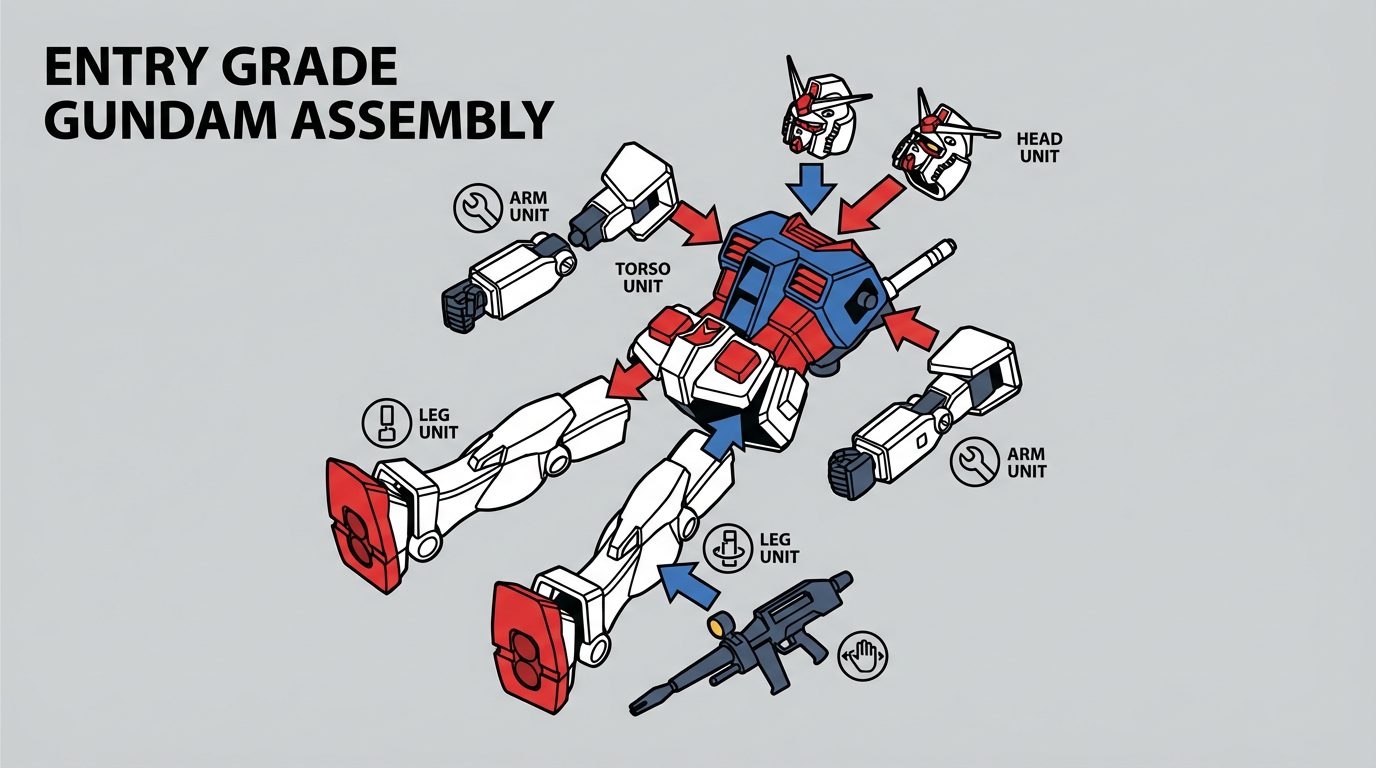
To understand how Gundam models became engineering tools, you have to start with the grades that still behave like toys in the best possible sense. Mecha Express describes Entry Grade (EG) kits as pure accessibility: pre-colored, glue-free, and even tool-free, with parts you can twist off by hand, standing around four to five inches tall. They are designed so that a complete newcomer or a younger fan can finish a build quickly and feel successful.
Older “No Grade” and First Grade (FG) kits, summarized by Otakumart’s guide to grade differences, live in the same general space. They tend to have very basic articulation, few colors, and sometimes only one or two plastic hues. Many joints barely move, and the main job of the builder is simply to assemble and, if they feel brave, paint. In other words, they are structurally closer to action figures than to intricate scale models.
For a lot of builders, these grades are the on-ramp. A Quora discussion on beginner mistakes notes that a typical High Grade kit can be completed in two to three hours, while EG and FG are even more forgiving. You grab a cheap pair of nippers, you follow pictures in the manual, and before the evening is over, you have something that looks like the hero on the box. The focus is emotional payoff, not precise tolerances.
Super Deformed and No Grade: Cute, Cheap, and Cheerful
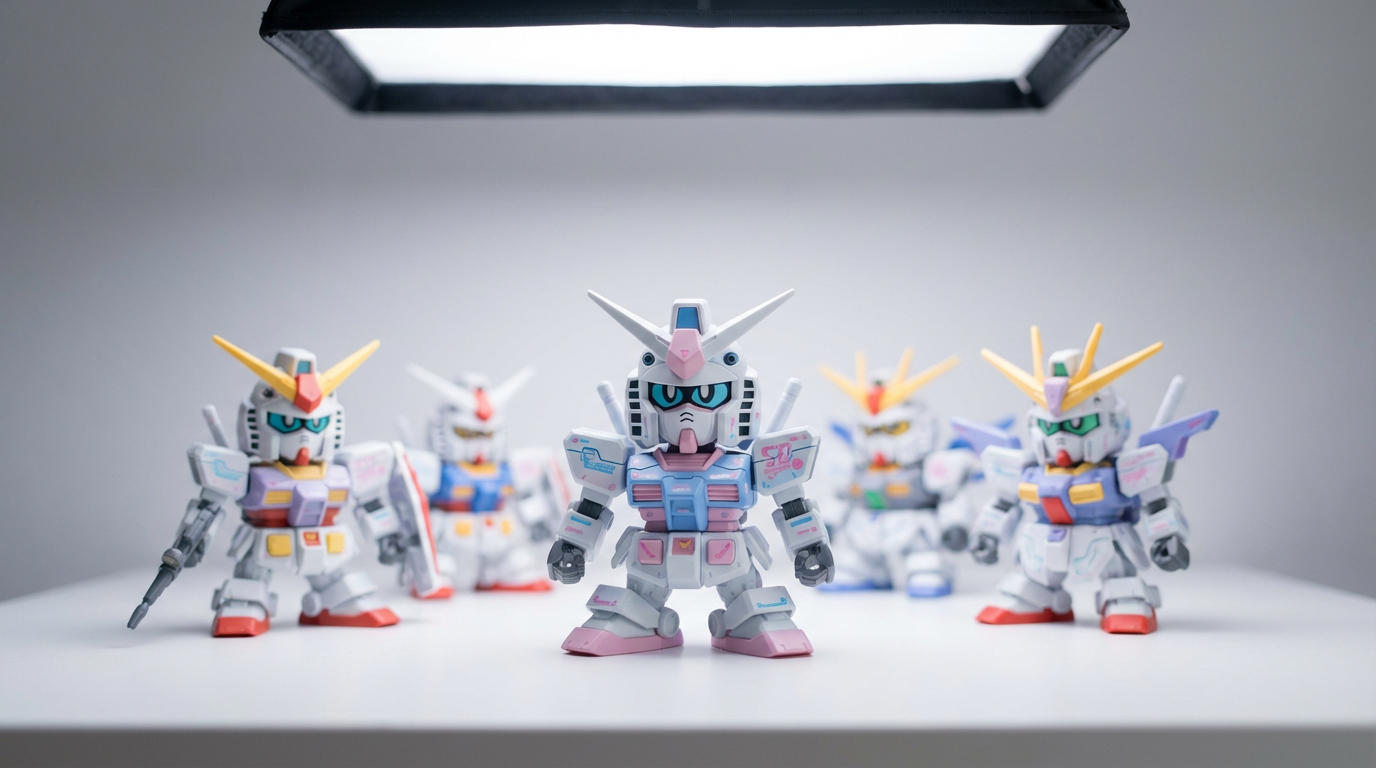
Super Deformed (SD) kits push the “toy” side even harder. Otakumart’s breakdown of SD and SD Cross Silhouette describes them as chibi, big-headed caricatures that trade realistic proportions for charm. They are small, inexpensive, and often allow parts to be removed without tools. Much of the color separation is handled by stickers, with optional eye expressions to dial up the personality.
These SD kits are fantastic as desk mascots or quick palate cleansers between more serious builds. They are also incredibly friendly for kids and nervous first-timers. Gunpla 101’s beginner tools guide and several store blogs emphasize that you often do not need anything beyond basic side cutters and maybe a panel line pen to get something adorable onto your shelf.
At this stage of the evolution, Gundam models function mostly as toys or collectibles.
They spark imagination, invite casual play, and give you instant gratification. But under the surface, the franchise is already pushing toward something more technical.
Gunpla Levels Up: When Kits Start Teaching Engineering
By the time you move into the main modern grades, Bandai has quietly turned your “toy” into a plastic textbook in mechanical design.
High Grade: The Accessible Workhorse
High Grade (HG) is where most builders truly catch the bug. Otakumart and Mecha Express both frame HG as the most common line: 1/144 scale, roughly five inches tall, with a manageable part count and decent articulation. Wise Guys Hobbies notes that HG kits typically cost around fifteen to thirty dollars and take about two to four hours to build for a newcomer.
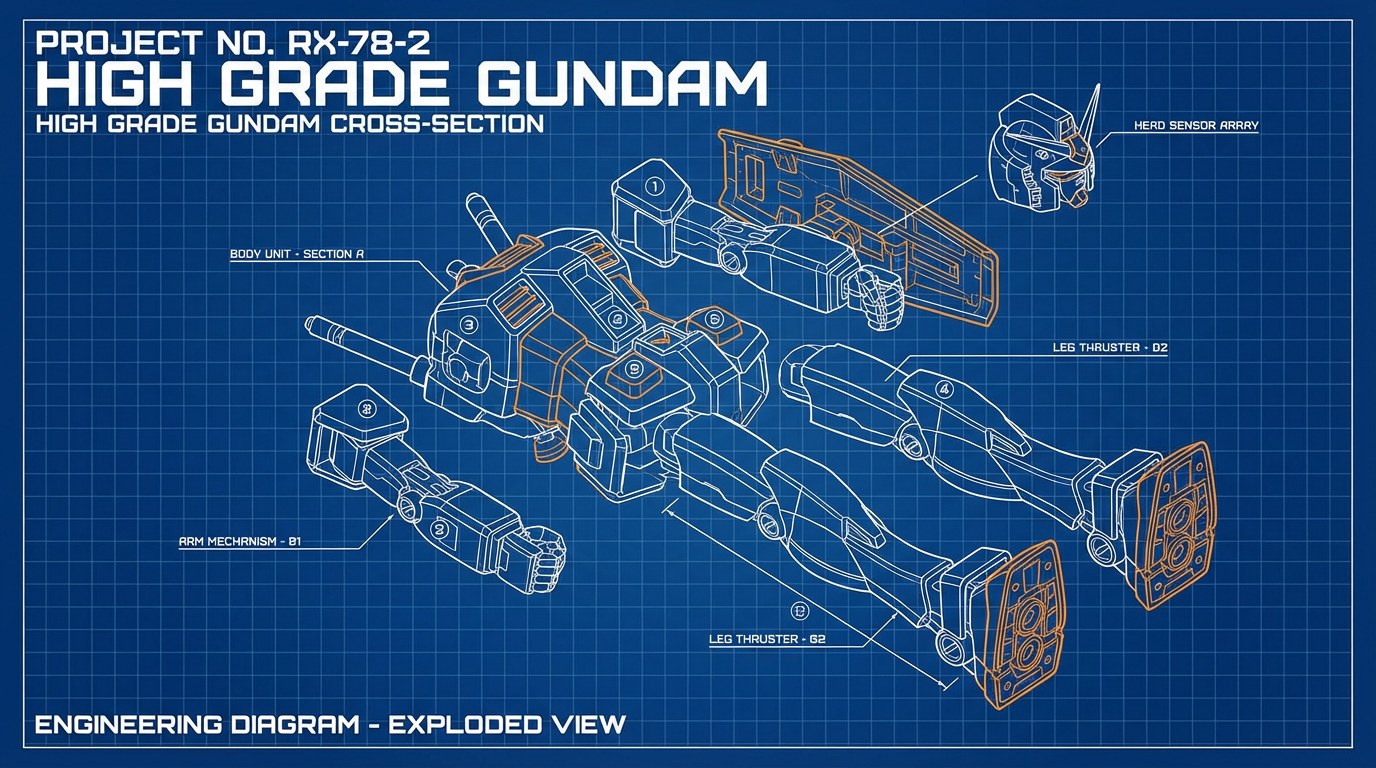
Even at this accessible level, you start to see the seeds of engineering. Parts are numbered, mirrored left and right, and keyed so they only fit one way. Modern HG kits often add pseudo–inner frame elements and layered armor, giving you a glimpse of how real-world mechanical structures might be organized. If Entry Grade is a toy, HG is your first lab exercise.
Real Grade and Reborn-One Hundred: Engineering in the Palm of Your Hand
In 2010, Bandai launched Real Grade (RG) to celebrate Gundam’s thirtieth anniversary, according to Mecha Express. RG kits keep the same 1/144 scale as HG, but pack in Master Grade–style detail, internal frames, and advanced multi-color molding. The Otakumart guide points out that RG kits often cost roughly twice as much as HG and demand much higher precision.
On an RG Sazabi or Wing Gundam Zero, which Union Gundam recommends for intermediate builders, you are now dealing with layered armor plates, micro panel lines, and armor that shifts as joints move. The experience starts to resemble assembling a tiny robot skeleton rather than clipping out a toy. You learn about clearances, joint tolerances, and how small design decisions ripple through the rest of the build.
Reborn-One Hundred (RE/100), introduced in 2014, and Full Mechanics (FM), which followed around 2015, widen that engineering focus. Otakumart describes RE/100 as 1/100 scale kits that offer detailed, large models without full Master Grade complexity, while Full Mechanics aims for Master Grade–like size with fewer parts. Both lines are essentially experiments in delivering mechanical presence and articulation without overwhelming the builder, and they show Bandai thinking like engineers about complexity budgets.
Master Grade, MGEX, and the Era of Inner Frames
Move into Master Grade (MG) and you have crossed a line. Mecha Express and Otakumart describe MG kits as 1/100 scale, often around seven inches tall or more, with fully realized internal skeletons, opening hatches, and multiple armor layers. Wise Guys Hobbies pegs the typical build time at six to twelve hours and the price range around forty to eighty dollars.
Union Gundam’s skill-level guide highlights MG RX-78-2 Ver. 3.0 and MG Unicorn Gundam Ver. Ka as quintessential examples. These kits feature inner frames you assemble piece by piece, then dress in armor like a mechanical anatomy lesson. You learn where pistons sit, how hip joints distribute weight, and why certain parts need polycaps or more rigid materials.
Then MGEX arrives in 2020 as a premium sub-line. Otakumart notes that MGEX layers in advanced articulation systems and integrated LED lighting to create true showcase-level models. Now you are routing wires or flexible LED strips through a frame, dealing with power supplies, and thinking about how light will interact with armor and translucent parts. That is no longer toy behavior; it is a compact systems-engineering problem.
Perfect Grade and Mega-Size: Building a Desktop Test Rig
Perfect Grade (PG) sits at the top of Bandai’s standard hierarchy. Mecha Express describes PG as 1/60 scale “flagship” kits with extremely high part counts, individually articulated fingers, extensive mechanical detail, and optional lighting systems that are usually sold separately. Wise Guys Hobbies notes that PG kits tend to cost more than one hundred dollars and demand twenty or more hours of work, while Union Gundam puts the build-time range between thirty and one hundred hours depending on customization.
Mega-Size 1/48 models, according to Otakumart, stand roughly fifteen inches tall, about three times the visual impact of a typical Master Grade. They are less complex internally than PG, but the sheer surface area turns panel lining, decals, and weathering into large-scale design exercises.
Add all that together and you can see the arc.
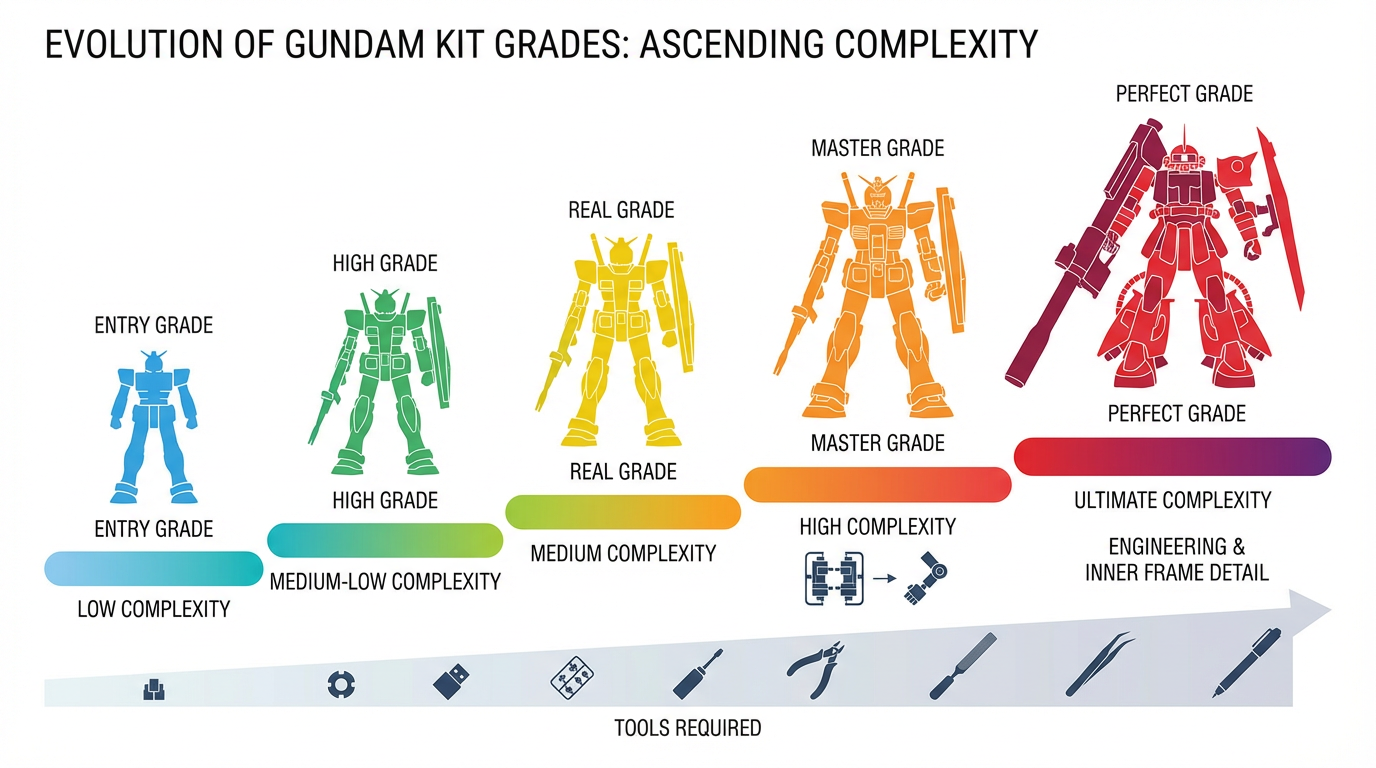
Early Gunpla asked you to assemble a toy. Modern grades ask you to think like a mechanical designer and production engineer, even if you never call it that.
A Quick Grade-to-Engineering Snapshot
To keep the evolution in view, here is a compact, data-informed snapshot of how major lines map from toy-like to engineering-heavy, drawn from Mecha Express, Otakumart, Wise Guys Hobbies, and Union Gundam.
Line | Scale | Approx height on shelf | Typical builder level | Engineering flavor |
|---|
Entry Grade (EG) | 1/144 | about 4 to 4.5 in | absolute beginners, kids | twist-off parts, no tools, quick gratification |
SD / SDCS | chibi | small desk mascots | beginners and collectors | simplified joints, heavy reliance on stickers |
High Grade (HG) | 1/144 | about 5 in | first “serious” kit for most builders | basic joint design, great for practice |
Real Grade (RG) | 1/144 | about 5 in | intermediate, comfortable with HG | inner frames, moving armor, dense detail |
RE/100 / FM | 1/100 | around 7 in | intermediate to advanced | large shells, simplified frames, display focus |
Master Grade (MG) | 1/100 | around 7 in or taller | experienced; enjoy long, intricate builds | full inner skeletons, layered armor |
MGEX | 1/100 | similar to MG | advanced collectors and tinkerers | integrated LEDs and advanced articulation |
Perfect Grade (PG) | 1/60 | large centerpiece size | very experienced, patient builders | maximum part counts, wiring, complex frames |
Mega-Size | 1/48 | about 15 in | display-focused collectors | huge surface area, poseable but less complex |
Once you look at the grades this way, the phrase “engineering tools” no longer sounds like hyperbole. These are structured learning platforms in plastic.
Tools of the Trade: From Safety Scissors to Precision Instruments
The Nine-Dollar Toolkit vs. the One-Hundred-Ten-Dollar Workbench
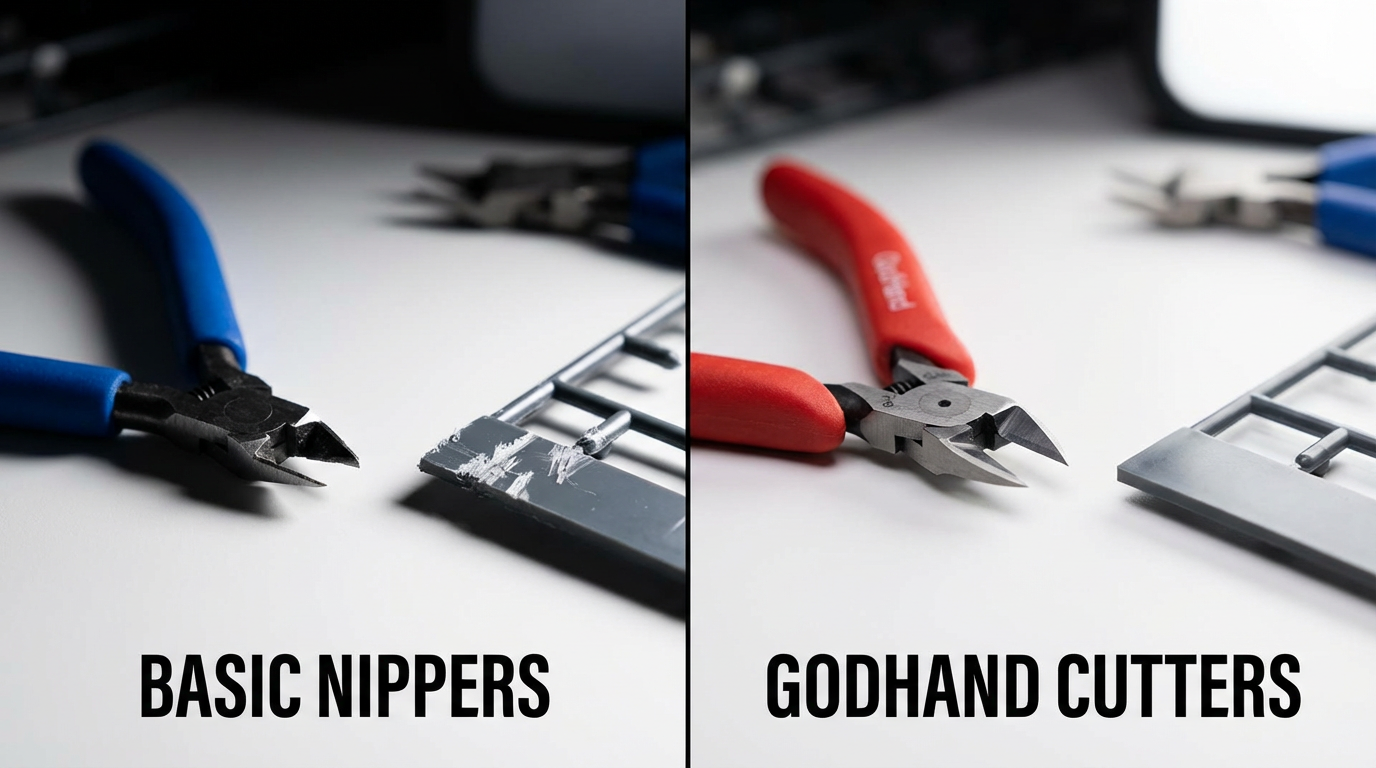
Nothing illustrates the shift from “toy” to “tool” better than the workbench itself. Front-end developer and builder Dave Rupert wrote about his Gunpla tools in a personal essay, tracking his progression from a minimal kit to a specialized setup. He started with around nine dollars’ worth of basic entry nippers and improvised sandpaper-on-popsicle-sticks, plus free bathroom tweezers. That got the job done, but the cuts were rough, the sanding inconsistent, and sticker placement frustrating.
Over time he upgraded to GodHand Blade One nippers, which he describes as cutting “like hot butter,” and a Gunprimer Raser glass file with a Balancer buffing sponge. These higher-end tools, paired with angled Mr. Hobby tweezers, pushed his kit quality way up and turned tedious cleanup into something almost meditative. The total investment climbed toward about one hundred ten dollars, but the payoff was not speed so much as consistency, confidence, and enjoyment.
That is exactly how professional engineering tools behave. A cheap wrench and a precision torque driver can both tighten a bolt; the difference is consistency, control, and how much mental energy you burn on the process. Gunpla tools teach that lesson in miniature.
Building Like an Engineer: Process, Planning, and Quality Control
Gunplanerd’s long-running “Tips & Tricks: Building” article lays out a build process that is eerily close to a small engineering project. The author starts with a parts check against the runner diagram, stressing that missing runners are rare with Bandai’s quality control but more common with third-party kits. That is essentially a bill-of-materials audit.
They then recommend planning your kit before cutting anything: deciding up front which runners to spray, where you will add heavy panel lining, whether you will install LEDs, or apply full water-decals. Some builders literally write these ideas on the inside of the box or on sticky notes, then attach them to the kit so future-you remembers the plan when you finally get to it.
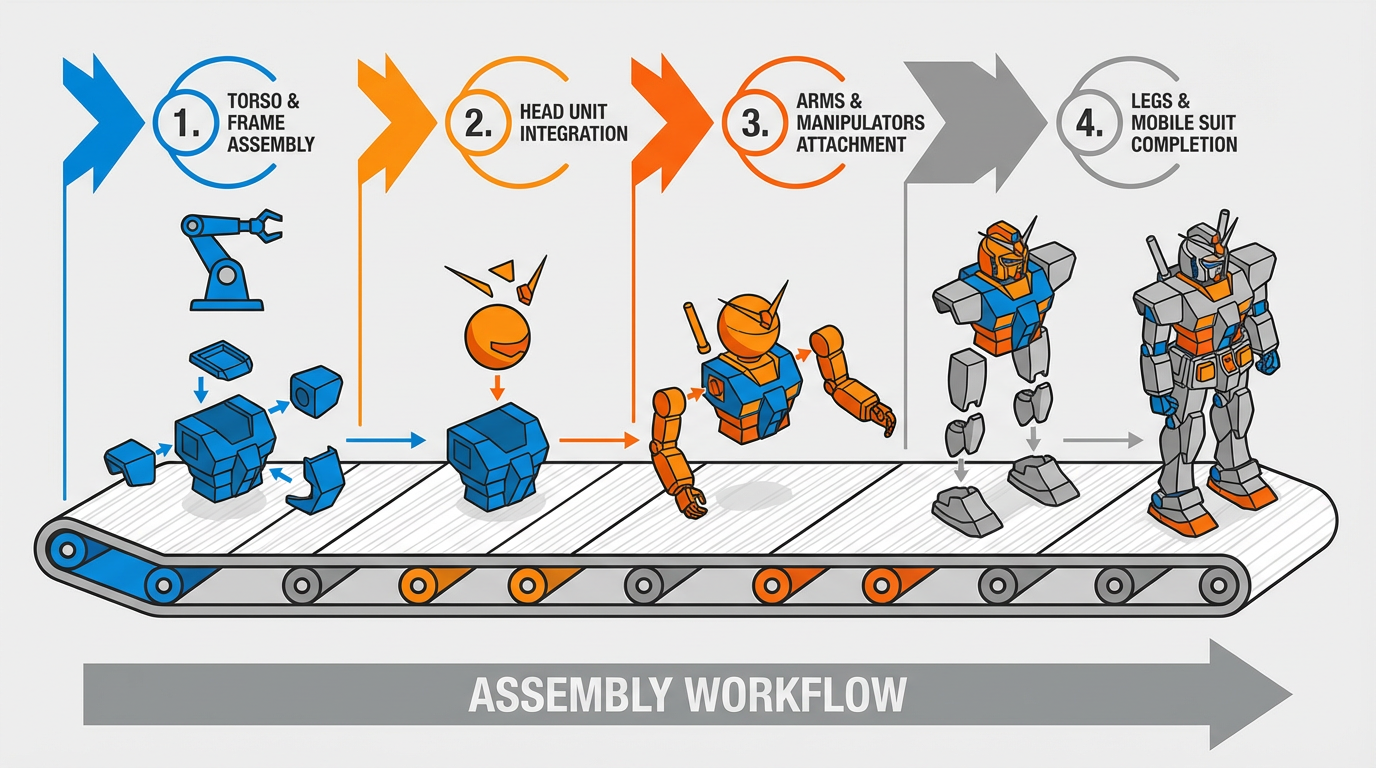
During assembly, the same author insists you should follow the manual’s flow rather than improvising. Torso, head, arms, legs, waist, backpack, weapons, extras: this sequence is not just about narrative satisfaction. It is about managing cognitive load and avoiding situations where you realize two steps later that a hidden joint should have been installed earlier. That is exactly how complex assembly lines are designed, with order-of-operations tuned to reduce errors and fatigue.
The cutting advice is equally methodical. Gunplanerd and several beginner guides describe using sharp nippers to cut slightly away from the part, then doing a second close cut, and finally cleaning the remainder with a hobby knife or file. This “two-cut” method, even dramatized in anime like Gundam Build Fighters, maps directly to real-world machining practice where you perform a rough cut and then a finishing pass to protect the workpiece.
The warning to “never force it” when parts do not fit is a lesson every mechanical engineering student learns early. If two plastic halves refuse to close, the advice is to re-check orientation and instructions, gently reposition, or use padded pliers, all while respecting the material’s limits. Force rarely fixes a tolerance stack-up; it just moves the failure point.
When Collectibles Teach Design Thinking
Gundam has always been about more than cool robots, and some of the academic writing around the franchise drives home how deeply it thinks about history and technology. In an essay titled “Turn A Gundam and the Problems of (Dark) History,” scholar Mark F. Moore discusses how Turn A Gundam, created for the series’ twentieth anniversary in 1999, weaves earlier Gundam timelines into a “Dark History” of forgotten wars. The show even digitally composites archival clips of older series into its hand-painted cels, turning the Gundam itself into a symbol of layered technological pasts.
That same layering shows up in the model kits. Every new MG or RG design is in conversation with previous engineering decisions. An MG RX-78-2 Ver. 3.0, recommended by Union Gundam, is not just “a Gundam” but a commentary on decades of previous attempts to articulate elbows, hide seam lines, and balance armor thickness against joint strength. Building it is a crash course in how design iterates over time.

Real Grade kits embody this design thinking at a condensed scale. With compact inner frames, armor panels that shift as you pose the limbs, and color separation that mimics real industrial plating, you are effectively assembling a small system of constraints. Move one joint too far and you see which armor pieces collide. Forget to snap a frame segment fully and you discover it three steps later when the outer shell does not sit right. It is trial-and-error systems engineering, but in a format that feels like play.
Even the cleaning and preservation advice reads like lab protocol. A Dhgate guide to caring for Gundam figures emphasizes gentle weekly dusting with soft brushes, avoiding harsh chemicals, keeping models out of direct sunlight, and sealing paint and decals under clear topcoats. That is essentially a crash course in material science and environmental control, framed through a display case instead of a test chamber.
Toy Mindset vs. Engineering Mindset
Because Gunpla lives at the intersection of play and craft, you can approach the same kit with very different mindsets. Thinking about those mindsets explicitly can help you decide how you want a particular build to function in your life.
A toy-first mindset treats a kit as a quick, joyful project. You prioritize getting a recognizable Gundam on the shelf, maybe over a weekend. You are content with visible nub marks, foil stickers, and the occasional wobbly joint. The main pros are speed, low stress, and accessibility. You can stick with Entry Grade, SD, and straightforward HG kits, spend minimal money on tools, and still feel deeply connected to the Gundam universe.
An engineering-first mindset treats the same plastic as a learning platform. You set aside longer blocks of time, break the work into subassemblies, and maybe keep a small notebook or phone gallery of in-progress photos. You experiment with panel lining, try topcoats like Mr. Super Clear Matte or UV Cut, and think about how a kit will respond to temperature, light, and handling over the long term. The pros are skill development, satisfaction with a job truly well done, and a tangible sense that you are growing as a maker. The trade-offs are cost, time, and the possibility of burnout if you demand perfection from yourself on every build.
Seen through that lens, the “evolution” of Gundam models is not just on Bandai’s side. The hobby grew from toys to engineering tools in parallel with fans maturing from kids who wanted robots to adults who wanted to understand how robots might actually work.
How to Turn Your Next Gunpla Into an Engineering Exercise
If you want to lean into the “engineering tool” side of the hobby without losing the fun, you do not need to jump straight into a Perfect Grade Unicorn and disappear for a month. A more sustainable path is to use each grade as a structured lesson.
On an HG kit, treat the manual as a technical drawing. Before you cut, skim the whole booklet the way Gunplanerd suggests, so you have a feel for torso, limbs, and weapon subassemblies. Do a careful runner check with the diagram on the first page; pretend you are the quality-control tech signing off on a parts list. When you cut pieces, try the two-cut method and pay close attention to where stress marks appear on darker plastic. That observation alone will teach you about gate placement and material behavior.
When you feel comfortable, follow the advice from Wise Guys Hobbies and Union Gundam and step into an RG or a simple MG. Choose something recommended for your level, like RG Wing Gundam Zero or MG RX-78-2 Ver. 3.0. Give yourself multiple evenings, not a single marathon session. Keep a mental note of where instructions assume you already understand how ball joints, polycaps, or sliding armor pieces work. Those are the moments where the kit is teaching you its underlying mechanical vocabulary.
As your tools improve, let them shape your process the way Dave Rupert describes. A sharper pair of modeling nippers and a dedicated glass file are not just luxuries; they remove friction from nub cleanup, which suddenly frees the mental energy to notice how parts nest or how joints are limited by sculpted armor. An angled pair of tweezers, like those from Mr. Hobby, makes decal and sticker placement more precise, which encourages you to tackle more complex marking schemes that reward patience and planning.
Finally, pay attention to finishing. Panel lining with specialized markers, whether Gundam-branded pens or alternatives praised on communities like MacrossWorld, forces you to study the kit’s surface as a map of mechanical seams. Topcoating with Mr. Super Clear, as recommended by builders and hobby blogs, gives you direct feedback on humidity, spray distance, and cure times. Every mistake, from cloudy finishes on a rainy day to fingerprints in semi-dry clear coat, is a low-stakes lesson in process control.
FAQ: From Snap-Fit to Mini Mech Lab
Can Gunpla really teach “real” engineering skills?
A Gundam kit will not replace a degree in mechanical engineering, but it absolutely trains real-world habits. You learn to read diagrams, follow structured processes, respect tolerances, and think in terms of subassemblies and interfaces. Academic work on Gundam, like Moore’s analysis of Turn A Gundam’s “Dark History,” shows how the franchise already thinks seriously about technology and consequence. Gunpla is that thinking translated into plastic. If you lean in, you come away with better spatial reasoning, steadier hands, and a more intuitive feel for how complex objects fit together.
Which kits feel the most like engineering projects?
Based on guides from Mecha Express, Otakumart, Wise Guys Hobbies, and Union Gundam, Real Grade and Master Grade are the sweet spot where engineering and enjoyment meet for many builders. RG gives you dense mechanical design in a compact five-inch form factor, while MG offers larger, more readable inner frames around seven inches tall. MGEX takes that further with integrated LEDs, and Perfect Grade raises the stakes with long builds that can stretch to thirty hours or far beyond. If you want something that truly feels like a mini capstone project, a PG RX-78-2 or Unicorn, handled patiently, is hard to beat.
Do I need expensive tools to start treating kits as “engineering tools”?
You do not. Quora discussions and Gunpla 101’s tools guide both emphasize that you can start with a cheap pair of nippers and basic hobby knives. Many Entry Grade and SD kits are designed to build straight out of the box. As Dave Rupert’s experience shows, specialized tools mostly amplify consistency and enjoyment rather than unlocking a secret gate. Start with what you have, figure out which step feels most tedious or messy—gates, sanding, decals—and then invest in a tool that specifically attacks that pain point. That is the same incremental tooling philosophy professional workshops use.
Closing
Gundam models began life as souvenirs of a groundbreaking anime, plastic echoes of a 1979 space war story. Four decades, many grades, and a pile of specialty tools later, they have become something richer: playful, accessible engineering kits that fit on a bookshelf. Whether you are snapping together an Entry Grade RX-78-2 in one evening or quietly wiring LEDs into a Perfect Grade Unicorn over a month, you are not just building a “toy.” You are training your eye, your hands, and your imagination to think like the people who design giant robots in the first place.
References
- https://www.academia.edu/82130374/Turn_A_Gundam_and_the_Problems_of_Dark_History
- https://scholarworks.uvm.edu/cgi/viewcontent.cgi?article=1158&context=hcoltheses
- https://d-scholarship.pitt.edu/21447/1/Williams_Thesis_Final_Draft_1.pdf
- https://scholarsbank.uoregon.edu/bitstreams/964824eb-0d3e-4811-a62b-f3208770b774/download
- https://edg.berkeley.edu/wp-content/uploads/2023/11/AHD-2023-group4.pdf
- https://iopn.library.illinois.edu/journals/jams/article/download/1584/1468/6546
- http://gunplanerd.blogspot.com/p/tips-tricks-building.html
- https://smart.dhgate.com/essential-tips-for-cleaning-preserving-and-displaying-your-gundam-figurine-toy/
- https://www.gunpla101.com/essential-tools-for-gunpla-building/
- https://www.instructables.com/How-to-Build-a-Gundam-Model-Kit/