The Rise of AI Designers: Can Algorithms Replace Human Creativity?
Imagine walking into your room, glancing at your shelf, and watching your favorite anime figurines come to life. Not literally, but in the sense that every pose, base, and color scheme was co-created by an AI designer and a human sculptor, iterating at superhuman speed. That is roughly where the creative world is heading: a crossover event between human imagination and algorithmic power.
The big question is whether these “AI designers” can actually replace human creativity, or if they are more like a hyperactive studio assistant helping us paint, pose, and storyboard our worlds faster. Based on recent research across art, product design, UX, gaming, and creative agencies, the answer is more nuanced than simple hype or doom.
As someone who has spent way too many late nights kitbashing mecha models and brainstorming AI-aided dioramas, I see AI in design less as a final boss and more as a new type of party member. Powerful, unpredictable, and absolutely needing human strategy to shine.
Let’s unpack what that looks like.
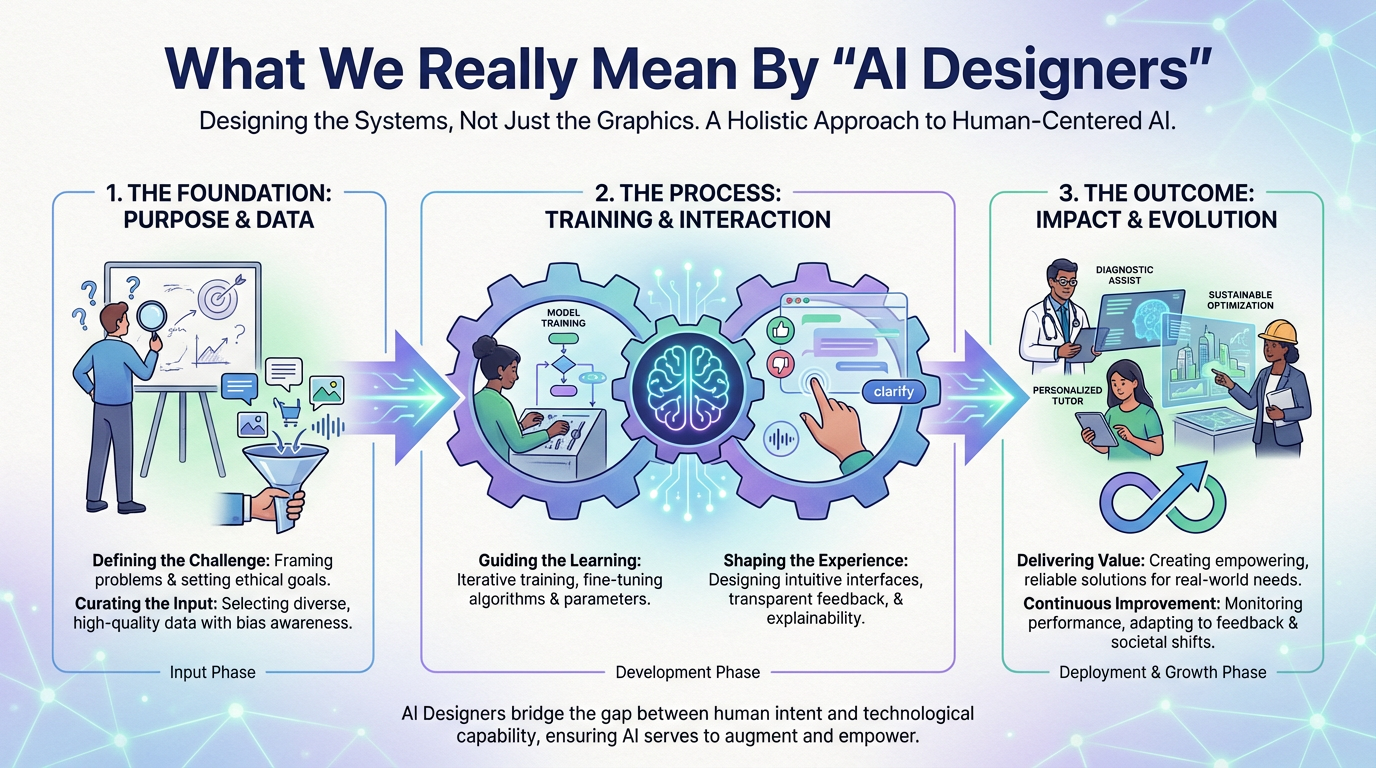
What We Really Mean By “AI Designers”
When people talk about “AI designers,” they rarely mean a single robot in a turtleneck pitching brand concepts. In practice, AI in design is a stack of tools woven into the workflow.
Several sources converge on a similar definition. AI in design means using machine learning, generative models, and automation to handle tasks across research, ideation, visual creation, layout, and testing. For example, one product-design article describes AI as “augmented intelligence” that amplifies human creativity rather than replacing it. Tools such as Adobe Sensei automate repetitive chores like image cleanup and layout suggestions, freeing designers for concept work and storytelling. Generative design platforms like Autodesk Generative Design or Uizard generate many options or wireframes based on constraints like cost, performance, and user experience.
Other articles emphasize the same pattern in graphic and UX design. AI-enhanced tools in Figma, Framer, or Webflow generate wireframes from text prompts. Image generators such as Midjourney, DALL·E, or Deep Dream create concept art. Analytics tools like Pendo or UXArmy AI sift through user data and surface patterns and pain points that would take humans weeks to extract.
If you frame the creative process like building a custom figure, AI is not the sculptor who cares about lore and personality. It is the resin printer, the auto-support generator, the catalog of pose references, and the simulation that tells you whether the base will fall over. It is deeply involved, but coded intention still comes from humans.
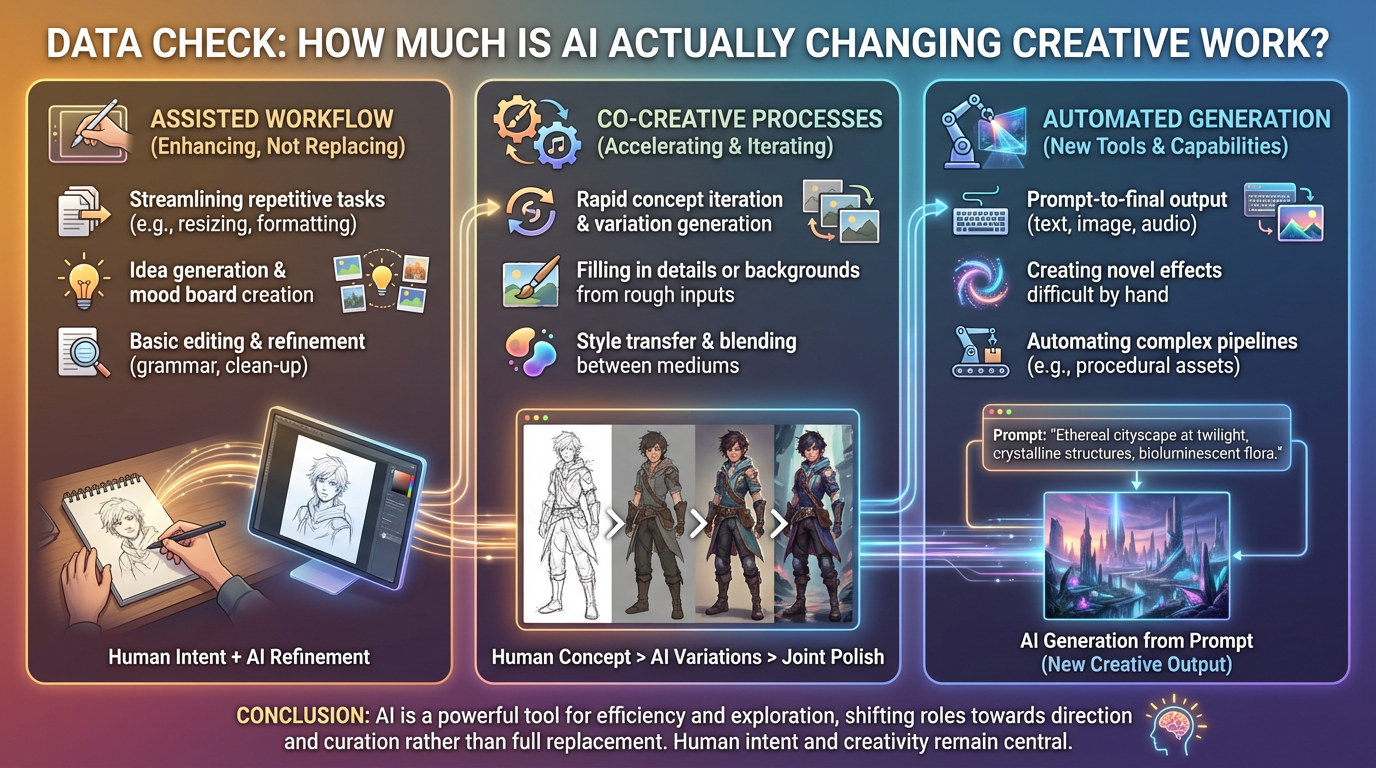
Data Check: How Much Is AI Actually Changing Creative Work?
The shift is not just vibes; it is measurable.
A design-focused market analysis reports that 98 percent of designers who adopted AI tools saw their workflow change. The same source forecasts the AI-in-design market growing from a bit over twenty billion dollars in 2025 to more than sixty billion by 2030, with strong annual growth. Another article on the broader creative economy notes that creative industries already contribute over one hundred billion in economic value in the UK alone, with AI tools increasingly woven into that output.
A literature review on AI in art and design from 2015 to 2025 highlights macroeconomic risks and opportunities. It cites estimates that about 40 percent of jobs globally, and up to 60 percent in advanced economies, could be affected by AI. Roughly half of those roles could see productivity gains, while the rest face task substitution, lower demand, and possible wage pressure. For creative workers, that means workflows may be transformed even if entire roles are not outright deleted.
Surveys of public perception show that 75 percent of Americans expect AI to reduce jobs over the next decade, and 79 percent do not trust businesses to use AI responsibly. Another study focused on creative professions estimated that generative AI could automate about 26 percent of tasks in arts, design, entertainment, media, and sports. That number is high enough to be disruptive, but low enough to leave a lot of work on the human side.
On the industry front, research into advertising agencies found that over 90 percent are using or exploring generative AI. Agencies that lean into it report about 3.7 times higher return on investment from their AI-enhanced campaigns on average, with top performers achieving over ten times. Production cycles that used to take six weeks can drop to around two weeks, while teams generate far more creative variations for testing.
From a fan’s point of view, this feels like shifting from hand-sculpting every prop to having a factory of customizable parts and a test chamber to see how different poses perform with audiences. The creative job does not disappear, but it moves to new territory.
Here is a quick snapshot of what various studies say.
Domain | Finding |
|---|
Art and design literature review | Around 40% of jobs globally, up to 60% in advanced economies, may be affected by AI. |
Creative professions study | Generative AI could automate about 26% of tasks in creative roles. |
Design market analysis | 98% of designers report workflow changes after adopting AI; strong market growth projected. |
Agency case studies | AI-adopting agencies see multi-fold ROI and shorter production cycles. |
Public perception surveys | Large majorities expect job loss and distrust business use of AI. |
The numbers suggest AI is less a curiosity and more a structural force in creative work.
How AI Actually Designs: Under the Hood
Underneath the buzzword “AI designer” are several capabilities that show up across the research.
Automation: Clearing the Creative Chores
Multiple sources describe how AI excels at the grindy parts of design. Adobe Sensei automates background removal, content-aware fills, tagging, and layout suggestions. Web-to-print platforms use AI to automatically adapt designs across formats. Tools in Canva or Photoshop handle resizing, color correction, and retouching.
One report on creative agencies describes these as “low-empathy” tasks that are ideal for automation. A case study from a marketing agency that adopted AI-based production tools reported about a 30 percent productivity boost, plus cost reductions of around 20 percent, after offloading repetitive image processing and layout work. Another example from the fashion world showed a 25 percent increase in customer satisfaction and a 40 percent rise in engagement when AI-powered personalization was added to graphic and UX design.
Think of it like sanding seams on a figure or painting endless base coats. You still need to know what you are doing, but if a machine can do the smooth, boring passes, you can focus on the tiny highlights that make a character feel alive.
Generative Design: Exploring Option Space
Generative design appears everywhere from mechanical products to architecture and character art. Autodesk Generative Design can generate structural options constrained by weight, strength, and cost, as demonstrated when an aircraft partition was redesigned to be about 45 percent lighter while maintaining performance. In game design, a study of professional designers highlighted tools that generate levels, NPC dialogue, and assets from prompts, helping teams prototype worlds far faster.
Text-to-image and image-to-image systems like Midjourney, DALL·E, and Runway take this to the visual plane. Several articles describe them as “engines for imagination.” Midjourney’s founder is quoted calling AI an engine for imagination, comparing it to cars not making walking obsolete. The point is that AI can explore enormous aesthetic space quickly, but humans still decide where to go.
In my own fandom projects, I use these tools like a visual gacha system. I feed in prompts describing a character, setting, and mood, then roll through dozens of options. Most are throwaways; some spark new angles I never would have sketched. The final illustration still involves hand drawing, reference to official art, and careful color work, but the AI stage is like flipping through infinite artbooks at impossible speed.
Data-Driven Personalization and Feedback
Another pillar is analytics. Product-design and UX articles emphasize AI tools that analyze user behavior—what people click, how they navigate, what they say in surveys—and then feed those insights back into design.
Platforms like UXArmy AI, Hotjar AI, and Maze summarize qualitative research, cluster comments by emotion and theme, and surface patterns. On the product side, Pendo tracks in-app behavior to show which features users love or ignore. For creative teams, these tools can turn mountains of feedback into maps.
In UX and marketing, AI also drives personalization. Dynamic creative optimization tools swap layouts, headlines, and images based on who is watching. Agencies report ten times more creative variations for campaigns thanks to generative tools, followed by AI-driven A/B testing that chooses winning combinations.
From a fandom perspective, this is like watching which photos of your figure collection get the most engagement and then tuning your poses, lighting, and backgrounds while a bot does the edge cropping and sizing for every platform.
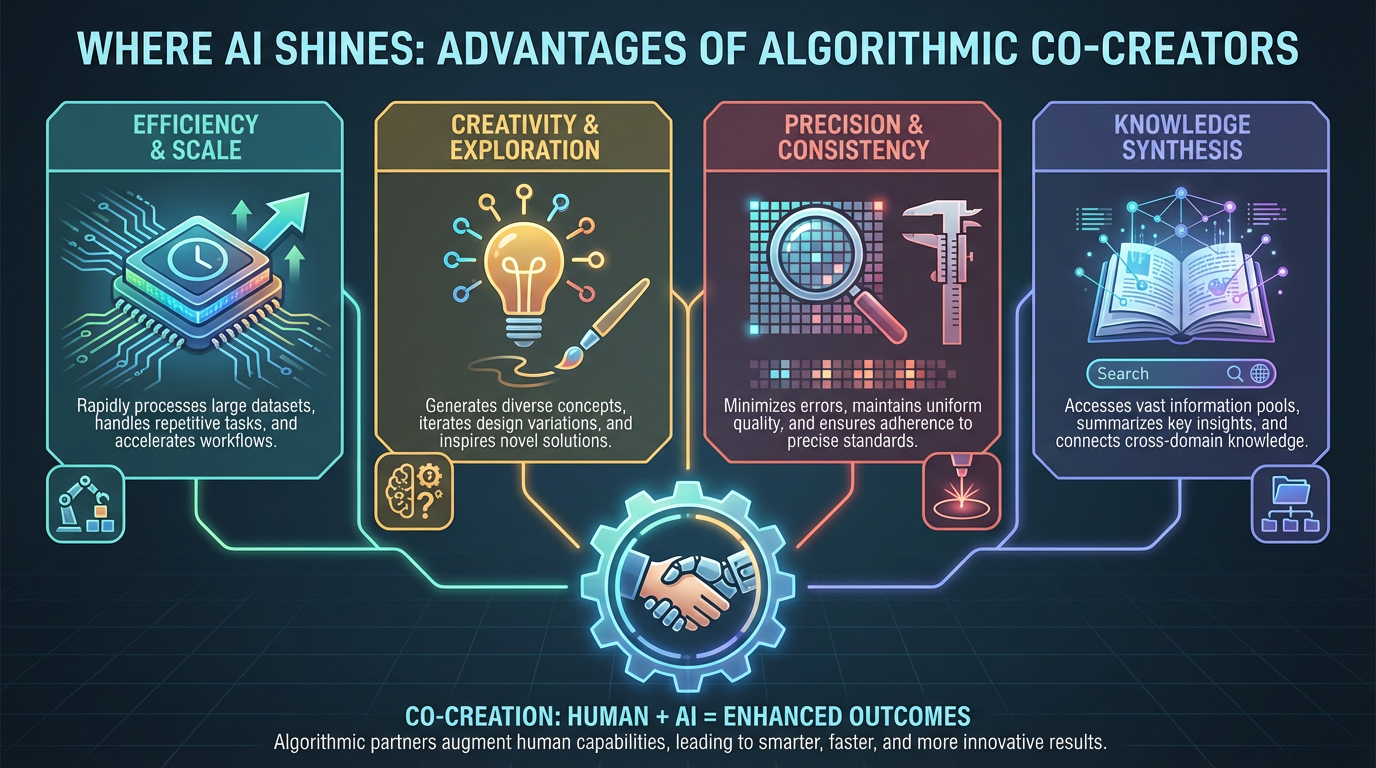
Where AI Shines: Advantages of Algorithmic Co‑Creators
Across the research, several themes come up as clear benefits.
First, efficiency. Whether in a web-to-print shop, a UX team, or an ad agency, AI cuts down on repetitive work. Designers in one UX article are encouraged to adopt an 80/20 model, letting AI handle roughly 20 percent of repetitive, data-heavy tasks so humans can focus on the remaining 80 percent: strategy, emotional aesthetics, and complex problem-solving.
Second, ideation and overcoming creative block. AI mood boards and visual generators let designers and artists explore more directions without committing heavy time to each one. In architecture and product design, generative tools produce forms and configurations that might not occur to humans, expanding the space of ideas. A book on AI image generation describes this as “hybrid creativity,” where human judgment and taste combine with algorithmic exploration.
Third, democratization. Multiple articles highlight how non-experts can now produce passable logos, flyers, and visuals using AI-driven platforms, dramatically lowering the barrier to entry. Independent filmmakers can access effects and editing tools that once required large studios. Hobbyist writers can get help refining plots or polishing drafts. A literature review notes that this democratization is a double-edged sword, but it undeniably opens the door for more people to create.
Fourth, personalization at scale. AI-powered systems let designers tailor experiences for different audiences simultaneously. Fashion brands personalize interfaces and visuals; game studios tune difficulty and content to each player’s style. A web-to-print piece emphasizes AI-driven customization of print templates, letting users adapt designs while maintaining brand rules.
Finally, measurable business impact. Across design agencies and marketing case studies, AI adoption correlates with faster turnaround, more variations, and improved metrics like click-through rates and cost per purchase. This does not mean AI is magic, but it does mean teams that treat it as a serious co-pilot tend to gain an edge.
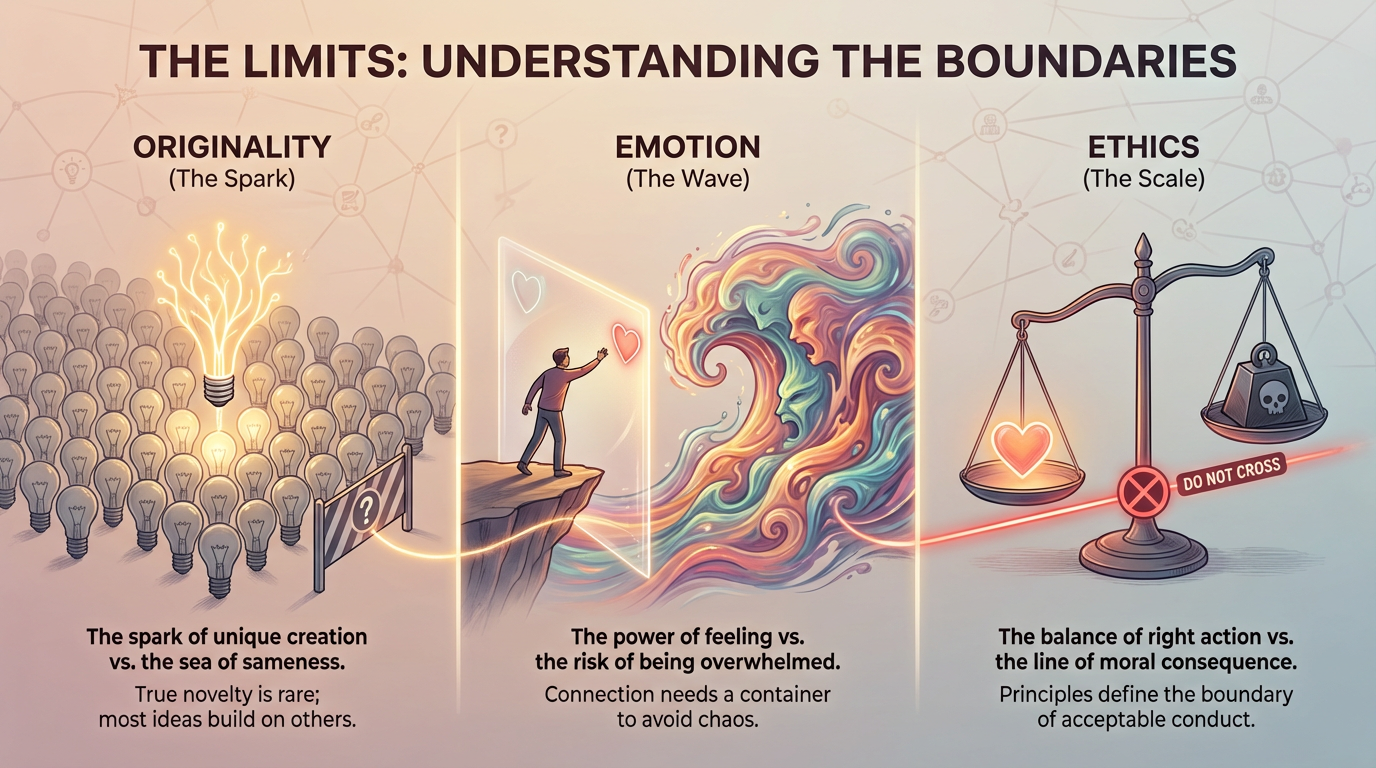
The Limits: Originality, Emotion, and Ethics
If AI were perfect at creativity, we would be done here. The research is very clear that it is not.
A big literature review of AI in art and design devotes considerable space to authenticity and authorship. It notes that AI art raises doubts about who the author is—developer, user, or underlying artists whose work trained the models. It also discusses fears that AI outputs could devalue human creativity, especially if floodgates open to cheap, generated work.
Several articles argue that AI lacks emotional depth and true understanding. It can imitate styles and patterns but does not have lived experience. That matters in areas like branding, narrative design, and art that aims to convey subtle cultural meaning. Designers in various sources describe themselves increasingly as curators who refine and contextualize AI outputs, precisely because they recognize the risk of homogenized, template-like visuals.
There are hard legal questions too. Multiple articles call out unresolved copyright and ownership issues. If a model is trained on copyrighted images without permission, what does that mean for derivatives? Who owns the rights to AI-generated work—the user, the tool maker, or someone else? Authors recommend that developers license training data, share royalties with artists where appropriate, and that users pay careful attention to each platform’s usage terms.
Finally, there is public trust. Surveys show strong skepticism about business use of AI and anxiety that it will destroy jobs. Deepfake scandals in video, AI-written articles that blur lines in journalism, and training datasets built from scraped artworks have all contributed to that mistrust. Several sources emphasize transparency—clearly labeling when AI is used, especially in news or artistic contexts—as a key ethical step.
From a fandom standpoint, this feels like the difference between a lovingly painted garage kit and a mass-produced bootleg. Even if the bootleg looks close at first glance, fans can tell when something is off, and they care deeply about who gets paid and credited.
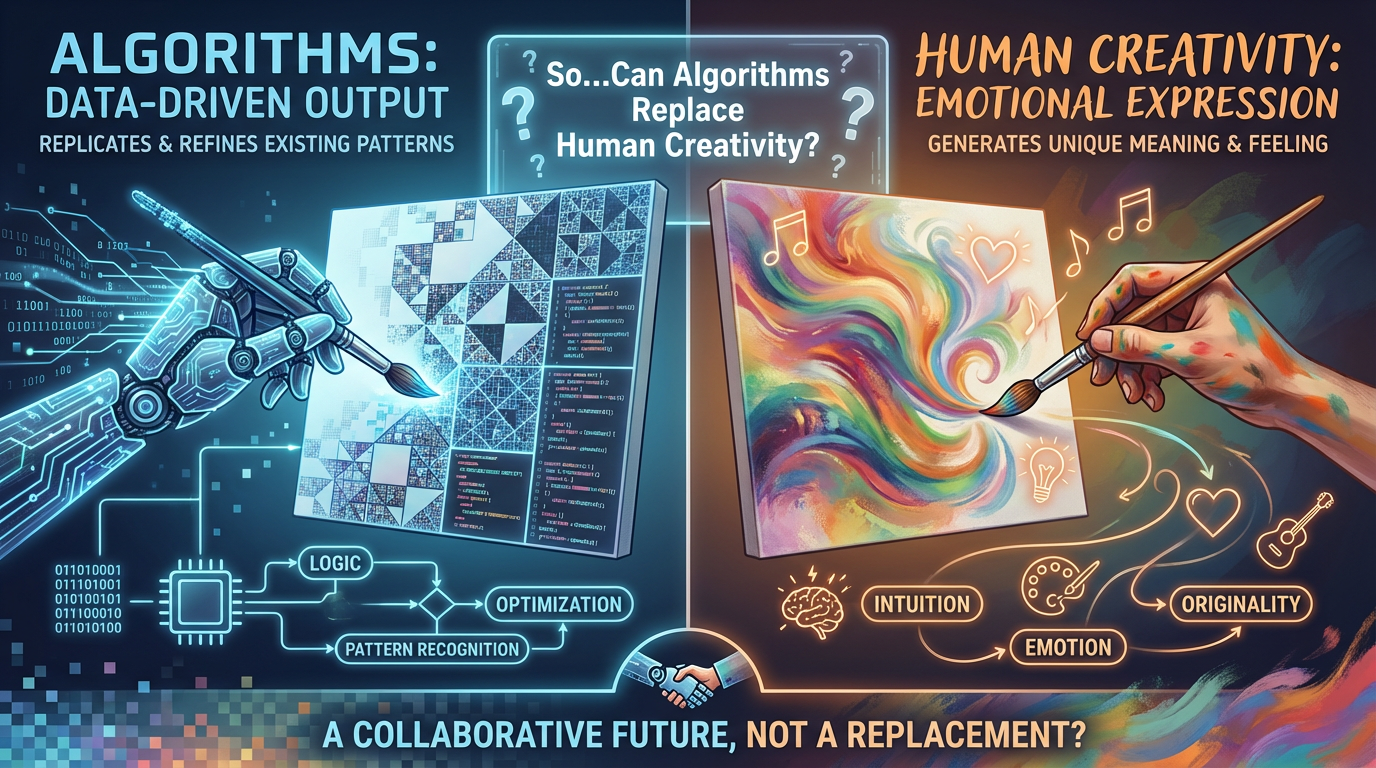
So…Can Algorithms Replace Human Creativity?
The short answer, grounded in the research, is no. But they can and will replace some creative tasks, and they will absolutely reshuffle what designers do all day.
Across product design, UX, gaming, and art, the consensus is to frame AI as a collaborator or co-creator. One design article argues that many businesses expect AI to increase headcount in product and service development, because it shifts designers toward higher-value strategic and creative work. A university study of generative AI adoption in creative professions concludes that future skills will center on critical thinking, idea management, and collaboration with intelligent systems, not on doing every technical task by hand.
A study of game designers reports mixed feelings: AI is invaluable for faster prototyping and world-building, but designers worry about over-reliance and loss of originality. The authors recommend treating AI as an assistant that proposes options while humans define the vision and narrative coherence.
Several sources rely on analogies that map well to anime fandom. One compares AI to vehicles: they extend our range and speed but do not replace the act of journeying. Another describes AI as an engine for imagination that can outperform most humans in raw idea generation but still depends on people for direction and meaning.
In other words, AI can automate and even surpass humans at certain sub-tasks, but creativity as a human process of intention, empathy, and cultural context is not something current models possess. They are remix machines, not storytellers with childhood memories of staying up late to watch mecha battles or sobbing over a season finale.
Practical Ways To Work With AI Without Losing Your Creative Soul
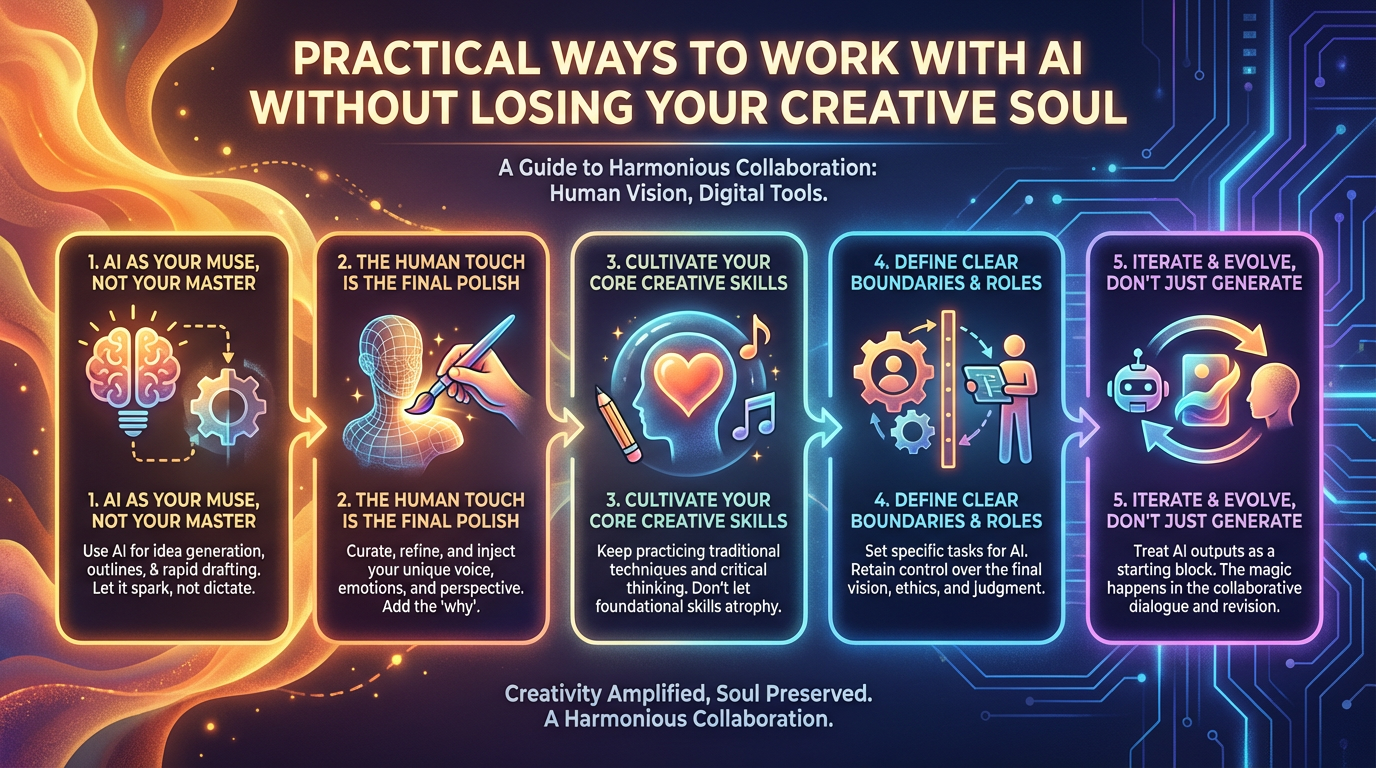
The more interesting question is not whether AI will replace creativity, but how to work with it well. The research offers a surprisingly consistent set of practices.
For professional designers, one UX-focused article recommends an 80/20 split, letting AI handle roughly one-fifth of the pipeline. That might include transcripts summarization, first-draft wireframes, quick asset variations, or layout suggestions. Designers then spend their time on defining the problem, aligning with business goals, crafting emotionally resonant visuals, and making final calls.
Several sources urge designers to build skills in prompting, data literacy, and critical evaluation. Prompting is about speaking the AI’s language to get outputs that align with your intent. Data literacy helps you interpret analytics tools without being misled by surface metrics. Critical evaluation means treating AI outputs as sketches to be refined, not as final products.
For indie creators, cosplayers, and fan artists, the advice is similar but more personal. Use AI to explore mood boards, test color palettes, generate pose references, or brainstorm alternate universes for your favorite characters. Respect the rights of original artists by checking platform licenses and avoiding tools that train on unlicensed art when possible. Keep your own touch front and center by redrawing, repainting, and rewriting rather than just posting raw outputs.
Studios and agencies face governance questions. Research on creative agencies urges teams to document prompts, keep human review checkpoints, and define which decisions must remain human-led—especially anything involving brand voice, politics, or sensitive cultural topics. There are also pricing and business model implications; AI allows more experimentation and personalization, and some agencies now charge premiums for AI-accelerated, high-variation campaigns.
Across all these levels, the pattern is clear: AI is most powerful when it is tightly aligned with human intent and strategically constrained.
Anime Shelf Moment: How AI Fits Into Fandom Creation
When I plan a new figure photoshoot or diorama, my setup these days looks different than it did a few years ago. The sketchbook is still there, along with reference screenshots from the anime. But right beside them sit AI tools.
I might use a generative model to explore background concepts: a ruined city for a post-apocalyptic mecha, a festival street for a slice-of-life cast, or a retro arcade bathed in neon. I will prompt it based on the show’s mood, then grab a few interesting compositions as starting points. After that, I sketch my own layout, adjusting angles so the real figures can hold the pose and the base will be stable.
For lighting, I sometimes ask an AI to suggest color schemes based on a character’s palette and emotional state. It is a fast way to test whether a cooler or warmer scene fits better. I still set up the lamps and gels by hand, but the ideation process is faster and weirder in a good way.
What I never do is treat the AI image as the final artwork. The joy of fandom, at least for me, is the handmade artifact: the tiny brush strokes on a cloak, the custom base sculpted from foam and clay, the improvised repairs after a figure takes a tumble. AI is part of the process now, but the pride comes from the choices I make on top of it.
FAQ
Will AI take away jobs from designers and artists?
Research suggests that AI will change creative jobs rather than erase them outright. A literature review on art and design highlights that many roles will see productivity gains, while others may lose some tasks to automation. Another study focused on creative professions estimates that about a quarter of tasks in fields like design and media could be automated by generative AI. However, multiple sources emphasize that human skills in strategy, empathy, and meaning-making will become more important, not less.
Is AI-generated art “real art”?
One review frames art as creative expression that conveys meaning, emotion, and aesthetic value, rooted in human experience. It contrasts that with views that judge AI art by its effects rather than the creator’s intent. The conclusion across sources is that AI outputs can certainly function as artworks in a gallery or game, but questions about authorship and authenticity remain unresolved. Many authors argue that the most compelling works will come from hybrid processes where humans use AI as a tool and co-creator, not as a replacement.
How can I use AI in my own creative projects without crossing ethical lines?
Several articles recommend clear, practical steps. Disclose when AI has contributed to your work, especially in professional or commercial contexts. Use tools that rely on legally sourced or licensed training data where possible. Treat AI outputs as drafts to be remixed, repainted, or rewritten, rather than just exported as-is. If you are using AI in a team or studio, establish guidelines for when human review is required and how credits and compensation will work.
Closing: Humanity, Algorithms, and the Next Limited Edition
AI is not the villain stealing the paintbrush out of your hand, nor is it the chosen one destined to replace human imagination. It is more like a powerful support character who can clone backgrounds, run simulations, and crunch audience data while you decide which story you want to tell. The rise of AI designers does not mean the end of human creativity; it means that the creative battlefield is getting bigger, faster, and stranger. For those of us who live for new worlds—on shelves, screens, or sketchpads—that is an invitation, not a threat.
References
- https://pmc.ncbi.nlm.nih.gov/articles/PMC12193870/
- https://www.uoc.edu/en/news/2025/ai-could-automate-creative-professions
- https://dl.designresearchsociety.org/cgi/viewcontent.cgi?article=1194&context=iasdr
- https://www.researchgate.net/publication/384953179_The_Impact_of_Artificial_Intelligence_on_Design_Enhancing_Creativity_and_Efficiency
- https://www.123internet.agency/how-ai-is-transforming-the-creative-process-in-graphic-design/
- https://www.adcreative.ai/post/how-ai-is-revolutionizing-the-creative-design-process
- https://blog.cindrebay.com/how-ai-is-transforming-the-product-design-industry/
- https://elvtr.com/blog/agent-of-change-how-ai-expands-human-creativity
- https://www.linkedin.com/pulse/how-ai-transforming-designers-toolkit-what-means-human-caroline-baker-tlrie
- https://blog.logowiz.app/future-of-creativity-with-ai-in-graphic-design/