Understanding the Fading of Figurines and Collectibles
Collectible figures, statues, and carded items fade and yellow because of light, heat, and humidity, but museum-style display habits can keep them looking vibrant for many years.
Maybe you remember unboxing a limited-run figure whose hair practically glowed, only to glance at it a few summers later and realize the teal has turned oddly gray and the once-clear blister is the color of old tape. Collectors who track where they place pieces quickly notice that figures near windows, hot spots, or harsh overhead bulbs age dramatically faster than the ones tucked into cooler, gentler corners. This guide explains what is actually happening to your figures and packaging, how conservation labs fight the same battles, and specific, repeatable steps you can copy at home to slow fading without turning your collection into a dark storage unit.
Why Your Figures Fade At All
Light is one of the main forces that damages the plastics, paints, and inks in collectibles, and conservation researchers treat it as a primary agent of deterioration for organic materials such as paper, textiles, and binders. Even the light you need to see your shelves slowly breaks chemical bonds, which leads to fading, discoloration, and weakening that never fully reverses over the life of an object.
In plastics, ultraviolet radiation drives photodegradation of polymers, cutting long chains into smaller fragments, creating reactive radicals, and gradually turning once-strong parts yellow, brittle, and prone to cracking. The same physics that yellows clear polystyrene panels outdoors also applies to plastic blisters, stands, and figure bodies that are exposed to light over many years. As those chains break and oxidize, you see that familiar shift from crystal-clear or bright white to tea-stained, plus the dreaded creaking or snapping when a joint or accessory is flexed.
Paint layers and printed card art suffer similar, but slightly different, problems. When pigments absorb high-energy light, they move into an excited state and can slowly change structure, which is why discussions of paint and pigment degradation and artist-grade lightfastness tests focus so much on how quickly colors lose saturation under light. Some pigments, especially bright organics and fluorescent dyes, are “fugitive,” meaning they fade or shift hue relatively quickly, while more stable inorganic pigments are slower to change even under the same exposure, as described in work on fugitive versus lightfast pigments. That is why certain neon accents or printed logos on boxes wash out long before the main figure looks different.
Color change is not just about molecules breaking; sometimes the surface itself becomes more light-scattering, which makes colors look pale even if the pigment is still there. Research on ancient painted relics shows that micro-cracks, pores, and dust in the upper layers can increase scattering and create a white, chalky veil that visually fades colors without fully destroying the pigment underneath, and reducing that scattering can make colors appear deeper again in tests on paint layers with added particles. On collectibles, you see a similar effect when a matte, slightly chalky haze creeps over once-glossy paint or clear plastic, especially on older pieces that have lived in hot, dusty rooms.
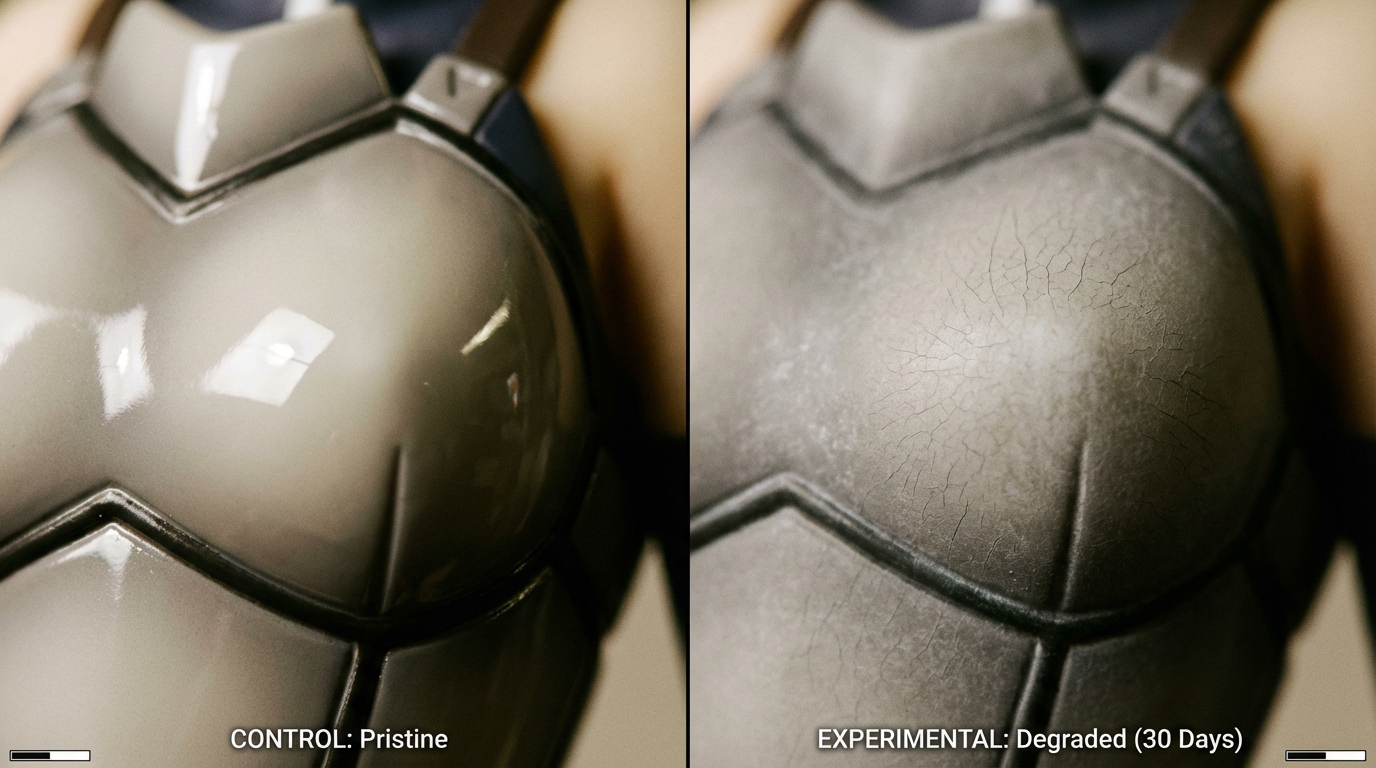
Light: The Biggest Villain On Your Shelves
Conservation leaflets on light protection emphasize that damage from light is cumulative and irreversible, depending on the total dose, not just how bright any single moment feels, which is why they focus on limiting overall lux-hours on sensitive objects in guidance for heritage collections. For a figure collector, that translates to a simple rule: the more hours a piece spends in brighter light, the faster its colors will drift, even if the room never feels “sunny” to you.
Sunlight is by far the harshest source in a typical room because it contains a significant ultraviolet component in addition to visible and infrared light, and even behind glass it can wreck color and paper fibers, as shown in analyses of UV lighting damage to documents and artwork. The frustrating twist is that UV rays easily penetrate clouds and windows, and up to about 80% of the sun’s rays can still come through on an overcast day, which means a shelf that never sees “direct sunbeams” can still fade if it faces a bright window, as warned in guides on UV-protected display cases for memorabilia. That is why one side of a room of Detolf-like cabinets can age faster than the wall opposite it, even if both feel evenly lit to your eyes.
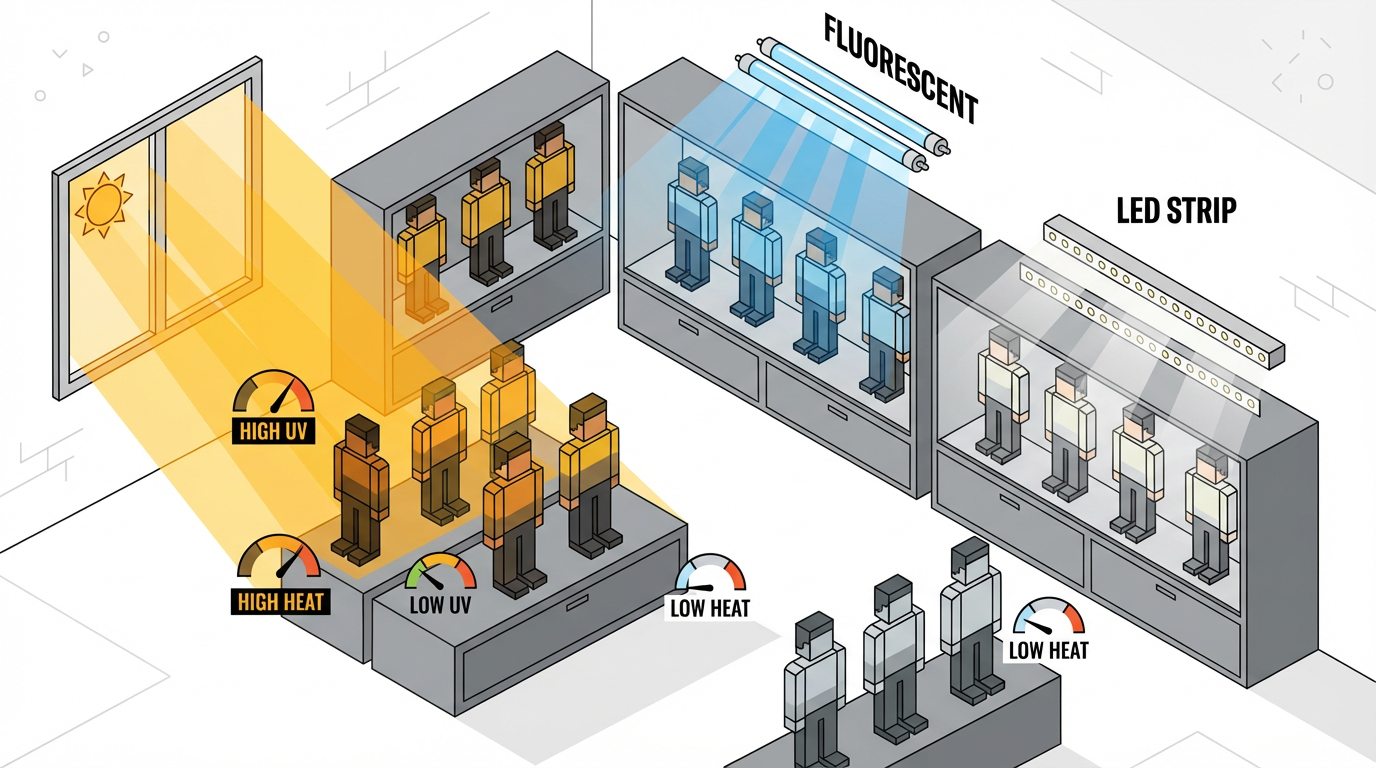
Artificial lighting has its own spectrum. Many legacy fluorescent and some halogen fixtures emit noticeable UV, so museum guidance recommends filtering or replacing them, while modern LEDs produce essentially no UV and much less heat, making them the preferred solution for sensitive displays in heritage environments. For shelf lighting, that means LED strips or pucks, kept at reasonable brightness and distance, are dramatically safer than older fluorescent under-cabinet lights or bare halogen spots, even though the total brightness still matters. You can think of it this way: a dim LED behind a frosted panel is like gentle moonlight, while a high-wattage halogen shining straight onto a figure is closer to a constant summer noon.
Infrared and heat are quieter villains that ride along with light. Conservation notes on light-induced deterioration explain how infrared radiation increases surface temperature, which dries and warps materials, and how hot lamps placed too close can soften paint and varnish in museum objects in preventive conservation work. On figures, that translates to warped weapons, softened bases, and joints that sag or lean long before color visibly fades. A figure on the top shelf under a ceiling can runs a very different thermal marathon than one on a middle shelf away from heat sources.
To visualize these trade-offs in a typical figure room, it can help to compare common light sources side by side.
Light source | Typical risk to color | Practical note for collectors |
|---|
Direct sun through windows | Very high, fastest fading and yellowing over months to a few years | Keep figures and boxes out of sun paths; use curtains or UV film on glass. |
Bright fluorescent ceiling light | Moderate to high, especially for long daily use | Prefer LED replacements or add UV sleeves and limit how long lights stay on. |
Warm halogen spot closer than a few feet | High local risk from heat and some UV | Avoid pointing directly at figures or move fixtures farther away. |
LED strips or pucks at moderate brightness | Lower risk if used sensibly | Still limit hours per day and avoid placing LEDs so close that plastic feels warm. |
Humidity, Heat, And Slow-Motion Color Shifts
Light is not the only environmental stress that matters. Recent work on historical paintings with arsenic-based yellows has shown that humidity alone can drive chemical changes and color loss in paint layers, even when artworks are kept in dark storage, because water molecules help degradation products migrate away from the original pigment particles in studies on humidity-driven color change. Follow-up experiments that recreated these pigments in the lab and exposed them to different humidity levels confirmed that high humidity can produce the same dulling and whitening seen in centuries-old paintings, as described in follow-up experimental work on arsenic pigments and moisture. While your figures do not contain those specific pigments, the lesson is clear: damp air can change colors even in the dark.
Environmental guidelines for paintings and mixed collections consistently recommend moderate, stable conditions around 65 to 70°F with relative humidity roughly between 40% and 60%, because both low and high extremes strain materials in different ways, according to museum display standards for paintings. Collectible-focused guidance echoes similar ranges, warning that hot attics and damp basements introduce warping, mold, and adhesive failure, and advising collectors to monitor conditions with simple digital thermometers and hygrometers, as described in best practices for displaying and preserving collectibles at home. Many anime collectors discover this the hard way when box art stored in a humid basement softens, the gloss dulls, and inks shift long before any harsh light reaches them.
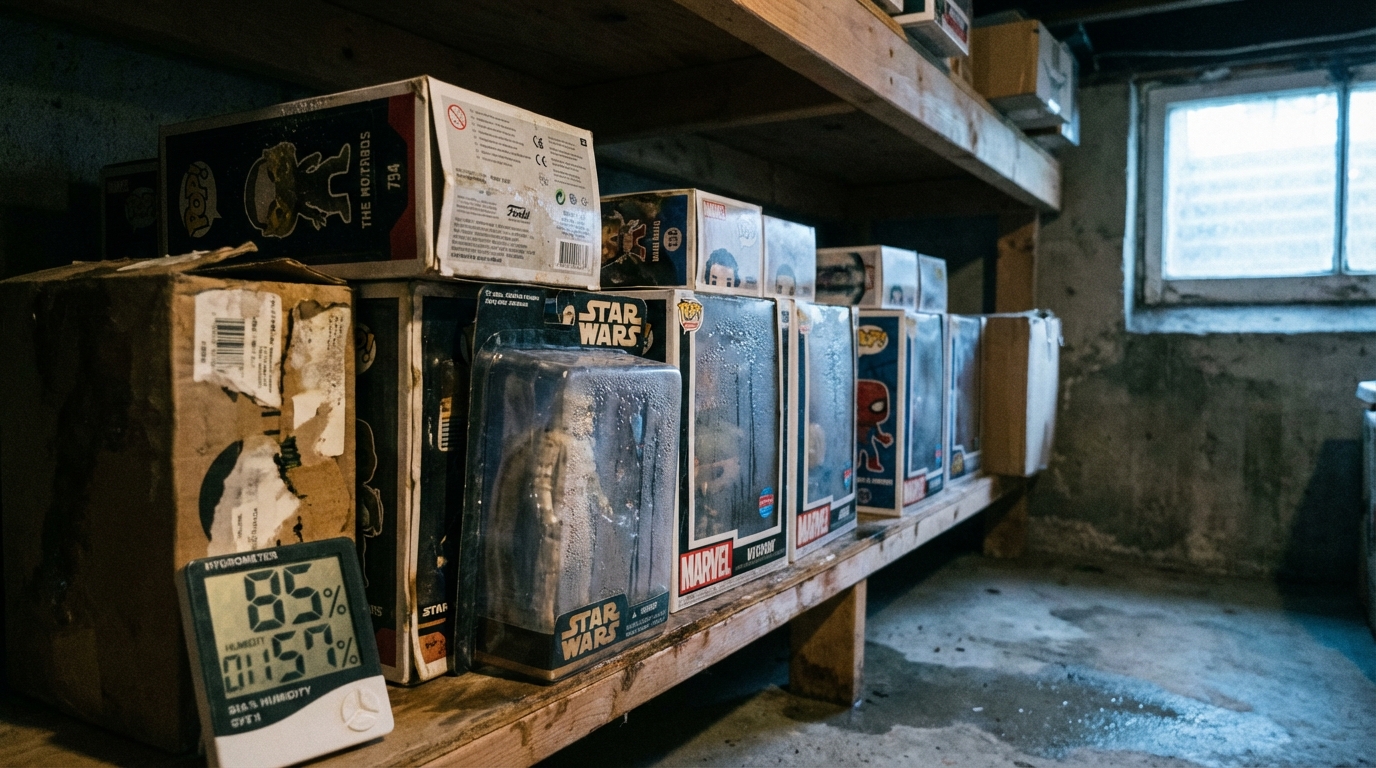
Plastics respond to humidity and temperature swings as well. Educational pieces on how sunlight affects toys explain that plastics break down faster when they are exposed to both UV and heat, and that additives such as plasticizers can migrate out of old toys over time, leaving surfaces sticky and changing material behavior in studies of aging plastic toys and containers. Combine that with high humidity and you get a perfect recipe for tacky, dust-attracting figures or accessories that feel softer or more brittle than when you bought them.
Materials, Pigments, And Why Some Lines Age Worse
Not all colors on your shelf are equally tough. Artists and conservation scientists talk about “lightfastness,” a measure of how well a paint resists fading when exposed to light, and they use controlled sunlight and xenon-lamp tests ranking pigments from highly stable to extremely fugitive in comparisons of fugitive pigments and lightfast colors. Bright, flashy hues, fluorescent accents, and certain synthetic organics tend to be less stable, which is why some neon hair streaks or day-glo logos on packaging wash out long before darker, earthier colors do.
The binder or medium that holds pigment also matters. Discussions of color fading across different art forms emphasize that tightly bound, well-formulated paints with high-quality resins and low filler content hold up better than cheaper mixtures overloaded with additives, and that varnishes can act as a sacrificial protective layer that absorbs part of the damage, as summarized in studies on how paint and pigments break down over time. Guides aimed at artists stress the value of choosing high-lightfastness pigments and binders when permanence matters, and of checking manufacturer data and doing small swatch tests to see how a material holds up in real-world conditions, as outlined in advice on color fading and lightfast choices. Translated to figures, that means some manufacturers’ paints and varnishes will simply age better than others under the same shelf conditions.
Even when two colors look identical on release day, small formulation differences can lead to very different long-term behavior. Artist-focused breakdowns of substitute pigments show, for example, that families of synthetic yellows and reds can range from solid to disappointingly fugitive depending on the exact chemistry and brand, and that binder choice can make the same pigment last longer in one medium than another, as explored in discussions of why some colors and substitutes fade. On collectibles, this is one reason two figures from different lines can sit next to each other for years, yet only one shows obvious fading or yellowing.
Under the surface, additive chemistry plays a role as well. In polymers, internal impurities and chromophoric groups, including certain residual solvents and additives, can sensitize plastics to light and accelerate degradation, making them more likely to yellow or crack when irradiated, as described in work on photooxidation and stabilization of polystyrene and similar plastics. Educational pieces on everyday plastics point out that plasticizers can leach to the surface of older toys, which is part of why some vintage pieces become strangely sticky or develop a sheen that grabs dust, as explained in consumer-focused discussions of aging plastic toys and chemical additives. Those subtle formulation choices largely determine whether a figure’s base stays snow white or drifts toward nicotine yellow over a decade.
Practical Ways To Slow Fading While Still Enjoying The View
Tame The Light In Your Display Room
Preservation guides for artworks and papers repeatedly stress that the safest approach is to keep the most light-sensitive items in the dark when they are not being viewed, using storage boxes, closed cabinets, and lights that switch off automatically, as outlined in recommendations on limiting light exposure in storage and display spaces. For figures and collectibles, you can mimic this by keeping grail pieces in opaque boxes or behind curtains when you are not in the room, then opening things up when you want to enjoy the display. Even a simple habit, like turning off shelf lights when you leave and closing blackout curtains during the brightest part of the day, cuts the lifetime light dose dramatically.
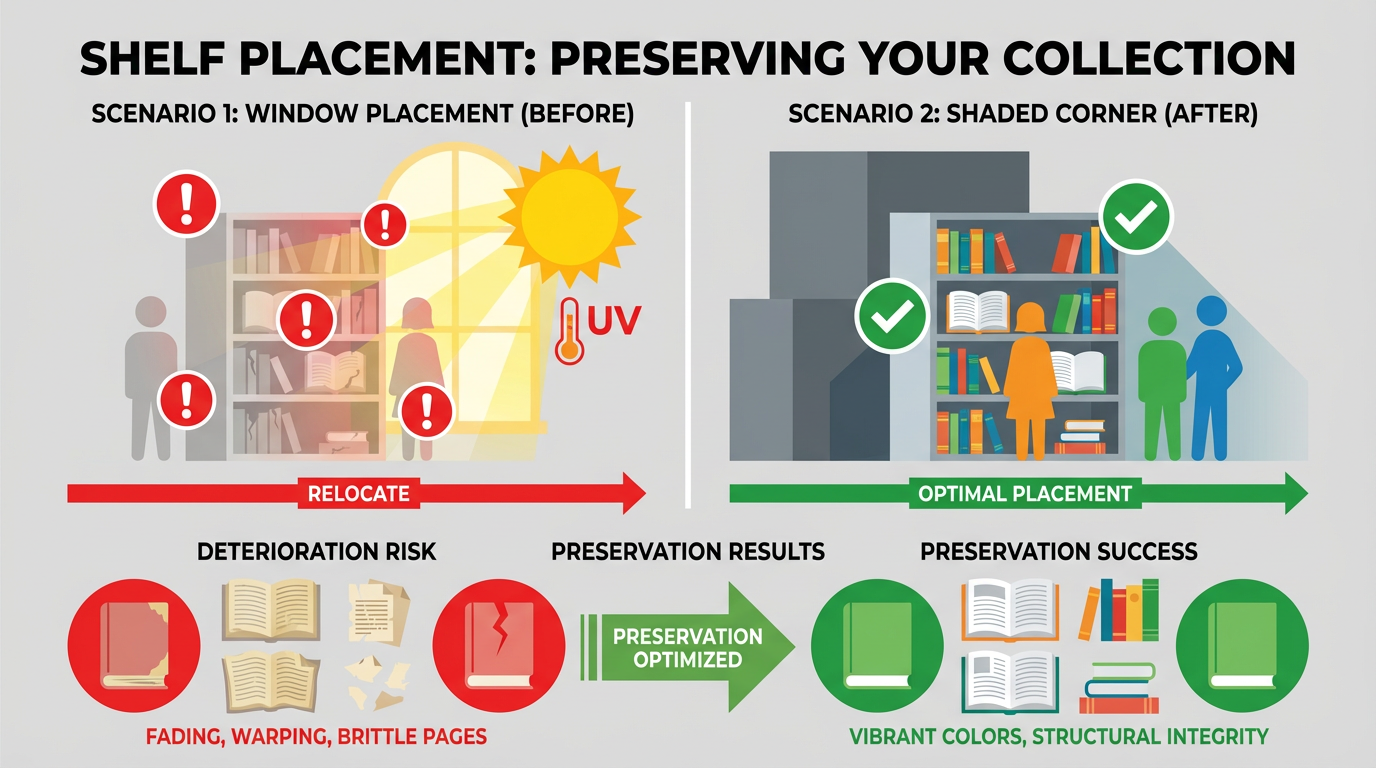
Where you put shelves matters almost as much as what lights you use. UV-focused analyses of document and artwork damage explain that unfiltered window light and many older lamps exceed safe UV levels unless you add filters, while UV-filtering acrylics and films can cut incoming UV to a small fraction of its original level in discussions of UV-filtering glazing and films. Collectible-focused guides recommend choosing rooms without windows when possible, or orienting shelves so their fronts face away from any light sources, and using curtains or covers around display walls to protect items between viewing sessions, as suggested in advice on UV-protected display cases and room setup. In practice, moving one bookcase from a sunny wall to a shaded corner can make a bigger difference over five years than any single choice of LED strip.
Keep Temperature And Humidity In The Safe Zone
Museum guidelines for paintings recommend keeping temperature moderate and stable and relative humidity in a narrow mid-range, often around 50%, because fluctuations cause mechanical stress, warping, and cracking while high humidity encourages mold and chemical deterioration, as explained in environmental display recommendations for paintings. Collectible-specific advice suggests a similar sweet spot, often around 70°F and roughly 40% to 50% humidity, while warning against hot attics, garages, and damp basements for long-term storage, as laid out in guidance on home setups for preserving mixed collections. A cheap digital hygrometer on the shelf is worth as much to your collection as a fancy figure stand if it helps you catch that your room is creeping into swampy or desert territory.
Within display furniture, microclimates matter too. Recommendations for UV-protected display cases note that good cases not only filter UV but also buffer against dust, humidity swings, and accidental spills, essentially creating a more stable environment around each item in advice on UV-protected memorabilia cases. You can enhance that microclimate by adding silica gel packs or other desiccants in damp regions and by keeping cases away from heaters, air vents, and exterior walls that experience strong seasonal temperature swings, practices that echo environmental control strategies for mixed-material collectibles. Pay special attention to bathrooms and kitchens; they tend to spike humidity and heat in ways your figures will not forgive.
Deciding When To Use UV-Protected Cases
For carded figures, signed items, or ultra-rare PVC statues, UV-protected cases are one of the most collector-friendly tools you can borrow from museum playbooks. Analyses of light damage to documents emphasize the effectiveness of UV-filtering acrylic sheets that can block the vast majority of UV while staying optically clear for viewing, and they show how such glazing is used both in frames and in front of display cases to shield objects from ambient light in discussions of UV-filtering acrylic for conservation. Collectible-specific guides extend this idea to action figures, recommending clear, UV-protected cases that create a stable micro-environment, keep cardbacks flat, and shield blisters and inks from UV, dust, and knocks, as described in advice on UV protection for action figure displays. A good case will not stop all aging, but it slows the main external threats significantly.
The trade-offs are mostly cost, space, and a slight loss of spontaneity in rearranging your shelves. UV cases and frame-grade acrylic are more expensive than basic stands, and even with high UV-blocking numbers there is still some residual risk, which is why experts recommend combining cases with smart room placement and light control, not treating them as magic armor, in practical guidance on UV cases and environment control. On the plus side, cases also make figures easier to dust and photograph, protect cardbacks from warping, and signal “this is special” every time you walk into the room.
A quick comparison helps clarify when a case is worth it.
Display choice | Main pros | Main cons | Best suited items |
|---|
Open shelf, no doors | Easy access and rearranging; lowest cost | Highest exposure to light, dust, and handling | Everyday figures and prize pieces |
Glass cabinet, no UV film | Shields from dust and fingers; looks premium | Still transmits much UV unless filtered | Mid-range scales and collections |
UV-filtered acrylic case | Strong UV reduction; stable microclimate | Higher cost; less flexible for posing | Grail figures, signed or vintage pieces |
Dark archival storage box | Maximum protection from light and dust | Minimal display joy; out of sight | Long-term investment pieces and spares |
When To Think About Restoration
Because light damage is cumulative and irreversible, conservation organizations repeatedly emphasize that the priority should be prevention, not repair, since faded colors and yellowed, weakened substrates cannot be fully brought back once they are damaged, as outlined in analyses of UV-induced damage to documents and artworks. However, some surface issues, like dust, grime, or haze, can be improved with careful cleaning or by addressing scattering layers, which is why studies on ancient artworks explore how reducing surface scattering or filling micro-voids can visually deepen faded colors even when pigments have not been replaced, as demonstrated in experiments on scattering-induced fading in painted relics. On figures, that is similar to how a gentle clean can make colors pop again, even though it cannot undo true UV fading.
For anything with serious monetary or sentimental value, it is worth considering professional help before you attempt drastic fixes. Expert guidance on dealing with faded artworks stresses that surface cleaning, removing discolored varnishes, or structurally supporting weakened pieces are operations best handled by trained conservators when color loss or physical damage is extensive, particularly when the piece carries high emotional or market value, as described in advice on when to involve conservation professionals. If a prototype, one-of-a-kind garage kit, or extremely rare limited edition starts to show alarming cracking, flaking paint, or severe yellowing, it is smarter to freeze the damage by improving environment and light, then ask a conservation-oriented professional what, if anything, can be done safely.
FAQ: Quick Answers For Worried Collectors
Are LED strips actually safe for anime figure displays?
Preservation resources have shifted strongly toward LEDs because they emit essentially no ultraviolet radiation and very little infrared heat, generate less warmth at a given brightness, and can be selected for color temperature and color-rendering properties that still show objects accurately, as outlined in light-damage mitigation advice for heritage collections using LED lighting. That makes LED strips or pucks the safest type of shelf lighting for figures, provided you keep brightness reasonable and avoid installing them so close that the plastic ever feels warm to the touch. The same dose rule still applies though, so leaving even cool LEDs blazing over your shelves 12 hours a day will age your collection faster than using them selectively when you are actually in the room.
Why did my blister bubble yellow while the figure inside still looks okay?
Clear plastics often degrade faster than opaque, painted parts because every bit of light passes through them and interacts with additives and impurities that can accelerate photooxidation, a process described in detail for polymers such as polystyrene in studies of polymer photodegradation and stabilization. Collectible care guides note that sun damage commonly shows up first as yellowed plastic, warped cardbacks, and dulled gloss on packaging, even while the figure itself still looks fine, because the card and blister are closest to the light source and built from different formulations, as explained in advice on protecting memorabilia from UV and heat. In practice, once a blister has turned amber, you can slow further change with better light and environment control, but you cannot “bleach” it back to factory clear without risking more damage.
Is it better to keep grails sealed in boxes or displayed?
From a pure preservation standpoint, the safest place for highly light-sensitive items is complete darkness in a stable, cool, mid-humidity environment, which is why conservation guidelines recommend boxing vulnerable papers and textiles and keeping lights off in storage spaces whenever possible in recommendations for light and environment management. Collectible-oriented advice then layers on practical reality: you can reserve that level of protection for the handful of pieces you treat as long-term investments, while using UV-filtered cases, careful room layout, and rotation for the figures you want to actually see every day, as described in best-practice discussions of displaying versus storing collectibles. Many collectors split the difference by keeping extra copies or empty boxes stored away and choosing one display copy to enjoy under controlled light, temperature, and humidity.
Final Thoughts For Your Shrine
Fading and yellowing are not curses from the anime gods; they are the slow, predictable result of how light, heat, and moisture interact with the plastics, paints, and papers that make up your collection. Once you understand those forces, you can rearrange a room, tweak a lighting setup, add a curtain or a UV case, and watch future releases hold their color far longer than your first-generation shelves ever did. Treat your collection like a tiny museum dedicated to your favorite worlds, and your captains, idols, and mecha will keep looking convention-fresh every time you walk past.