Understanding the Lifespan and Care of PVC Figurines
PVC figurines can last for decades and even outlive their owners, and this guide explains how environment, handling, and cleaning practices determine whether they still look display-ready years later.
PVC figures can easily survive for decades, but whether they stay crisp, colorful, and non-sticky depends almost entirely on how you control heat, light, humidity, and cleaning.
You know that sinking feeling when you pick up a favorite figure and the base feels a little gummy, or your once-white armor has turned a sad tea-stain yellow. Many collectors who dialed in temperature, humidity, and gentle cleaning routines have watched their PVC armies stay “just out of the box” for fifteen years or more, while pieces left in hot, damp corners warped, molded, or melted into sticky heartbreak. This guide walks through what actually determines a PVC figure’s lifespan, what real aging looks like, and the specific display and cleaning habits that keep your collection looking convention-table fresh instead of attic-box tragic.
How Long Do PVC Figurines Really Last?
PVC itself is stubbornly long-lived. Vinyl records made from PVC can stay playable for more than a hundred years when stored cool, clean, and flat, and PVC film used in packaging and decor routinely lasts five to ten years indoors before it even starts to look tired. That tells you the base material is not on a ten-year timer; in chemical terms, it breaks down painfully slowly.
Collectors who also deal in older toys see the same pattern. Vintage ponies, dolls, and bears from the 1980s often show spots, faded manes, and plasticizer leakage, yet still sell well on the secondary market because the plastic bodies themselves are intact. One anime and toy collector comparing vintage toys to modern scales argues that PVC figures are built to higher standards and will generally take longer to show visible aging than those childhood ponies or early action figures. From a pure “existence” standpoint, your PVC waifu is going to be around far longer than you are.
Where the conversation gets real is not “Does the figure still physically exist in 100 years?” but “Does it still look good enough that you want it on the front row of your shelf?” There, the lifespan is dictated by environment and handling. Under stable indoor conditions, sources that look at sculptures, PVC films, and vinyl records all converge on the same message: keep plastics cool, dry, dark, and gently cleaned, and you are talking about multi-decade display life, not a handful of years.
What Aging Looks Like: Yellowing, Stickiness, Leaning, and Failures
Fandom aging horror stories tend to fall into four categories. Yellowing is the most visible: white clone troopers and stormtroopers turning cream or brown, armor panels shifting tone, bases going from neutral to nicotine. In a Star Wars action figure discussion, collectors named specific releases where torsos and helmets browned badly while other figures on the same shelf stayed clean, suggesting that resin mix and paint matter as much as age.
Stickiness is the second issue and is tied directly to plasticizers. These additives keep PVC flexible; over time, especially in heat and poor ventilation, they slowly migrate to the surface. Collectors describe figures that feel oily or tacky, including relatively recent releases, not just vintage toys. A care guide for anime PVC figures notes the same thing and points out that stickiness is especially common when figures live in hot or humid cases. Museum conservation guidance on plastics backs this up more broadly: as plastics degrade and plasticizers move, surfaces become sticky and dust and pollutants cling aggressively, which is hard to reverse.
Third is leaning and warping. Heavy characters posed with one leg stuck out or with big weapons extended tend to slowly tilt as the softened PVC creeps under its own weight, particularly if shelves get warm. Some figure collectors call leaning the most serious flaw because it is difficult to correct without carefully heating and reshaping parts, and in extreme cases the pose cannot be fully recovered.
Finally, you see mechanical failures: glue giving up on a hand or accessory, joints cracking, or adhesives inside bases drying out. One collector described an older figure whose hand simply fell off when the glue failed, and they ended up sculpting and repainting a replacement rather than tossing the statue. That kind of repair is possible, but most people would rather never reach that stage.
The common thread across all four types of aging is not a simple “age equals damage” curve; it is environment. Figures from the same line stored in a cool, ventilated room can look fresh while the ones in a hot, closed box go shiny, sticky, and yellow.
Environment: The Real Lifespan Multiplier
Temperature is enemy number one. A temperature-control guide for Star Wars collectibles notes that PVC and other components exposed to around 150-158°F can suffer irreversible damage, and that risk starts creeping up once you get much above about 70°F. At the same time, serious collectors and storage facilities routinely aim for roughly 50-60°F for long-term storage, with humidity around 45–55 percent and as little daily fluctuation as possible.
Multiple sources that work with plastics and statues land in a similar comfort zone. A conservation article on sculptures recommends about 64–72°F and 40–55 percent humidity for indoor preservation, while a statue-care guide for resin and PVC suggests keeping rooms between about 59–77°F with moderate humidity and no big swings. The consistent message: think cool living room, not hot attic or damp garage.
Humidity is the sneaky co-villain. That Star Wars storage guide describes one collector losing about forty items to mold because heat and moisture were not controlled. Above about 70 percent humidity, especially combined with temperatures over about 70°F, you risk mold on packaging, paint smearing, oxidation on metal parts, and slow microscopic damage to plastics. Museum plastic guidelines also flag high humidity as a driver of hydrolysis and surface changes, while low humidity makes some plastics more brittle and builds static charge that attracts dust.
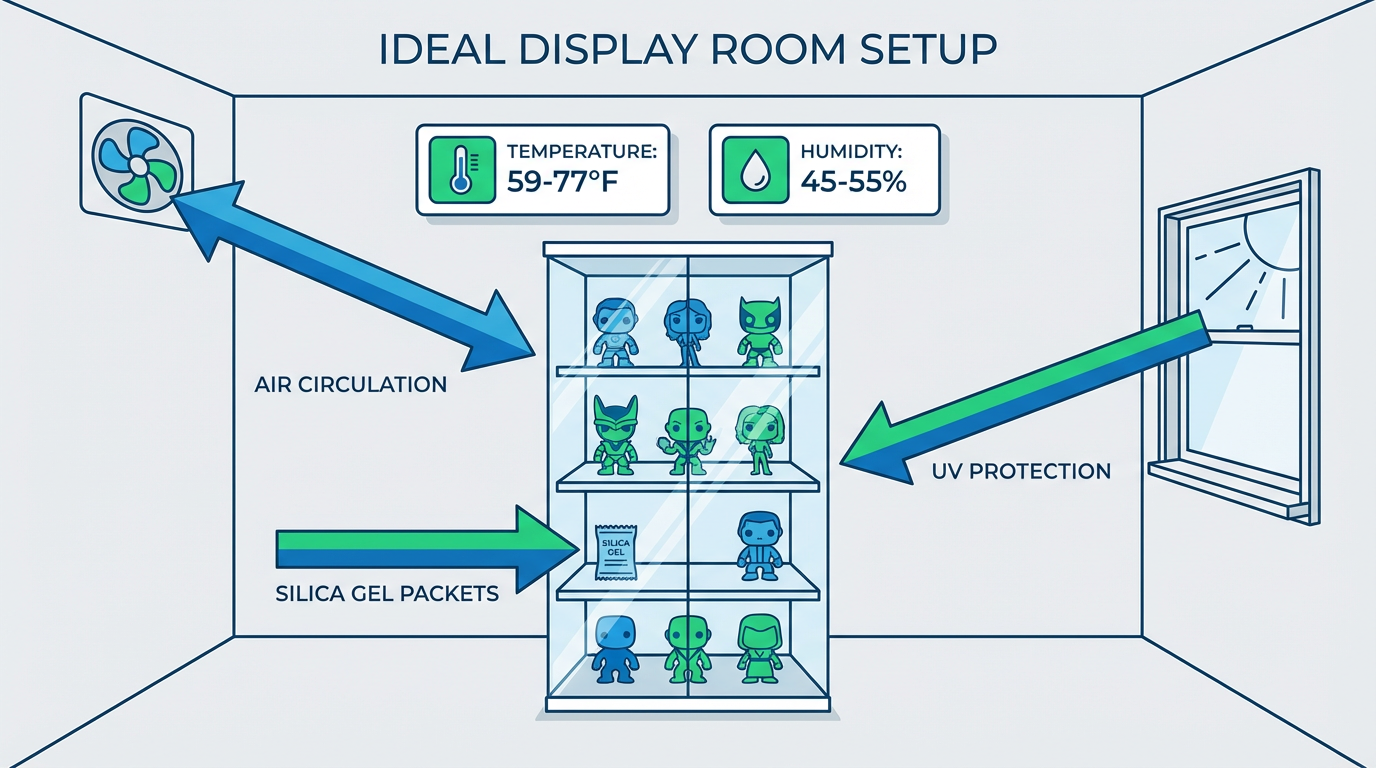
Realistically, most home collectors are not building museum vaults. The goal is much simpler: keep figures in climate-controlled indoor rooms, not in attics, sheds, or next to kitchen stoves and heaters; avoid direct sunlight; and try to stay in that roughly 59–77°F band with humidity close to 45–55 percent. A cheap digital thermometer-hygrometer in your display room will do more for your shelf life than any fancy cleaning product.
Practical Setup at Home
Imagine two shelves of prize PVC scales from the same line. Shelf A is in a glass cabinet against an interior wall, away from windows, with a small dish of silica gel packets and a digital humidity monitor that usually reads around 50 percent. Shelf B is on an open bookcase in front of a sunny window in a room that regularly hits 80°F in summer. You can almost predict the future: a few summers in, Shelf B’s whites will start to yellow, clear parts may haze, and joints and bases will soften, while Shelf A keeps its “new” look far longer.
Display placement is doing most of the work here. Figure-care guides recommend glass cabinets or acrylic boxes to cut dust and accidental knocks, but they consistently warn against putting those cases where sunlight or heaters beat on them. A toy maintenance article even suggests that fully sealing figures away long term is not ideal, because trapped off-gassing can discolor paint; that matches reports from collectors who noticed more yellowing in poorly ventilated boxes. A better approach is a mostly closed case with some airflow and desiccant, checked periodically.
If you are running a larger or higher-value collection, it can make sense to treat your figure room like a small gallery. Some serious collectors rent climate-controlled storage units where interior temperatures and humidity are managed professionally; costs can average around $190 a month, which sounds high until you compare it with the value of grail statues and limited runs. For most of us, a home air conditioner, a fan, and careful room choice are enough.
Everyday Care: Cleaning, Handling, and Display That Add Years
Dusting and Deep Cleaning Without Damage
Dust seems harmless until you leave it on a figure’s hair drills or armor panels for a year. A PVC figure cleaning guide notes that even in closed cases, figures gather dust, and a quick light dusting every one to two weeks dramatically reduces the need for risky deep scrubbing later. Another action-figure care article frames regular cleaning as a direct value move, noting that well-preserved aesthetics can boost resale value significantly compared with visibly neglected pieces.
The gentlest tools win. Collectors and care guides alike reach for soft synthetic makeup brushes, microfiber cloths, and camera lens blowers. Brushes loosen dust in hair, folds, and armor vents, while a blower or carefully used compressed air pushes particles out of tight spots. The key is soft bristles and light pressure; PVC and paints sit in the “scratches easily” zone, so you treat surfaces more like a camera lens than a kitchen plate.
When you do need deeper cleaning, different sources give slightly different water advice, but they agree on two principles: mild soap and avoiding heat. One anime figure care guide recommends lukewarm water with a few drops of mild dish soap, applied with a soft cloth or toothbrush and rinsed gently, then air-dried fully before reassembly. Another PVC figure maintenance article warns that hot or warm water can soften PVC enough to deform it, especially if combined with brushing, and suggests avoiding warm soaking as a routine. Museum guidance on plastics says most undegraded plastics can tolerate brief immersion and air-drying, but surface layers can still be marred if you get aggressive.
A safe compromise is simple. Use cool to barely lukewarm water that feels comfortable on your skin, add a tiny amount of mild dish soap, and treat it as a wipe-down rather than a bath. Detach safe parts like bases or hair pieces if the design allows it. Work in small sections with soft cotton swabs or a microfiber cloth, never scrub, and keep water away from electronics, decals, and obviously delicate paint. Always patch-test any method on a hidden area first; some older or cheaper figures have paints that are less water-safe.
Handling and Posing to Avoid Mechanical Stress
How you touch and pose your figures quietly sets their long-term fate. Statue-care guides and toy cleaning articles emphasize clean hands or cotton gloves, limited handling, and never lifting by thin parts like weapons, fingers, or hair strands. Museum advice for plastics adds that stress itself accelerates degradation, and flexible plastics may permanently creep under load. That is exactly what we see when a heavy character leans over the years.
When posing articulated PVC figures, think “low stress,” especially in warm months. A temperature guide for collectibles suggests posing figures in relaxed stances with arms down and legs straight during heat waves to reduce tension on softened joints. If you love a dramatic, weight-shifted pose, support it: use clear stands, reposition weapons closer to the body, or rotate poses occasionally so the same ankle is not bearing the entire load for a decade.
For statues and scales, support is part of display design. Use solid, level shelves; avoid overcrowding that makes knock-overs more likely; and if a base feels wobbly, reinforce it with a discreet acrylic riser or a level pad rather than letting the statue rock. When moving pieces, cradle the base and a solid torso area with both hands rather than grabbing a cape or staff. Those habits sound fussy until you remember that a single fall can do more damage than ten years of dust.
Fighting Stickiness and Yellowing
Sticky PVC is one of the most unnerving aging signs because it feels like the figure is melting. Figure-care sources explain that stickiness usually comes from plasticizer migrating to the surface, especially in hot, stagnant air. A cleaning guide specifically for anime PVC recommends using 70 percent isopropyl alcohol on a soft cloth to wipe sticky areas, while avoiding printed decals and tampo details, then letting the figure air out in a cool, dry place for a day or two. Another PVC maintenance article suggests that oily films can also be gently removed with neutral dish detergent, followed by thorough drying, and notes that certain clear sprays can temporarily isolate the surface from air to slow recurrence.
Broader plastics research, and even the experience of coin and record collectors, adds a cautionary twist. PVC sleeves and holders that off-gas plasticizers can leave cloudy films and even etch surfaces over time, especially with heat and moisture, and museum plastics guidance warns that dust sticks stubbornly to these degraded, sticky films. That is a strong argument against long-term sealed storage in PVC containers or baggies and in favor of breathable, PVC-free materials with regular visual checks.
Yellowing is harder. Once pigments and plastics have chemically changed, you are mostly managing appearance, not reversing time. Some toy collectors mention peroxide-based whitening methods that can brighten plastics, but also warn that these can weaken or embrittle the material and should be reserved, if at all, for lower-value pieces with full understanding of the risk. Many long-time collectors simply adjust their expectations: as one figure and vintage toy fan put it, plastic decomposes so slowly that figures will outlive us, and communities gradually adapt standards for what “display-worthy” looks like as spots and color shifts become normal for older runs.
The practical takeaways are straightforward. Keep figures out of hot, stagnant boxes so plasticizers can dissipate instead of condensing. Deal with mild stickiness early with gentle alcohol or soap-and-water treatments on unprinted areas. Accept that some yellowing is the patina of time and focus your perfectionism on pieces where condition truly drives value.
PVC vs Resin: What Your Material Choice Means for Lifespan
If your collection mixes PVC and resin, material choice absolutely changes how you should think about lifespan and care. A comparison of PVC and resin figures points out that PVC is flexible, impact-resistant, and relatively tolerant of typical home conditions, while resin is brittle, heavier, and more prone to yellowing and micro-cracks, especially in clear or light-colored areas. Under normal home display with daylight and temperature swings, PVC usually outlasts resin in practical durability, even though both can survive more than ten years in carefully controlled environments.
A seven-year comparison of matching Charizard figures illustrates this nicely. The PVC version kept its colors and sharp lines, while the resin counterpart yellowed at the wings and developed a hairline crack in the base after a minor bump during cleaning, which forced the owner to move it into a sealed case and treat it like glass.
Statue-care guides echo this difference. Resin and PVC statues both hate UV, heat, and humidity, but resin reacts more dramatically to bumps and falls. That is why many collectors reserve resin for high-end, low-handling displays in closed cabinets, use UV-filtering acrylic or glass, and sometimes apply specialized protective coatings with extreme caution.
You can think of it this way: PVC is the workhorse material that thrives in a well-managed living room and can handle occasional reposing and photography sessions. Resin is the limited-run art print that rewards obsessive environmental control and minimal handling.
Material | Strengths for collectors | Main risks in home display | Care level |
|---|
PVC | Flexible, impact-resistant, good color retention, forgiving in indirect light | Can slowly exude plasticizers and become sticky in heat; can lean if heavily posed; paint can still fade under UV | Low to moderate: stable room, occasional dusting, cautious cleaning |
Resin | Incredible detail, sharp edges, prestigious feel, often limited runs | Brittle, chips and cracks easily, prone to yellowing, sensitive to solvents and impact | High: climate control, UV protection, gentle dusting, minimal handling |
Realistic Expectations for Your Shelf Life
Putting all these threads together, a realistic expectation for PVC figurines in a typical, well-managed home is measured in decades. Evidence from vinyl records and PVC films shows that the material itself is capable of century-scale survival, while toy and figure collectors report that even older pieces are still structurally sound; the battle is almost entirely cosmetic. If your display room stays roughly between 59 and 77°F, humidity hovers around 45–55 percent, sunlight never hits your figures directly, and you stick to soft-brush dusting plus occasional gentle cleaning, your favorite scales and Nendos should be happily photogenic for a very long time.
That does not mean they will never change. A little mellowing of whites, minor plasticizer sheen, a repaired hand here or there — these are the scars of a well-loved collection, not automatic death sentences. The real disaster stories almost always involve hot storage, damp basements, sealed PVC containers, or rough handling.
If you treat your display like a tiny museum for characters you love — cool, dry, shaded, calmly dusted — the odds are good that someone decades from now will pull your figures out of their cabinet, smile at the sculpt, and be amazed at how well they have held up. And that, more than chasing an abstract “perfect mint forever,” is how a fandom shelf quietly turns into a long-lived archive of your story with those characters.
References
- https://myfigurecollection.net/thread/16797
- https://blockapps.net/blog/how-to-properly-control-temperature-when-collecting-and-reselling-star-wars-collectibles/
- https://www.demengtoy.com/a-pvc-figurines-a-guide-to-collecting-and-displaying-these-fun-and-versatile-collectibles.html
- https://insights.made-in-china.com/How-to-Maintain-Your-Plastic-Figures-A-Step-by-Step-Guide-to-Meeting-User-Needs_PAzayhMDgxIs.html
- https://www.alibaba.com/product-insights/pokemon-pvc-vs-resin-figures-which-one-lasts-longer-for-your-collection.html
- https://www.cnbiopack.com/blog/how-long-does-colorful-pvc-film-last-1896038.html
- https://sculptureshome.com/how-long-does-a-sculpture-last/
- https://www.weijuntoy.com/detail-and-durability-why-pvc-remains-the-top-choice-for-action-figures/
- https://www.moviefigures.co.uk/blogs/collectors-hub/how-to-care-for-resin-and-pvc-statues-essential-tips-for-collectors
- https://forums.collectors.com/discussion/698809/my-impression-of-the-long-term-affect-of-pvc-on-our-hobby