Understanding the Physics Behind Large Figurine Stability and Design
If you collect big anime figures long enough, you eventually hear it: the slow scrape of PVC across a shelf, followed by the heartbreak of a toppled grail and a snapped accessory. It feels random and cruel, but underneath the drama is a very predictable villain: gravity.
The good news is that the same physics that keeps skyscrapers upright and racing cars glued to the track can be used to keep your towering waifus, mecha, and monster girls standing tall. Using insights from physics texts, engineering guides, stability research, sculpture practice, and even high‑gravity 3D printing studies, we can treat figure stability as a solvable design problem rather than a roll of the dice.
In this article, we will unpack what actually keeps a large figurine standing, why tall and dynamic pieces are extra tricky, how base design and materials change the game, and what sculptors and collectors can do in practice to design and display large-scale characters safely.
Center of Gravity: The Hidden Stat That Governs Stability
In physics and engineering, the center of gravity is the point where an object’s total weight can be treated as if it acts. Texts from BYJU’S, CK‑12, and ExplainThatStuff all emphasize the same idea: no matter how complex the shape, gravity behaves as if it pulls at a single point. For small objects near Earth’s surface, this center of gravity coincides with the center of mass, which depends only on how material is distributed inside the figure.
If you could magically suspend a figure from its true center of gravity, it would not try to twist or rotate. That is because there would be no net torque: the pull of gravity does not create a turning effect when it acts exactly through the point of support. As soon as the support point shifts away from that line, gravity starts to create a twisting moment that tries to tip the object.
Physics and engineering resources from CK‑12, Open Oregon’s body‑stability chapter, and the Royal Academy of Engineering all express stability in the same simple rule. An object is stable as long as the vertical line through its center of gravity falls inside its base of support. Once that line crosses the edge of the base, gravity creates a torque that makes the object topple.
College‑level physics texts from the University of Iowa classify equilibrium into three types. In stable equilibrium, a small displacement raises the center of gravity and creates a restoring torque that pushes the body back to its original position. In unstable equilibrium, a tiny nudge lowers the center of gravity and the object accelerates away from its starting pose, like a ball perched exactly on the top of a hill. Neutral equilibrium is the in‑between case, where nudging the object neither restores it nor makes it accelerate away; a marble on a perfectly flat table is the classic example.
Large figurines spend their lives somewhere on that spectrum. The “chill” statue with a wide circular base and a low stance sits in stable equilibrium. The ultra‑slender character balancing on one toe with a tiny logo base lives closer to unstable equilibrium, waiting for the slightest vibration or temperature‑induced plastic creep to push its center of gravity past the tipping point.
Why Humanoid Characters Are Naturally Wobbly
Stability gets even more interesting when the figurine is based on the human body. BYJU’S notes that in an anatomical position, the center of gravity of a human lies roughly a little in front of the second sacral vertebra, which is just above the hips. Open‑access body physics texts highlight that this point sits above a relatively small base formed by the feet. That makes the human body inherently precarious. Even a modest displacement must be actively corrected by muscle control to keep the center of gravity over that small footprint.
Open Oregon’s body‑stability chapter explains why toddlers are so easy to knock over. Young children have disproportionately large heads, which shifts their center of gravity upward toward the shoulders. Combine that with a tiny base of support from small feet, and even a slope of around ten degrees may be enough to move the line of action of weight outside the base so they fall. By contrast, an adult with a wider stance can often tolerate the same slope without tipping.

A fascinating comparison in a college physics text is the chicken. Chickens have a center of gravity that hangs below their hip joints, over widely spaced feet. Their body acts like a pendulum beneath the supporting hips. If the chicken is pushed, gravity itself tends to swing the mass back underneath the support, making them remarkably stable with relatively little muscular effort.
Anime figurines modeled on human proportions inherit the same challenges as real bodies. Slender ankles, high heels, and big hairstyles push mass upward. A flowing cape, broad wings, or a massive weapon shifts mass away from the footprint. The higher the center of gravity and the narrower the base, the closer your favorite character gets to that unstable regime.
How Our Brains Judge Stability (And Why Tall Figures Look Scarier Than They Are)
Here is a twist worthy of a mind‑bending anime: your brain is constantly running physics simulations, even if you never passed a mechanics exam.
A reviewed preprint in eLife on “a stochastic world model on gravity for stability inference” showed that people can quickly judge whether a stack of ten blocks is stable or about to fall with around 70 percent accuracy, despite the fact that the number of possible stack configurations is astronomically large. That accuracy is far too good to come from memorizing every scenario; instead, the authors argue that we use an internal “world model” of gravity to mentally simulate possible outcomes.
The same preprint reviews decades of behavioral and neuroimaging work suggesting that even infants have strong expectations about gravity. Four‑month‑old babies already expect a box to fall when it loses contact with a supporting platform. Adults can estimate when a thrown ball will land even without watching it the whole way, and brain imaging points to specific regions, such as the parieto‑insular vestibular cortex, that encode this gravity‑based sense of stability.
The eLife experiments test whether this mental world model is perfectly deterministic or inherently uncertain. Participants watched 3D stacks of blocks collapse under simulated gravity whose direction was subtly tilted away from true downward. When simulated gravity matched real gravity exactly, people judged the collapse trajectories as “normal” with about 91 percent accuracy. As the gravity direction was gradually tilted, their confidence dropped not suddenly but in a smooth, Gaussian pattern, with a standard deviation around twenty degrees. In other words, the brain represents the direction of gravity not as a single arrow, but as a fuzzy cone of likely directions around vertical.
Later experiments inverted the entire virtual world so that gravity pointed upward instead of downward, yet the internal uncertainty profile remained essentially the same. Even in a flipped environment, the width of the Gaussian tuning stayed similar, and the per‑person values for the width parameter in upright and upside‑down conditions were highly correlated. That suggests that our internal gravity prior is a robust, encapsulated module, not something that flexibly updates just because the visuals changed.

This has a direct payoff for figurine design. The eLife authors compared two types of simulators. One used a perfectly vertical gravity direction and is analogous to a real‑world physics engine. The other sampled gravity directions from the measured Gaussian and averaged many simulations; this “mental gravity simulator” matched human judgments better and reproduced a familiar illusion: tall, thin stacks were judged as more unstable than their real physics warranted. There was a conservative inference bias of around minus 0.31 in stability ratings, meaning people tended to over‑predict collapse, particularly for taller configurations.
When we look at a towering anime figure with one foot off the ground and a sword flung behind them, we run a similar mental simulation. Our internal gravity prior is a little noisy and biased toward caution, so tall, slender figures feel more dangerous than their actual static stability might justify. That is important for designers. It is not enough for a piece to be objectively stable. It also needs to look stable enough that fans trust it on a shelf.
A delightful illustration of the same physics in action comes from a performance analyzed by Buildingspeed, where an artist balances sticks and a feather into a seemingly impossible structure. The performer always supports the overall center of gravity directly over the contact point with their finger, even as they add more elements. The system remains stable as long as that combined center of gravity stays over its base. One wrong move that pushes it outside the base, and the whole arrangement crashes down. Stack those sticks high enough, and it starts to look dangerously unstable even while physics still allows it, mirroring the tall‑figure illusion the eLife study quantified.
Materials, Weight, And How Gravity Treats Different Figurines
Not all statues are created equal in the eyes of gravity. Material properties and weight distribution play a huge role in whether a large character stays put or slowly drifts toward oblivion.
Heavy Stone, Light Resin, And Everything In Between
A practical garden‑statue guide from a landscaping blog explains that stone statues have an obvious advantage: sheer weight. A heavy stone piece tends to stay where you put it, provided it sits on a level, firm surface. However, even stone can become unstable if the ground underneath erodes or if moisture and freeze–thaw cycles slowly damage the base. Regular sealing is recommended to limit moisture ingress and long‑term destabilization.
Metal statues sit in a similar category: dense, strong, and good at resisting toppling, but vulnerable to corrosion in humid or coastal climates. Left unchecked, rust can eat away at structural cross‑sections and gradually undermine stability.
Resin and plastic statues are the opposite. They are light and easy to move, but that also means they are easy for wind or a minor bump to topple. The same garden guide suggests using anchors, weighted bases, or filling hollow forms with sand or stone to increase effective weight and lower the center of gravity. Wooden statues fall somewhere in the middle, but need repeated treatment with weather‑resistant coatings to prevent warping, rot, or insect damage that could shift mass in unpredictable ways. Concrete statues are naturally sturdy and weather‑resistant, yet they still benefit from sealing to reduce moisture absorption and from being kept away from harsh chemicals that might weaken the material over time.
Collectible‑focused guides for figurine bases add a more display‑centric perspective. One such guide highlights acrylic bases as a kind of all‑rounder: clear, visually light, and surprisingly grippy when finished properly. Acrylic is durable and can keep even slightly top‑heavy displays stable on flat shelves, though it shows fingerprints and can look visually cold if overused. Wood bases bring warmth and a classic feel, but, as the garden statue guide also noted, can be sensitive to moisture. Metal and stone bases are excellent for adding weight and stability to heavy figures, but are themselves heavy and can scratch furniture unless you add a protective layer. Resin bases are highly customizable and can carry theme textures, but can be fragile if too thin.
A simple sizing rule from the figurine base guide is to start by measuring the footprint of the figurine and then increase the length and width of the base by roughly ten to fifteen percent. That small margin makes a big difference to stability, especially for dynamic anime or game characters with outstretched limbs. The same guide notes an example of a roughly 24 centimeter character figure, about 9.5 inches tall, shipped with a double‑base solution at a price point around forty‑five dollars, combining style with an extra layer of stability.
These recommendations echo the engineering principle repeatedly emphasized by the Royal Academy of Engineering: a wider base and a lower center of gravity make an object far less likely to tip. Over and over, examples from racing cars to cranes show designers trading height and narrowness for broader supports, outriggers, or counterweights.
Base Materials At A Glance
Here is a compact comparison, synthesized from garden‑statue advice and figurine‑base buying guides, of common base materials for large figurines.
Base material | Visual feel | Stability and maintenance notes |
|---|
Acrylic | Clear, modern, almost invisible under the figure | Durable, good grip on flat shelves, shows fingerprints, visually “cold” if over‑used |
Wood | Warm, classic, good with traditional or fantasy characters | Needs protection from moisture, can warp over time, add felt to protect furniture |
Metal | Industrial or premium, fits mecha and sci‑fi designs | Very sturdy and heavy, excellent for lowering center of gravity, but can scratch surfaces and may rust without coatings |
Resin | Highly customizable, can match scene textures | Can be lightweight and fragile if thin, often needs added weight or non‑slip pads for stability |
Stone or marble | Luxurious and monumental | Heavy and very stable if placed level, but unforgiving on shelves; benefits from sealing and careful handling |
For large, expensive statues, outdoor sculpture studios go even further. Custom‑sculpture companies that work in stainless steel, bronze, and marble stress the importance of planning the base or pedestal as part of the design from the very beginning, not as an afterthought. For public or outdoor pieces, they consider the ground conditions, choose durable materials, and plan anchors or foundations that can take years of wind and weather.
Gravity, Surface Tension, And The Secret Life Of 3D‑Printed Figures
Many large anime figures today are designed or prototyped digitally, and a growing number of collectors print their own original characters or fan sculpts. That brings us to a surprising connection between figurine stability and some very hardcore research on high‑gravity 3D printing.
Material extrusion, often called fused filament fabrication, is a 3D printing method where a thermoplastic filament is melted and pushed through a nozzle to build up an object layer by layer. Detailed studies published in technical journals on material extrusion highlight how sensitive this process is to the interplay of gravity and surface tension.
In standard printing at normal gravity, molten polymer exits the nozzle as a kind of hanging filament. Gravity pulls it downward, while surface tension tries to keep it cohesive and curved. Researchers characterize this competition using the Eötvös number, a dimensionless ratio of gravitational forces to surface tension forces. When gravity is relatively strong for a given nozzle size and surface tension, the fluid stretches and flattens more; when surface tension dominates, the material can cling to the nozzle and even fail to detach.
Several studies take this into extreme territory by using centrifuges to create high‑gravity material extrusion environments, sometimes reaching effective gravity levels from 1G up to 15G or more. Numerical and experimental work on high‑gravity extrusion of materials like PLA and ABS shows a consistent pattern: as effective gravity increases, the extruded lines become thicker and more uniform, and adhesion between layers improves. For example, in one set of experiments, single‑line thicknesses more than doubled for certain settings between 1G and 15G, with increases on the order of fifty to well over two hundred percent depending on material and print speed. Across studies, researchers report that high‑gravity extrusions are not only thicker but also visually smoother and more consistent.
The same research connects this behavior back to droplet physics using the Young–Laplace equation. Detailed models treat the emerging filament as a sessile droplet whose shape is governed by the balance of hydrostatic pressure, Laplace pressure from curvature, capillary forces at the contact line, and gravity. Under stronger gravity, the droplet spreads more on the build surface, increasing the contact area and effectively compressing the molten polymer against previous layers. Studies in Nature and related outlets argue that this tight packing reduces porosity and increases structural integrity.
Other work models high‑gravity extrusion numerically, showing that as gravity increases from values like 10G to 15G, peak material velocities can jump by more than fifty percent in some regions, altering how material is deposited along the height of the build.
You and I are not printing at fifteen times Earth gravity in our garages. However, the message for figurine design is clear. Good bonding and dense, consistent layers come from sufficient downward force and contact between extruded material and the layer below. If a tall figure’s legs or ankles are printed too cold, too fast, or with insufficient “squish” into the plate and lower layers, microscopic voids and weak interfaces will make it mechanically fragile in the very places where gravity creates the strongest bending moments.
Understanding that gravity helps stabilize extrusion leads to more informed decisions about layer heights, temperatures, and support structures when printing tall, slender characters.
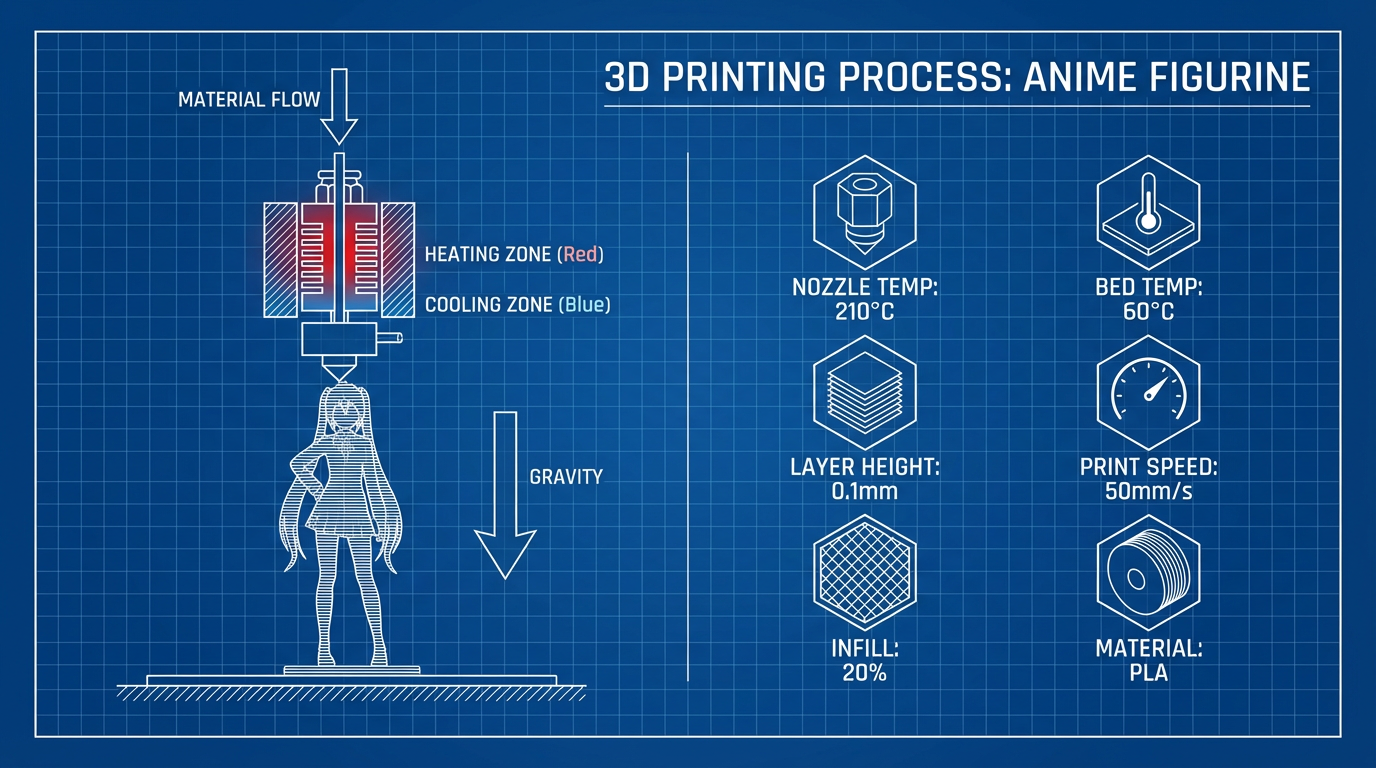
Dense, well‑bonded legs and bases are not just about surface finish; they are the load‑bearing structure for your display.
Design Strategies For Stable Large Figurines
So how do we turn all this physics and fabrication science into practical design and display choices for big anime figures?
Base Size And Shape: Your First Line Of Defense
Multiple sources, from engineering tutorials to collector‑oriented base guides, converge on the same prescription: give your figure a base that is slightly larger than its footprint and that grips the surface well.
The figurine base guide emphasizes that wobbling, leaning, and toppling almost always trace back to a mismatch between the figure’s weight distribution and the base’s size, shape, and attachment quality, sometimes made worse by uneven shelves. A very simple fix is to upgrade to a base that extends ten to fifteen percent beyond the figure’s footprint in both directions and to add a non‑slip underside. Rubber or silicone pads and even simple felt, when paired with adhesive putty between the feet and base, can dramatically reduce micro‑slippage from vibrations or small bumps.
The same guide proposes tailoring base material to figurine type. Dynamic anime characters with airborne poses or lots of outstretched mass often pair well with low‑profile acrylic bases that do not visually distract but offer good grip. Heavier statues and garage kits benefit from solid wood, stone, or well‑finished resin bases that add meaningful weight and provide wider support. Miniatures and tabletop game pieces often use snug resin or metal bases that integrate thematically with the environment.
The garden‑statue article pushes these ideas further for truly large works. Tall statues catch more wind and often require professional installation on concrete foundations or heavy anchors. Smaller ornaments still benefit from being bolted down or anchored to a weighted base. If the figure’s internal cavity allows it, filling hollow sections with sand or stone moves more mass toward the ground, lowering the center of gravity without changing the visible sculpt.
These are different scales of the same design move: expand the base and move mass downward.
Lowering The Center Of Gravity Without Ruining The Sculpt
Physics resources from BYJU’S, CK‑12, ExplainThatStuff, and the Royal Academy of Engineering all hammer home that a low center of gravity makes toppling less likely. Racing cars, for example, are designed with extremely low centers of gravity so they can corner hard without rolling. Open‑access texts show that buses or tall trucks become dangerous if their center of gravity rises too far relative to their base width.
For figurines, the key is to lower the effective center of gravity in ways that do not spoil the visual design. The garden‑statue guide mentions a simple trick: fill hollow statues or plinths with sand or stone. The added mass sits low, and the overall center of gravity sinks closer to the ground. For large resin or PVC characters that ship with hollow bases, collectors can sometimes borrow this idea, provided ventilation, material limits, and manufacturer guidance are respected.
Figure‑making communities add another layer of technique. A prop‑making discussion in a well‑known costume and prop forum recommends building the main body of a sculpt in a bakeable polymer clay, then using a high‑strength epoxy putty for the legs after baking. The internal armature is left protruding from the baked torso so the epoxy can grip both metal and clay, forming a mechanically strong joint. That approach deliberately makes the load‑bearing supports out of a stiffer, stronger material than the detailed body, improving stability and resistance to creep in slim legs.
This mirrors advice in general sculpture practice, where large‑scale sculpture guides stress the importance of internal armatures and frameworks. They recommend planning the internal structure around where the weight will sit, using metal frameworks or sturdy supports to carry that load rather than relying on fragile surface material.
From a collector’s vantage point, this means that when you choose or commission a large figure, it is worth looking closely at what the legs and base are made of, whether the support rods are metal or molded from the same plastic as the figure, and how any internal armatures are used. The more mass and stiffness you can concentrate low in the piece, the more forgiving the physics becomes.
Poses, Overhangs, And The Art Of Keeping Things Over The Base
The Buildingspeed article on center of gravity uses a performance art piece to demonstrate how wild overhangs can still be stable if the overall center of gravity remains over the support. In that work, tapered sticks are stacked and cantilevered in increasingly dramatic ways, yet the performer always supports the combined center of mass at just the right point. The system essentially “leans over” as a whole while keeping its center of gravity within the base.
The same principle is illustrated with stacks of books. By moving each book slightly farther out over the edge while keeping the cumulative center of gravity above the table, you can achieve a surprisingly large overhang. A shift of only a few millimeters too far causes the entire stack to crash.
Figurine designers and sculptors deal with exactly this trade‑off. Every outstretched weapon, flowing ribbon, or dynamic mid‑air pose is effectively a book pulled farther off the table. If that mass is balanced by extending the base under the projection or by adding mass on the opposite side, the combined center of gravity can still sit inside the support. If not, stability becomes precarious, and the piece depends on material strength and friction alone to survive.
Physics texts remind us that the worst situation is a high center of gravity acting at a long horizontal distance from the pivot point. That configuration maximizes torque for a given weight. That is why tall, narrow cabinets, high‑heeled stances, and towering dynamic figures are all more likely to topple than bulky, low, or symmetric ones.
When you see clever designs where a flowing cape trails along the ground, a long tail wraps back to touch the base, or rubble and effects connect to multiple points on the display surface, you are seeing designers manufacture extra base of support in artistic form. They are extending the support polygon so the center of gravity has more room to move without crossing the edge.
Shelves, Slopes, And The Environment Around Your Figures
Even the best‑designed figure can be betrayed by its environment. Open‑access physics texts on body stability note that placing a body on a slope effectively tilts the base relative to gravity. Once the tilt angle becomes large enough that the line through the center of gravity exits the base, the object tips. For a toddler, that critical angle can be quite small because their center of gravity is high and their base is small.
Garden‑statue guides make the same point on a larger scale. They advise placing statues on level, stable ground and avoiding areas where rainwater pools and slowly undermines the base. They also recommend studying predominant wind directions and placing tall pieces near hedges or walls that act as windbreaks.
For indoor figures, uneven shelves, warped boards, and soft surfaces like thick padding can act like tiny slopes. A small tilt that would be irrelevant to a low, wide figure can spell disaster for a tall, slender one. Collector‑oriented base guides, as mentioned earlier, call out uneven display surfaces as a frequent hidden cause of toppling. Flattening the shelf, reinforcing sagging boards, and using non‑slip base materials all reduce the effective “slope” your figure experiences during everyday vibrations or minor bumps.
From Desk Scale To Colossal: Building Big Anime Statues Safely
Everything so far has focused on objects you can reasonably place on a shelf. But fandom is full of artists and studios working at much larger scales, from four‑foot garden guardians to life‑sized character statues for events and public spaces. The physics is the same; the stakes are higher.
Articles on large‑scale sculpture and custom‑sculpture design point out that big works are not just scaled‑up versions of small ones. Size creates new constraints around studio space, transport, installation, and structural engineering. They recommend starting by clarifying where the piece will live, how it will be moved, and what subject and pose make sense at that scale. Detailed sketches and small maquettes help visualize the composition and, crucially, where weight will be concentrated.
For truly large outdoor works in stainless steel, bronze, or marble, custom‑sculpture studios describe a workflow where the artist collaborates closely with engineers and fabricators. Together they choose materials that balance visual intent with durability, decide on internal frameworks and armatures, and design pedestals or foundations that can safely carry the weight. They use 3D renderings and small‑scale models to explore options and then plan installation in detail, including bases, surface preparation, and any permits required for public sites.
Forum posts from character‑arts communities show how these ideas filter down into fandom practice. One sculptor planning a life‑size figure based on the human form asks for advice on armature materials and design, explicitly concerned about balancing strength with the ability to adjust pose while sculpting. Other makers discuss workflows where a life‑size or large bust is built around a robust steel or wooden armature, with clay or foam providing bulk and a harder outer shell applied later. Even when the goal is a stylized anime character, the underlying structure is very much an engineering problem.
On the more modest end of “large,” a four‑ to five‑foot statue still poses practical challenges. A ceramics forum thread that captures only the metadata of such a discussion hints at how makers seek advice on how to build safely at that height, from segmentation to firing and structural support. High‑gravity printing research, while very specialized, similarly reflects a desire to handle taller and more demanding shapes with better control over material behavior.
Whether you are designing a one‑off convention centerpiece or dreaming about a bronze version of your favorite mecha for a public plaza, the through‑line is clear. Start from physics: map where the center of gravity will sit as the pose changes, design the base and internal armature to keep that center over a generous support area, choose materials that can handle both weight and environment, and treat installation as part of the artwork rather than an afterthought.
FAQ: Collector Questions Through A Physics Lens
How can I tell if a large figure is actually stable on a given base?
Physics texts and engineering guides all say the same thing: what matters is whether the vertical line through the center of gravity falls inside the base. You cannot see that line directly, but you can approximate it. Imagine the figure and base as a single rigid object and picture where its “average” weight sits. If that point is clearly inside the footprint, small nudges or vibrations are unlikely to topple it. If it feels like the figure’s weight is hanging over the edge of the base, you are relying heavily on friction and material strength, which is risky. Testing on a perfectly level, firm shelf and gently tapping at ankle height can reveal whether the piece rocks easily, though this should always be done carefully to avoid damage.
Is heavier always better for stability?
Heavier objects are harder to accelerate, but weight alone does not guarantee stability. Engineering and physics resources emphasize that what matters is the combination of total mass, where that mass is located, and base width. Adding weight low in the base, as garden‑statue guides recommend with sand or stone fill, is excellent: it lowers the center of gravity and increases the friction force the base can provide before slipping. Adding the same extra mass high up, such as a heavy accessory at shoulder level, can make the figure more likely to topple because it raises the center of gravity and increases the torque when the figure is tilted. For very large statues, heavy materials also demand stronger foundations to avoid sinking or tilting the support structure itself.
Why do some extreme poses feel more dangerous than they truly are?
The eLife study on the brain’s world model of gravity shows that we carry a built‑in, somewhat uncertain prior about gravity direction and a conservative bias about stability, especially for tall configurations. Our internal simulator tends to over‑predict collapse for tall, thin stacks even when they are statically stable, leading to a bias on the order of minus 0.31 in stability ratings compared with a perfect physical model. When you see a figure hanging mid‑air on one foot with lots of mass flung outward, that mental simulator kicks in and screams “that cannot be safe,” even if the sculptor has cleverly extended the base or hidden supports to keep the center of gravity well within the footprint. Designers can lean into this by making invisible supports structurally robust and visible supports aesthetically integrated, so the piece both is and feels secure.
In the end, keeping your oversized anime heroes and villains upright is not about luck; it is about respecting the same gravity that makes their world feel real. The more you think like an engineer and a sculptor while you think like a fan, the more confidently you can pose, print, and display big characters without fearing the midnight crash.
References
- https://www.uml.edu/docs/A%20Study%20of%20the%20Barrel%20Constructions%20of%20Baseball%20Bats%20by%20Fa%E2%80%A6_tcm18-60852.pdf
- https://pmc.ncbi.nlm.nih.gov/articles/PMC10385754/
- https://pressbooks.uiowa.edu/clonedbook/chapter/stability/
- https://elifesciences.org/reviewed-preprints/88953
- https://community.ceramicartsdaily.org/topic/13200-how-to-create-a-very-large-4-5ft-statue/
- https://buildingspeed.org/2013/07/31/cg-as-performance-art/
- https://flexbooks.ck12.org/cbook/ck-12-cbse-physics-class-11/section/6.11/primary/lesson/center-of-gravity/
- https://www.researchgate.net/publication/371541104_Numerical_Study_of_the_Effect_of_High_Gravity_in_Material_Extrusion_System_and_Polymer_Characteristics_during_Filament_Fabrication
- https://www.explainthatstuff.com/center-of-gravity.html
- https://smart.dhgate.com/the-ultimate-guide-to-selecting-the-ideal-base-for-your-figurine-tips-for-stability-and-style/