Understanding the Weight Limitations of Figurine Bases and Stands
This guide explains how weight limits, materials, and pose choices affect the safety and stability of figurine bases and stands in everyday displays.
Figurine bases and stands can only handle so much weight, leverage, and abuse before they start to lean, wobble, or fail. Learn how that limit actually works so you can match every figure to the right base, reinforce weak spots, and keep both your collection and your shelves safe over the long term.
Maybe you’ve watched a favorite anime figure slowly tilt over months, its clear support arm bending a little more every time the shelf gets bumped, or had a tall statue topple and scrape three other characters on the way down. Safety tests for children’s toys literally slam figures weighing under about 3 pounds onto hard floors from around 4.5 feet, over and over, just to prove that bases, joints, and attachments will not break apart under real-world abuse. The same physics are at work on your display, and this guide walks through how much weight bases and stands can realistically take, how to upgrade them, and how to avoid heartbreaking faceplants.
The Two Ways Weight “Breaks” Your Display
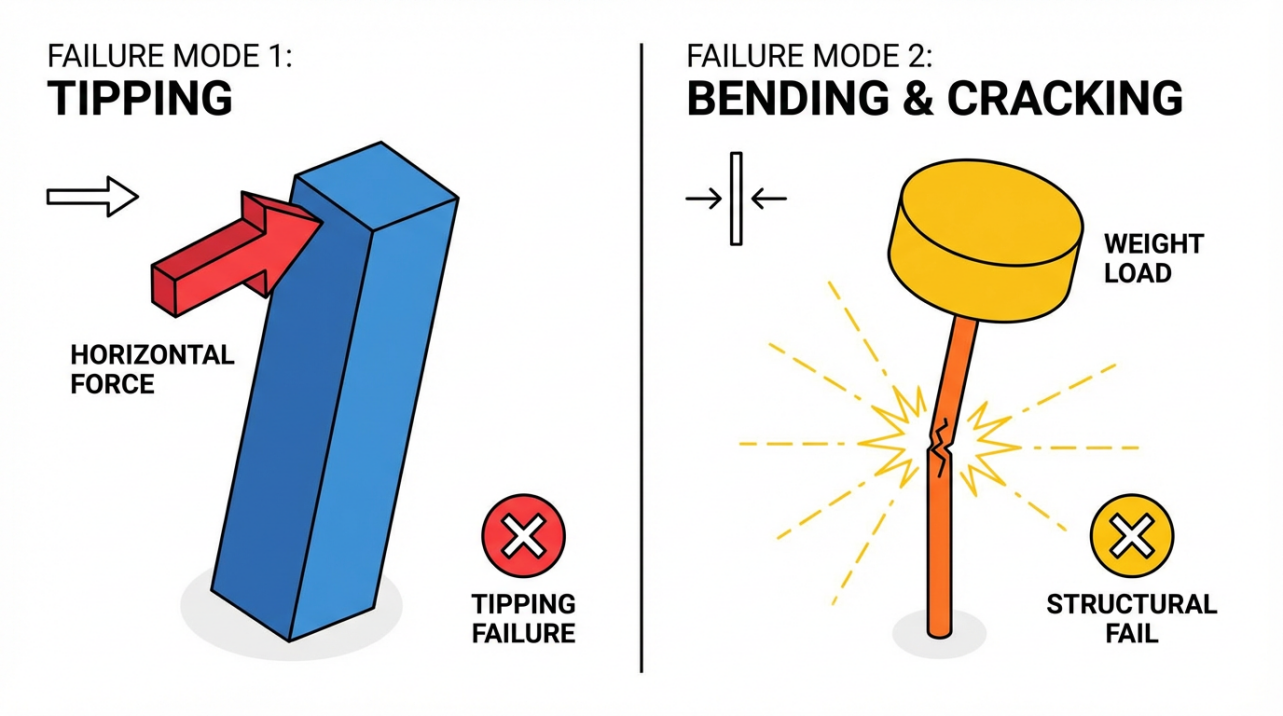
When people talk about the “weight limit” of a base, they usually mix up two different limits that matter for your collection. One is stability, which is about whether the piece tips over. The other is strength, which is about whether the stand, peg, or rod actually bends, cracks, or shears.
Stability fails first in a lot of anime collections. Woodworkers who design stands for heavy objects point out that simply making the footprint wider does not let a structure hold more static weight; the material and joints handle that. What width really changes is how hard it is to tip the whole thing over. If the base is wider than the stand is tall, the horizontal shove required to flip it grows a lot. Translate that to figurines and you get an important cue: tall, narrow risers and tiny hex bases under big characters are inherently easier to knock over than short, wide plinths, no matter how light or heavy the figure is.
Strength is the second limit. U.S. toy regulations for very young children use tests like dropping toys weighing under roughly 3 pounds from about 4.5 feet onto a hard tile surface ten times, then checking for small broken parts, sharp edges, and structural failures. The related bite, torque, and tension tests pull and twist projections with forces in the 10–25 pound range to see if anything snaps off. If you are displaying resin, PVC, or soft vinyl characters on stands that were never designed for that kind of punishment, a hard bump or fall can drive the stand past its strength limit even if it never technically tips in normal use.
Practically, that means your bases and stands have to survive both the slow daily loading of the figure’s weight and the sudden shock of a drop, nudge, or table slam. A setup that looks fine when you place it can still be one clumsy elbow away from disaster if you are close to those hidden limits.
How Much Weight Can Different Stands Handle?
Commercial action-figure stands and bases are not all created equal. Technical guidance for action-figure base stands used in the manufacturing world treats weight capacity as a primary spec: high-quality stands with reinforced cores and joints are test-loaded for standard and large figures, often in the neighborhood of 5–10 pounds or more. The idea is that a stand rated in that range can reliably hold heavy die-cast or big PVC statues, not just small articulated bodies.
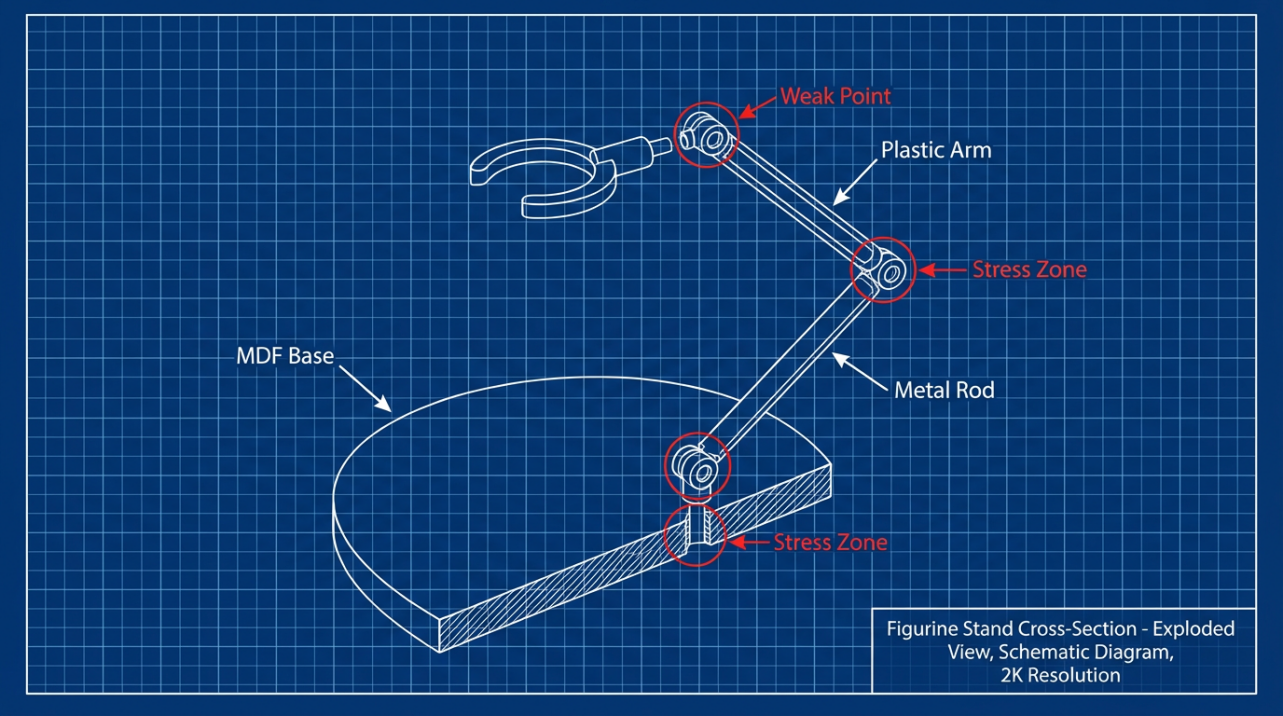
The material of the stand is a huge part of that story. ABS and similar plastics keep costs down and are totally fine for light characters, but they are more likely to fatigue or crack if you hang a dense resin statue or a metal mecha on a long arm. Acrylic has that gorgeous transparent, “floating” look and is strong in short, thick pieces, yet it can become brittle or yellow under strong light over time. Metal cores and rods, usually aluminum or steel, move you into a museum-style setup: they are heavier, more expensive, and visually louder, but they tolerate higher loads and long-term stress much better. Wood bases and MDF plinths sit in the middle: they add pleasant heft and spread the load over a wider footprint, especially once you reach roughly one eighth of an inch thick, but they depend on whatever rod or peg you embed in them.
It helps to think of the stand as a chain of parts, and the weight limit is set by the weakest link. A thick MDF base with a skinny plastic arm is limited by the arm. A hefty metal rod drilled into soft, thin wood may rip out of the base before the rod bends. Even a stand with a high advertised capacity can become the weak link if you hang the figure far away from the support point and turn gentle weight into aggressive leverage.
Flying Poses and Vertical Supports
Nothing reveals weight limitations faster than a “flying” pose. Scale modelers who mount large spaceship kits have documented this painfully: a big model mounted on an L-shaped brass square tube just under a quarter inch wide can sway noticeably if the tube is long and the load is high. In one example, a large model perched on a 7/32‑inch brass tube had enough sway that the builder said they would step up to a full quarter‑inch tube if they ever rebuilt it.
Acrylic rods tell a similar story. In tests where quarter‑inch acrylic rods were mounted close to a model’s center of gravity, there were no stability issues. The same rod used on a different piece, where the support was placed far from the center of mass, bent so much under the sustained load that it took a slight permanent curve. The lesson for anime displays is simple: even without knowing the exact pounds involved, moving the support closer to the figure’s center of gravity and shortening the “lever arm” drastically lowers the effective stress on the rod or arm.
If you love midair drops, dramatic kicks, or magical effects columns, assume you will need either a thicker, stiffer rod or a shorter span than the default stand in the box. Keeping a small stash of brass tubes and acrylic rods in different diameters and test-fitting them with one figure before you commit to drilling or gluing can save both money and heartbreak.
Weighting Bases: How Much Is Too Much?
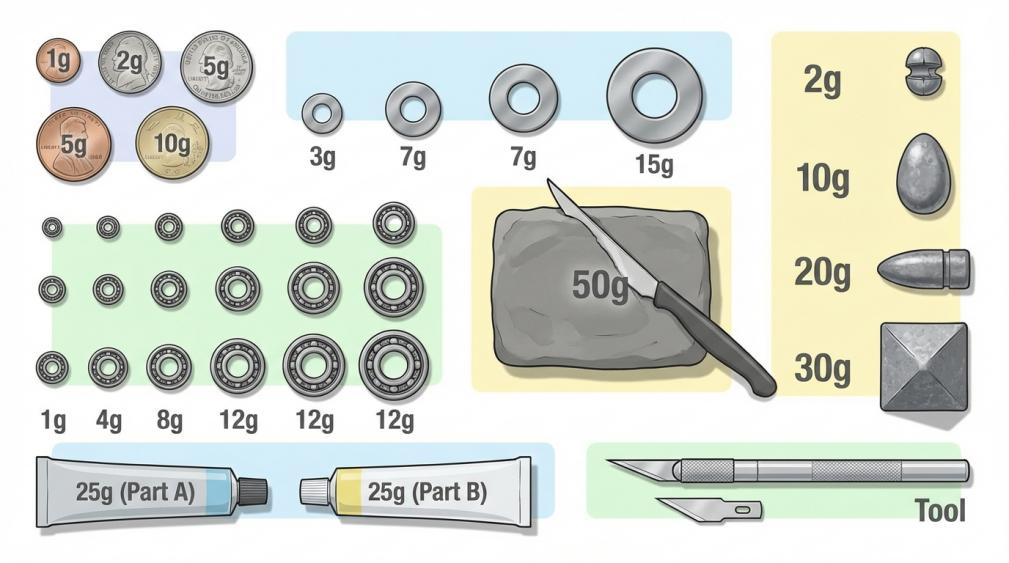
On the tabletop-gaming side of the hobby, collectors have been hacking base weight for years, and their experiments translate well to anime figures on smaller bases. Hobbyists on forums routinely add weight to skinny plastic bases using coins, thin steel washers, ball bearings, lead or steel shot, fishing weights, and even trimmed metal sprue. Glued under or inside a base and then sealed with putty or filler, these dense materials dramatically change how “planted” a model feels.
One detailed guide on weighting bases showed that embedding a coin into a standard small plastic gaming base, roughly 1 inch across, with two-part epoxy increased the base weight from well under a tenth of an ounce to a few tenths of an ounce. In everyday terms, that is roughly a tenfold jump in base weight, from a barely there sliver to something you can feel when you flick it with a finger. The author had to hollow the base carefully with a hobby knife and then use tape to seal gaps so the runny epoxy would not leak out, but once cured overnight and sanded flat, the base was both heavier and still perfectly usable.
For bulk, low-cost ballast, another popular trick is plain air-dry modeling clay. One hobbyist reported buying a 10‑pound brick of clay for about $8, enough to weight hundreds of bases. They packed clay into the underside cavity of each plastic base, pressed it flat so any excess squeezed out, let it dry until it lightened and shrank slightly, popped out the plug, and then glued it back in permanently. The result was a base that felt solid and resisted tipping without any metal at all, which is particularly appealing if you are worried about kids or pets getting into loose shot.
Even your ground texture can contribute some weight. A classic beginner recipe mixes playground sand and small aquarium gravel, sometimes with bark or twigs, glued over the top of a base as “terrain.” Collectors who use that mix for entire armies point out that a $4 bag of sand and a similarly priced bag of gravel is basically a lifetime supply, and once that much mineral bulk is glued down across a base, it adds noticeable ballast in addition to visual interest.
The real limitation when you add weight is not usually the maximum pounds a base can theoretically hold; it is how much mass you can fit into the available cavity without lifting the figure so high it looks strange or creates new leverage. A shallow, 1‑inch round base simply cannot hide much shot or metal without bulging. At that point, it is usually smarter to step up to a thicker MDF base or a wider plinth than to keep cramming material into a tiny footprint.
Choosing Base Materials and Thickness for Stability
Manufacturers who cater to mass games and armies have already done a lot of trial and error on this front. MDF base makers who supply fantasy battle systems commonly offer base thicknesses around 1/16 to 1/8 inch and explicitly recommend the thickest, about one eighth of an inch, for standard 1‑inch gaming miniatures and larger. The thicker base resists warping, carries its own weight better, and feels more secure during play and transport, especially once you start drilling holes for magnets or pinning.
Miniature hobbyists who prefer heavier figures often swap standard plastic bases for metal washers or pre-cut steel plates. A 1‑inch galvanized washer glued to the underside of a plastic base barely increases the height but adds a surprising amount of weight and has a bonus: it sticks to magnetic sheet in carrying cases and on painting stands. Commercial steel bases are another option; they act as both the visual base and the weight, and they pair naturally with magnetized movement trays.
In display terms, a good rule borrowed from woodworking is that once your “stand” is taller than it is wide, you should assume it is easy to tip unless you either widen the footprint or shorten the column. That applies whether the stand is a narrow glass riser under a scale figure or a tall, skinny wooden plinth under a garage-kit statue. The heavier the character on top, the less you can afford to ignore that height-to-width ratio.
Safety Limits When Kids Are Involved
If any of your figures or stands are meant for children, or if curious little hands are likely to reach your lower shelves, weight limitations stop being just about paint chips and start being about safety law. The U.S. Consumer Product Safety Commission enforces a mandatory toy standard called ASTM F963 for children’s toys, with extra third-party testing for products meant primarily for kids under 13. That standard ties into the federal test methods that slam toys under 3 pounds onto hard floors, twist and pull on attachments, and compress surfaces to reveal sharp edges and small parts.
Those rules matter because many DIY weighting tricks use small, dense objects like lead shot, ball bearings, or chopped scrap metal. Hobby forums are full of tips about flattening lead pellets with pliers and gluing three or four under each base to counterbalance forward-heavy models, or packing cavities with steel shot and then sealing everything with epoxy putty. For adult display pieces that will live in a glass case, those are practical, cheap, and effective methods. For anything marketed to, gifted to, or regularly handled by children, you need to treat loose metal shot and heavy metals as potential hazards and either avoid them or encapsulate them in a way that would still pass those bite, impact, and tension tests.
If you are selling or gifting weighted bases as “toys,” it is worth mapping what you make against the relevant sections of ASTM F963 and related CPSC regulations on small parts, sharp edges, and lead content, then designing so that even after rough play, nothing hazardous comes loose. That usually pushes you toward sealed metal plates, coins deeply buried in cured epoxy, or all-clay solutions instead of free pellets or partially sealed cavities.
Focus on the Base, Not Just the Figure
Backpackers talk about “base weight” as the core of how heavy their kit feels, and figurine displays have a similar dynamic. The stand, base, and support structure are your display’s base weight: they determine how stable the whole setup feels much more than swapping one tiny accessory for another.
Collectors who manage big lines of figures professionally lean into this. When building a business around custom and “mini-me” figurines, some manufacturers prototype new designs in full-color resin prints and then test not just likeness but durability, assembly torque, and drop-tested packaging before moving into mass PVC or soft vinyl production. Paint standards, glue checks, and impact tests become part of the pipeline, because any failure in the base or stand multiplied over hundreds or thousands of units becomes a reputation problem and a customer-safety issue.
In a home collection you do not need a factory checklist, but the mindset is useful. Rather than agonizing over one more plastic effect part, ask three simpler questions for every new piece: how wide and heavy the base is compared with how tall and dramatic the pose is, how strong the material is that actually carries the load, and what happens if this figure is dropped or shoved. If any of those answers make you uneasy, the weight limit of your current stand is probably too close for comfort.
FAQ
Is there a universal weight limit for figurine stands?
No. Each stand’s limit depends on its materials, geometry, and how the figure is mounted. Some industrial stands are specifically rated and test-loaded in the 5–10 pound range, while many bundled “bonus” bases in figure boxes are built only for the included character in a fairly static pose. When in doubt, assume the stock stand is near its limit for that figure, and upgrade to a stiffer rod, wider base, or higher-rated commercial stand before adding extra weight or dramatic, off-center poses.
Can a base be too heavy?
A heavier base is almost always more stable for a single figure, but there are trade-offs. Very heavy bases concentrate a lot of mass in a small footprint, which can crack thin glass shelves or make large displays awkward to move. If you find yourself adding layer after layer of metal or clay, step back and consider a wider, thicker base material instead; spreading the weight out and improving the height-to-width ratio is usually more effective and kinder to your furniture than trying to turn a tiny base into an anchor.
Closing thought: the best anime displays feel like little worlds that just “sit right” when you look at them. Understanding the real weight limits of your bases and stands lets you push poses, scale, and drama without flirting with gravity-induced heartbreak, so your favorite characters can keep striking their coolest stances for years instead of seconds.
References
- https://www.cpsc.gov/Business--Manufacturing/Business-Education/Toy-Safety
- https://static.tti.tamu.edu/tti.tamu.edu/documents/5-4358-01-1.pdf
- https://library.ctr.utexas.edu/hostedpdfs/tti/0-4358-1.pdf
- https://www.ada.gov/law-and-regs/design-standards/1991-design-standards/
- https://www.law.cornell.edu/cfr/text/16/1500.51
- https://www.wichita.edu/industry_and_defense/NIAR/Documents/NMS-201-Base-Material-Spec-2024-08-7.pdf
- https://www.dau.edu/sites/default/files/2024-01/MIL-STD%2011991B.pdf
- https://cfaessafety.osu.edu/sites/safety/files/imce/osha2226.pdf
- https://www.starshipmodeler.net/talk/viewtopic.php?t=122089
- https://www.heresy-online.net/threads/weighting-model-bases.108455/